A traditional fund manager has a given sum to invest. And to evaluate his performance you will typically look at his relative return and compare this measure with the same measure applied to other fund managers.
If you are an advanced observer, you will try to account or adjust for the risk taken.
But in some instances the relative view is not satisfactory. When investments are easily funded, and where e.g. absolute risk and not the invested amount is the limiting factor, the relative return is not interesting.
This is the case e.g. if a bank has ample funding possibilities or if the fund manager to a large extent can rely on the use of derivatives.
Here you will still want to know whether relative performance is satisfactory compared to a peer group, but you will also want to know whether the absolute risk taking has been profitable.
We will here generalise a well-known method for performance measurement and attribution to take into account the choice of the absolute level of risk. We will also show how this performance attribution, which has been developed for equity portfolios, can be used for interest rate related instruments. And we will show how to reinterpret the formalism to get a performance attribution for the risk-adjusted performance.
We will consider J assets indexed by j = 1,...,J. At the beginning of a period under consideration there is invested Vj in asset j as measured by the market value. Let V be the J-column vector [Vj].
Let 1I be the I-column vector of 1-s. Define V := 1I' V as the total investment. The portfolio is kept fixed over the period.
We will consider a partly aggregated picture of the portfolio in the form of K sectors (or countries, risk factors etc) indexed by k = 1,...,K. Let S be a KxJ mapping matrix, where 1K'S = 1J' and let VK = SV be the K-vector of investments in the K sectors. Of course we have V = 1J' V = 1K'SV = 1K'VK.
The mapping matrix maps each asset to one or more sectors. In the case of equities this allows
And in the case of interest risk products it allows
Or more generally a composite portfolio consisting of bonds, equities, equity-linked bonds etc can be mapped to the relevant risk components.
We will also consider the relative return on asset j over the period rj and the absolute return Rj := rjVj. Let r and R be the corresponding J-vectors. These returns can be thought of as either gross returns or returns net of funding costs.
Let the K-vector of absolute sector returns be RK := SRR, and let rK be the K-vector of relative sector returns [RKk/VKk]. Here SR is a KxJ matrix.
If S is a matrix of 0-s and 1-s, then SR = S. If you have no better information (e.g. to decompose the total return on a holding in a conglomerate into the different sectors) you may also choose SR = S. But in other instances you have better information, and we will see an example on this looking at interest related products.
Let a benchmark in the form of a possible portfolio VB be given. Use the superindex B to denote investment, return, weights etc corresponding to this benchmark, while the notation without the B characterises the actual portfolio.
We will assume that rj = rjB, i.e. that the return on individual assets in the actual portfolio and in the benchmark portfolio is the same over the period; i.e. that the benchmark portfolio trades at the same prices and with the same transaction costs as the actual portfolio.
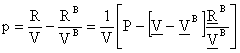
We define the absolute performance P by the scalar P := R - RB and - if V VB ¹ 0 - the relative performance p:= r - rB.
Note that p = R/V - RB/VB
(1)
The absolute performance can be decomposed in several ways. A natural choice is the following:
(2) 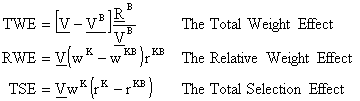
The TWE measures effect of the strategic decision of being over-invested measured by the total benchmark return.
The RWE measures the effect of the allocation between sectors measured by the sector returns of the benchmark.
The TSE measures the effect of the selection of individual assets where weighted by the actual sector weights.
It is easy to check that P = TWE + RWE + TSE.
Note also that
(3) 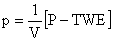
so that the relative performance is the absolute performance less the total weight effect relative to the total actual investment.
If different individuals do the sector allocation and the choice of individual assets respectively, you will want a further decomposition of TSE in
(4) 
The pure Selection Effect weighs the relative sector performance by the benchmark weights, and not by the actual weights which are the responsibility of the asset allocator. The Interaction Effect measures the success of the asset allocator in giving weight to sectors where the stockpickers can outperform the benchmark (or the success of the stockpickers in outperforming in sectors that are heavily weighted).
Note that TSE = SE + IE.
You might have noticed that in the definition of the RWE and TSE we multiply with the actual investment V and not the benchmark level VB. Thus there is an implicit interaction effect in that the total weight decision scales these two measures. You could, as done with TSE, make a further decomposition separating these interaction effects. Here we have chosen not to add that complexity.
If we consider a measure of risk, which is additive, then the above framework can be reinterpreted to yield a decomposition of a risk-adjusted performance.
There are several such risk measures. For interest rate risk this could be BPV, Basis Point Value. But more generally we can use the concept of Garman and others of CVaR (or IVaR etc). These measures have the quality that the diversification effect is allocated to each risk source. This is done in such a way that the risk of each component at the same time measures the marginal contribution to the total risk and the sum of the risk of each component yields the risk of the total portfolio.
The idea of Garman can be used with any measure of risk, which is (locally) homogeneous of degree one, since then by a theorem of Euler the weighted sum of first derivatives yields the total. Thus it can also in principle be used with a risk measure which e.g. emphasises tail risk.
In the above we just re-interpret V as the total risk, Vj as the j-th component risk, rj as the return per unit risk from a position in the j-th asset etc.
The mapping S has to be reinterpreted to map a each risk position to some aggregate risk positions. When S consists of only 1's and 0's you will do this without hesitation as with value: Value, risk, return and performance are mapped to the same sectors. When distribute risk to several sectors this may not be the best solution. In some cases it may be the only solution, e.g. in the decomposition of the value, risk, return and performance of an investment in a conglomerate you will probably use the same mapping. When the subject is an index position or a bond position you will typically have better information, which allows you to distribute value or risk in one way and performance in another way.
When we want to allocate performance or make a risk-adjusted performance attribution with interest rate related products we typically have more information that can be used to decompose the performance.
In the following we assume that we know the movement of the zero coupon yield curve over the period under consideration.
Let V be a portfolio of positions in J bonds as measured by market value, and S an NxJ matrix mapping the value of these bonds to the value of N zero coupon positions.
If the bonds are not priced on the benchmark yield curve you will have that the net present value of the payments does not add up to the dirty price of the bond. However since by construction 1N'S = 1J', this residual value is distributed in proportion to the calculated value of each payment. The same remark applies to the difference in value that may arise if you map to dates, which are not the actual payment dates.
Let VN=SV. This is not the traditional vector of total payments, but rather the entries are the net present value contributions of payments at particular points in time.
The interest rate risk or modified dollar duration on a zero coupon bond with maturity t periods from now and with price d(t) is
(5) 
Usually you will divide this measure with 100 to get an approximation of the loss if the interest rate curve moves upward with 0,01 (or 1%).
Let Z be the N-vector of interest rate risk per dollar invested in zero coupon bonds.
The total interest rate risk of our bond portfolio is Z'VN = Z'SV.
Let VNB be a benchmark portfolio (without loss of generality assume that this is a portfolio of zero coupon bonds).
Let r be the J-vector of relative returns on the J bonds and rN the N-vector of returns on the N zero coupon bonds.
The total return is rV and the return on the benchmark is rNVNB. Note that the value and the risk of the actual portfolio may differ from that of the benchmark.
We define performance as P := rV - rNVNB.
Instead of attributing performance according to the value invested we will use the interest rate risk.
Let
(6) 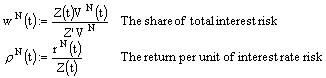
and let wN and rN be the corresponding N-vectors.
In line with the previous definitions we now define
(7) 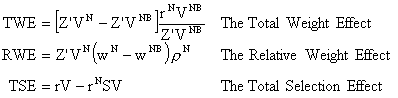

Note that P = TWE + RWE + TSE
The Total Weight Effect measures the absolute return of a position with a BPV that may differ from that of the benchmark, but which the same distribution of risk over the yield curve as in the benchmark.
The Relative Weight Effect measures the absolute return of a curve risk position where the curve position is measured relative to the benchmark.
The Total Selection Effect measures the effect of picking bonds not priced exactly on the benchmark zero coupon curve.
With absolute performance measures you have the advantage that you in principle can aggregate directly across time periods. Of cause there will be an effect if - or rather when - the portfolio is not kept constant between periods. Here there is a loss of information, which will give a residual performance, which you may attribute to the selection effect or calculate explicitly as a timing effect.
Different currencies do not constitute a problem if investments are fully funded at a term corresponding to the calculation period and returns are after-funding returns. If there is a direct currency to which performance must be attributed there will also be interaction effects (e.g. from the allocator's ability to put weight to -or the stock pickers ability to outperform in - appreciating currencies).
Ankrim, Ernest M. (1992): Risk-Adjusted Performance Attribution. Financial Analysts Journal, March-April, 75-82.
Brinson, Gary P. and Nimrod Fachler (1985): Measuring non-U.S. equity portfolio performance. Journal of Portfolio Management, Spring, 73-76.
Fama, Eugene F. (1972): Components of Investment Performance. Journal of Finance 27 (3), 551-567.
Garman, Mark (1996): Improving on VaR. Risk, Vol 9 (5).
Garman, Mark (1997): Taking VaR to Pieces. Risk, Vol 10 (10).
Back to Main Page
Opdated feb-26-2001