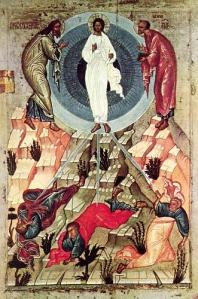
August 6 is the tragic anniversary of distruction of Hiroshima - and paradoxically the feast of the Transfiguration of Jesus. Let us stop for awhile to think about the contrast between the unleashed energy by human hate and the beauty of God's love shining through the humanity of Christ.
We should have faith in, we need to hope for and ought to pray that at the end God's love would win ...
For todays feast here is a meditation from "Finding Our Way Together" :
284. The Transfiguration of Jesus, Lk 9:28-36 (Mt 17:1-9; Mk 9:2-8)
This event is presented in the three Synoptic gospels at the climax of the public life of Jesus right after the confession of Peter (Mt 16:13-20; Mk 8:27-30; Lk 9:18-21), and the two scenes together form a diptych, a double image reflecting the good news that God personally entered human history and his transcendent presence can be experienced. On one side of the diptych we see an act of commitment and deep faith on the part of Peter, while the other side reveals the ineffable mystery of the person of Jesus that surpasses any human expectation. After this turning point Jesus begins to reveal the mystery of the suffering Messiah to his disciples. The evangelists carefully constructed into their particular concept of gospel these two complementary passages between which the connection became clear only in the light of the post-resurrection faith .
The transfiguration happened on a mountain, which is generally retained as a place of revelation in the Bible (see the Sermon on the Mount [278]). Jesus took with him Peter, James as John, the same three disciples present at the raising of the daughter of Jairus (Mk 5:37; Lk 9:51) and whom we see with Jesus in Gethsemane (Mt 26:37). While in prayer, Jesus “transfigured”, his appearance changed, his face became radiant and his clothes dazzling white . Then Moses and Elijah appeared and conversed with Jesus. Luke’s narrative tells also that they spoke about the exodus Jesus should carry out in Jerusalem (v. 31). The word exodus (“exodos” in Greek means “outgoing”) refers to his death and resurrection and is an allusion to the exodus of Israel out of Egypt, the deliverance from slavery and the covenant of the people with God . The term so rich with meaning becomes an expression for the definite liberation and covenant for which Israel had waited and now was about to be accomplished by Jesus. Moses and Elijah both of whom had a very intimate experience of God represent the entire religious tradition of Israel; Moses, the mediator of the covenant at the Mount Sinai represents the law and Elijah the greatest prophet who renewed the covenant is the paradigm of the prophetic tradition. The scene suggests that the history of Israel was oriented toward Jesus in whom the law and the prophetic tradition reached their final accomplishment .
While Jesus prayed, the three disciples fall asleep - just what happened with them in the Gethsemane later – but were able to wake up and saw Jesus’ glory and the two men speaking with him. Peter took the initiative and offered to prepare three tents or booths for Jesus, Moses and Elijah to prolong the experience (v. 33). These tents are reference to the feast of the Booths or Tabernacles, when the tradition required living during the festival that lasted eight days in little booths made of branches of trees. The feast of the Booths is one of three great Jewish festivals besides Easter and Pentecost; it is a thanksgiving festival after the harvest, celebrated in an elaborate and joyful manner. Men were clothed in white, carried branches of palms and pomegranates and sang Psalm 118, the “Hosanna”. This feast had an eschatological connotation in the Old Testament and in the rabbinic literature and referred to the future reign of God in the world. The transfiguration presented with the symbolism of the festival of the Booths acquires a meaning as a revelation of the “eschaton”, of the “end times” erupting in history. The symbolic language is the most efficacious way to describe an experience of a mysterious, transcendent reality and the evangelists found the rituals of this great feast the most appropriate way to speak about the transfiguration of Jesus. The same symbolism is applied in the book of Revelation where heaven is described as being in a constant feast of the Booths, picturing the saints and martyrs in white robes waving palm branches in their hands and singing the praise of God (Rev 7:9-17). The events of Palm Sunday (see [287]), with the crowd waving palm branches and singing “Hosanna” might be another reference to this symbolism rendering to Jesus’ entry in Jerusalem an eschatological meaning.
The story of the transfiguration continues with another deeply significant episode. While Peter offered to prepare the booths, a cloud, biblical symbol of the divine presence covered them and a voice declared Jesus the beloved Son of God (v. 5). The evangelists applied here a rabbinic literary instrument, the “heavenly voice” (“bath kol” in Hebrew) used often for describing a public or semi-public announcement of a revelation or command . The same words that at the Baptism of Jesus are heard only by himself, or by the Baptist or by everybody in the different gospels (see [273]) are now uttered in third person and directed to the disciples in all the three versions of the story.
The fourth gospel has a different form of Peter’s confession at end of the discourse on the bread of life (Jn 6:67-69), but follows it with the feast of Tabernacles or Booths, the symbolism of which is present in the scene of the transfiguration.
See more on Peter’s confession and the connection with the transfiguration in Stanley, “A Modern Scriptural Approach to the Spiritual Exercises,” pp. 195-201.
The second letter of Peter as well as the gospel and the first letter of John mentions this episode, all references to the apostolic testimony of experiencing the glory of Jesus (2 Pt 1:12-18; Jn 1:14; 1 Jn 1:1-3).
Luke uses the word “eisodos” meaning “incoming” for the birth of Jesus (Acts 13:20); it makes clear that the “outgoing” includes not only the death but also the resurrection and ascension. Cf. Edersheim, “The Life and Times of Jesus the Messiah”, p. 366.
For this and the following insights we rely mainly on the presentation of the transfiguration in Stanley, “A Modern Scriptural Approach to the Spiritual Exercises,” pp. 202-205.
Cf. Vermes, “Jesus the Jew,” pp. 91-92 and p.205. See also the vision of Peter in Joppa (Acts 10:10-16).