Faith and reason
"Faith and reason are like two wings on which the human spirit rises to the contemplation of truth"
"Discernment of the Spirits" Lived
photo

Lately we had a discussion about the "discernment of the spirits" as presented in the Spiritual Exercises of St. Ignatius.


Personally, I've found the Rules of the Second Week quite difficult for discerning. How difficult maybe I can illustrate with an example.


I took a class in Spiritual Direction from a rather famous Jesuit whose name I won't use here. He wanted to give an example from his own life, which was: One day, he decided to relax and watch the last part of the “Super bowl”. Just as he sat down he was told that someone was at the door and wanted to meet with him. He relayed to the person that he was unavailable. Thereupon he had a huge feeling of guilt and remiss and regret. Fr. Jesuit used this example to show how the second week of the Exercises works and how the Holy Spirit works to keep us on the straight path. He was sure this was the Holy Spirit reminding him of his duty and failings.


I spoke up and said that I believe he got it wrong. This was the devil tempting him to self-hatred, despair, and to failure through overwork. Now, remember this was an older Jesuit who for years spent all day every day in service to others, even up until midnight and beyond! He nearly never relaxed. His ministry bears many fruits.


He firmly stood by his opinion of how he had done wrong and how my opinion was wrong. I couldn't move him off of it.


This shows the difficulty of the Second Week. What do the readers think was the correct interpretation - was the devil tempting or the Holy Spirit guiding this man?


---J


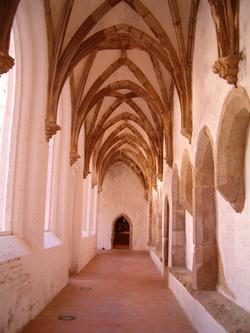
(The picture is of a cloister in Hungary - Photo by Peter Somogyvari)


2007-08-17 16:50:09 GMT
Comments (1 total)
Author:Anonymous
This sounds for me a good example when a possibly very advanced person might be tempted with desolation; he was tormented by guilt for something that could have been right for him to do.
Fr. Jesuit anyway insisted that he really should have got up and served the visitor - and it might be that he was right, since only he can decide based on his conscience that is the final forum of discernment. What I want to say that discernment is not like a mathematical problem with an exact solution - which should be self evident- rather it is one that has multiple good solutions from the point of the outside observer, while for the person it should boil down to his/her conscience and for a moral decision he/she makes. Might be Fr. Jesuit know other details that made it imperative for him to get up and renounce his rest, we cannot decide for him. Although it seems totally right that he needed more the rest and relax even in order to serve better later and he might have had scruples regarding his service, we cannot know.

"The evil spirit is very clever to discover if our conscience is lax or delicate and will use this information to attack us accordingly [349]. Just as the last guideline on how desolation works [327] pointed out the devil will attack our weakest points. If one has a delicate conscience the evil spirit will seek to make him or her more excessively sensitive, he will encourage the analytical and perfectionist person mentioned before to be more reflective and anxious. Thus one who would not consent to real sin will see sin where there is none as in a passing thought; this person will be upset and disturbed constantly, but will think of oneself as very virtuous. On the contrary, if one has a lax, permissive conscience, the evil spirit will seek to reinforce this tendency, rendering one more and more shallow and unreflective. As St. Ignatius says, if such person was easygoing on some sin, they will be encouraged to be light on more and more serious ones, maybe thinking of it as a form of freedom or spontaneity. The devil will try to make virtue of the vice and in the same time press our virtues to the point of becoming vices to bring us further away from God.

The advice of Ignatius is to work against the evil spirit (cf. [319-321]), to “act in a manner contrary to that of the enemy” [350]. It means to seek self-knowledge and balance; if one is tempted toward laxity they should try to have a more delicate conscience and if one excesses in sensitivity, should firmly moderate himself or herself in order to find peace. Conscience is the ultimate forum where our responsibility and freedom governs our actions. It is extremely important to educate our conscience toward moderation and balance and to inform ourselves about the truth".
(in "Finding Our Way Together" pp. 414-415 in the printed book; or [349-350] "Conscience and its education". see also in this context [351] "Freedom of conscience" on pp. 415-417)
--K
2007-08-17 16:53:29 GMT


1