| PAKB4U |
Seawater Baths |
Beach Shade |
|
Sea Water Baths, Sunshine, and Fresh
Air
While I'm not sure if this treatment helps the arthritis, I'm absolutely positive it helps the psoriasis. I've tried using Sea Salts at home, but they do not seem to work at all. The only substitute I've found to work is AIM Cell Wellness Restorer (CWR). When I go for a trip to the beach I usually camp for 2 weeks and spend every minute I can soaking in the water or in the sun. Since I have to travel, my favorite beach spots are the Gulf Islands National Seashore parks, and Padre Island National Seashore, which are managed by the US National Park Service. I usually plan my trips for the last 2 weeks of May. I'm typically on the beach from about 9am to sunset, for as many as 15 days straight. Sound like fun? Then you try it... it can be boring as anything you can imagine. I'd start earlier in the morning, but the campground racket keeps me up too late. When you also consider that most PA medications cause a hypersensitivity to the sun, these extended beach trips can be rather tricky to accomplish. I am able to pull it off by temporarily postponing my drugs, using lots of sunscreen, and avoiding direct sunlight, especially around midday. The first time I tried regular seawater baths it healed at least 80% of a severe psoriasis condition that covered all of my scalp, as well as several other small patches in other areas. For the areas that did not completely heal, the healing effects seemed to continue for about 2-3 weeks after I left the beach. Eventually some areas began to get worse again, but some areas have stayed completely healed. I got a crew cut my first trip, but after that I shaved my head each time. Since it is difficult to get to clothing optional beaches (the best choice by far if you have psoriasis in your groin area, etc.), it is best to wear a light suit. There is a "tan thru" suit made by Solar that works really well. It dries out really fast and lets some UV rays through. You can order these suits from LifestylesDirect.com (I know, it does not sound like a swimsuit distributor, but it is). If you find a cheaper outlet for these suits please let me know. (contact) My usual beach day routine is that once I get the shade setup I go through cycles of soaking in the water for about 5-15 minutes, then air drying my body in the sun by either walking or lying down. The drying time is usually about 15 minutes. Being dry between soaks keeps things much simpler (fewer wet towels, etc.). I then read or meditate, or just stare out over the water and ponder things for anywhere from 45 minutes to an hour or more, and then start all over again. Initially it was obvious that sunshine, in combination with the sea water baths, helped affected areas a great deal. But eventually I discovered that Fresh Air is an essential ingredient for best results. This is what happened: Over the course of several trips (one trip per year at best), I noticed that there were several stubborn psoriasis areas that would not heal as well as others. One of the worst of these was a 2-3 inch diameter area on my spine at my waistline. I eventually realized that not enough fresh air was getting to the affected areas. The problem was that after air drying my skin, my suit would still be wet. And while the Solar suits that I use dry very fast in the sun, I could not stay in the sun long enough for them to completely dry. So when I would sit down on my towel draped chair to relax before my next soak, there was a constant damp area that never dried, mostly because it did not get much air. When I started sitting on the edge of the chair for a while to let the suit dry more, it allowed more air and less confined dampness over these areas. These stubborn areas eventually began showing a level of improvement that was more equal to the areas which got a complete treatment cycle of soak, sun, and air. For me, this experience is further proof that wearing nothing at all is the best way to go. I generally enjoy making these beach trips, but they are a bit difficult, complicated, and relatively expensive for me. There is also the weather to consider. I've been very fortunate that I've had very little down time due to cloudy and rainy days, but when the weather keeps you at bay you just watch your travel expense evaporate for nothing. While the benefits of a 2 week beach trip can bring modest results for a full year, it makes more sense to have shorter treatments over a longer period of time. Since I discovered AIM CWR, it has made my life a lot less complicated. Portable Beach Shade Lightweight - Strong - Versatile 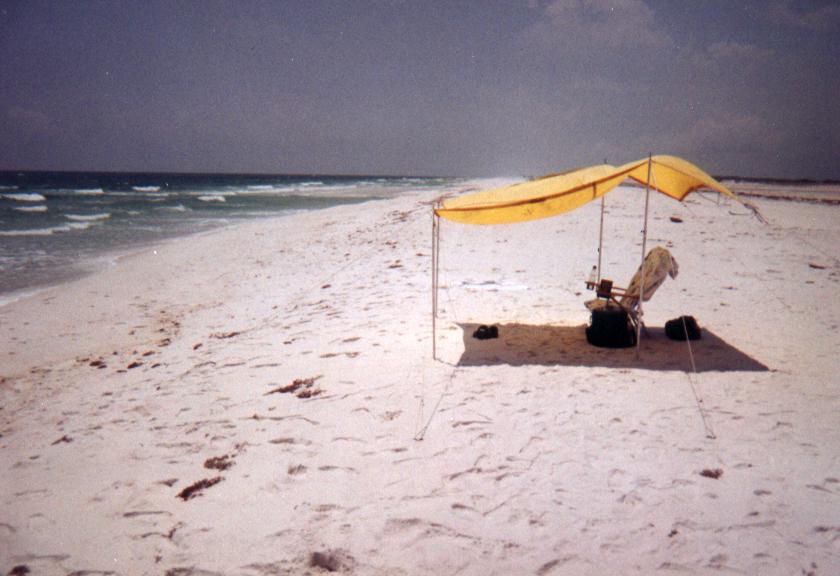 I
have spent as many as 15 days in a row, all day, on a beach. This
photo was taken on the Gulf side of
Fort Pickens near
Pensacola, FL. I
have spent as many as 15 days in a row, all day, on a beach. This
photo was taken on the Gulf side of
Fort Pickens near
Pensacola, FL.Most beaches have no shade, so it is necessary to provide your own. This is especially true since most PA meds cause hypersensitivity to the sun. In order to reduce my direct exposure to the sun I have concocted the shade screen described here by using a bit of Boy Scout technology. It is remarkably lightweight and durable, and is quite versatile. Recently I have seen some fairly inexpensive shade rigs in the camping sections of some "big box" stores, but I doubt any of them could out perform my rig in terms of weight, versatility, and strength. They are worth considering however if you do not want the trouble of putting together your own rig. The shade rig pictured above probably cost me close to $150. While that may sound rather pricey, it is worth mentioning that I have been using the same rig for several years now on my pilgrimages to the beach (a total of 15-30 days per year). You can buy less expensive parts, but it is generally worth the extra effort and expense to get quality components. The tarp, lines, and stakes all easily fit into a medium size stuff sack (say 10"x14"). The poles collapse and are lashed together. The chair has a shoulder strap. The tarp sack, towels, and a few other bits (like something to read) fit in a net bag with loop style handles that also can be slung over my shoulder. I have a soft pack cooler for food and water. This cooler has some net pockets for sunscreen and a spray bottle of vinegar (for jellyfish stings). Include a big hat, some light clothing over my swim suit (this is not a clothing optional beach), and some sandals that can get soaked by water and still be comfortable to walk in, and I'm ready for (literally) a day at the beach. At Fort Pickens it is about a 10-15 minute hike (for me) from the campground to the beach, so it is important to get everything in one trip. I've seen folks use wagons or carts, but that just means more stuff to manage. I like to keep things simple, and getting down to the most raw basics can be an art form, and I enjoy that too. I have weathered some fairly heavy winds & even a few squalls with this rig. I can recall one or two squalls where I had to "batten down the hatches" so-to-speak, and modify the rig to withstand the gusts & driving rain without being shredded. Basically I moved the front (short) poles to the center (left the long ones on the ground), and staked the front down to the sand. This prevented the wind from getting under the The Tarp What you really want is a good quality nylon tarpaulin, and these are difficult to find in a store (or even on-line). A good nylon tarp, well cared for, will give you many, many hours of pleasant service. Nylon is much more durable than plastic, and far lighter than canvas. Most importantly nylon is much quieter than the cheap-o woven plastic tarps that you can find most anywhere. If you are a purist, I can assure you that after 30 minutes in even a modest breeze, you will want to set your plastic tarp on fire! I carry a spare tarp with me now because I suspect that my current tarp will disintegrate, it seems so old & brittle, but it keeps on going! The Poles This is another item where quality is a key issue. A good pole will be lightweight, strong, and easy to adjust. If well cared for they can last a really long time. 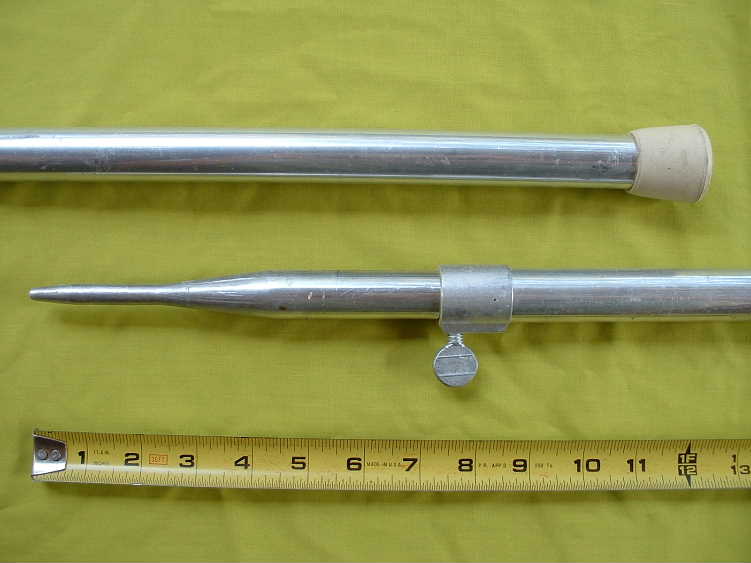 The
best poles I have were obtained (about 1995) at an army surplus
store. The manufacturer sticker on them reads: A&A
Enterprises, Inc., 23-25 Lakeshore Dr. E, Dunkirk, NY 14048,
716-366-0002. As I recall a 9' pole (shown here) was about
$15. I also have two shorter ones (that are also a smaller
diameter). The
best poles I have were obtained (about 1995) at an army surplus
store. The manufacturer sticker on them reads: A&A
Enterprises, Inc., 23-25 Lakeshore Dr. E, Dunkirk, NY 14048,
716-366-0002. As I recall a 9' pole (shown here) was about
$15. I also have two shorter ones (that are also a smaller
diameter).These poles are extremely durable and lightweight. The key feature is that they are easy to adjust and lock into position, even after being hammered by salt spray and sand all day. They are mostly aluminum (the thumb-screw is steel), so the rust factor pretty much does not apply. The only modification I made to these poles was to replace the plastic tip (at the bottom of the pole) with a rubber tip (like the ones commonly found on chair legs and cane ends). I found both the sizes of rubber tips that I needed at a hardware store (actually I think it was The Home Depot). Try searching on variations of: "adjustable aluminum tarp pole" Searching on: canopy, tent, tarpaulin, etc., may also work. I have seen a pole by Eureka that looks pretty good. 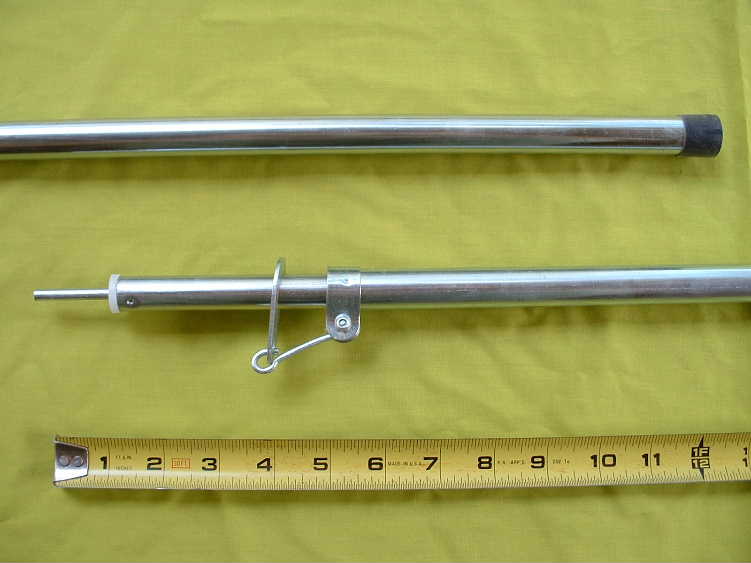 These
poles were obtained at Wal-Mart. They are steel (prone to rust),
heavy (not at all fun to carry), and difficult to keep properly
adjusted. But they are better than nothing. These
poles were obtained at Wal-Mart. They are steel (prone to rust),
heavy (not at all fun to carry), and difficult to keep properly
adjusted. But they are better than nothing.The Spikes Your choice of spikes (a.k.a. stakes) will depend on the type of soil encountered. In sand you obviously need something that works well in loose soil. Ironically, the best spikes are often referred to as "snow stakes" (etc.). While there are lots of tricks to secure guy lines in sand (like using a "deadman"), it is quickest and easiest to have a good stake. 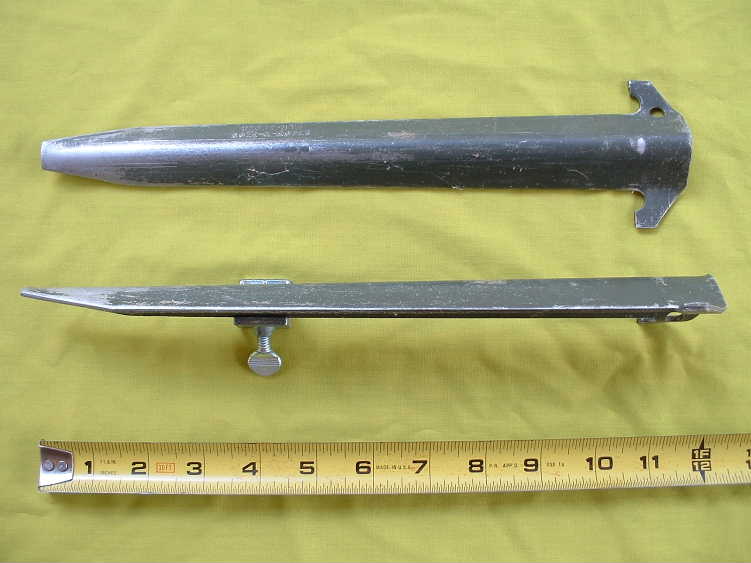 The
spike shown here works exceptionally well. In fact I've never
even bothered to try anything else. They are a stamped piece of
aluminum, which makes them lightweight and resistant to the
elements. The shape holds well in sand, even under storm wind
conditions. The broad top and tapered shape make it easy to drive
into the sand simply by stepping on it. It only takes a few tries
to perfect the quick push needed to properly secure the spike (if is
wiggles around a lot as you shove it in it won't hold as well). The
spike shown here works exceptionally well. In fact I've never
even bothered to try anything else. They are a stamped piece of
aluminum, which makes them lightweight and resistant to the
elements. The shape holds well in sand, even under storm wind
conditions. The broad top and tapered shape make it easy to drive
into the sand simply by stepping on it. It only takes a few tries
to perfect the quick push needed to properly secure the spike (if is
wiggles around a lot as you shove it in it won't hold as well).Most army surplus stores carry these aluminum spikes, but be prepared to hunt for them. It may be easier to locate them on-line. The last time I checked a 12" spike could be ordered for about $2.50 each. I've seen 9" ones, but I've never tried them, and based on my experience it is doubtful if they would work. 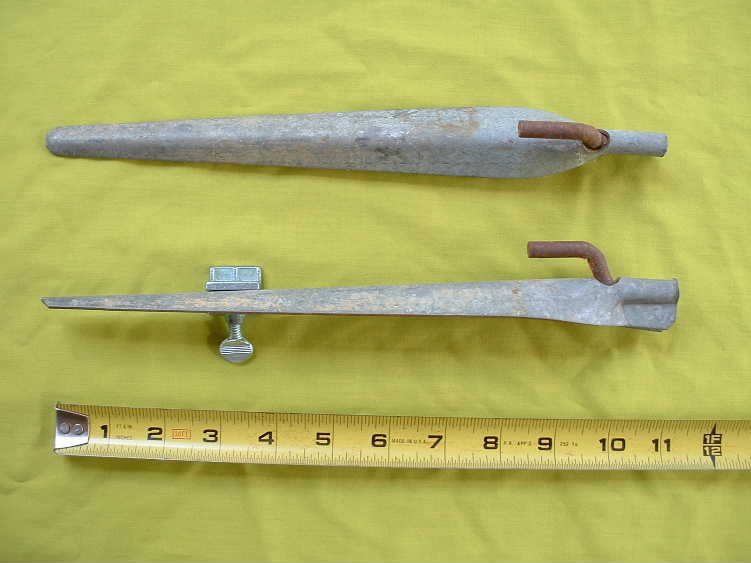 This
standard spike may (or may not) work in sand, but they are easily found
at Wal-Mart and such. I've never bothered to try them in sand
since I got the good 'uns. They work great in firm soil, but you
need a tool (like a hammer) to install and remove them. This
standard spike may (or may not) work in sand, but they are easily found
at Wal-Mart and such. I've never bothered to try them in sand
since I got the good 'uns. They work great in firm soil, but you
need a tool (like a hammer) to install and remove them.I have seen some plastic spikes at The Home Depot that look as though they may work just as well, but plastic tends to fail easily, especially after continued exposure to sunlight. The Rope Nylon braided cord with a filament core is the best. It is really easy to work with, holds knots well, and is very compact for its strength. There are lots of different kinds of nylon rope/cord, so be careful here. The stuff that looks like sash cord is what you want, not the stiff, unusable, cheap-o stuff. "Poly" rope is the pits. The trick to nylon braided cord is in cutting and finishing the ends. The best way I know of is to wrap a piece of electrical tape around the point you want to cut, and then use a sharp knife to cut the tape and the cord. This process keeps the cut from becoming frayed. Then hold the cut end over a candle to melt the cut and bind the end. The tape will help prevent it from mushrooming too bad, and keep it smooth. It may take a few tries to get this down. Be careful that you don't leave any sharp or pointy edges in the melting process. Give it plenty of time to cool before you touch it (you will probably only forget this one time). Eventually the tape may fall off, but it won't matter if you properly finish the end. The Setup It can be pitched in any number of configurations. |
updated: April 2005