|
|
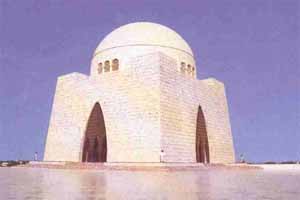 |
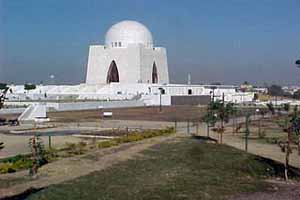
Mazar-e-Quaid
|
|
|
From Karachi, Kausar Bashir
Ahmad reports on the newest garden for Karachi, the landscaping around the
Mausoleum of Quaid-e-Azam, the father of the nation. Although the mausoleum was
completed in 1971, the grounds surrounding it have only recently been landscaped
to an overall plan. This plan is modelled after the famous Shalimar Garden at
Lohore, adopting the 'Chahar Bagh' principle that is commonly used in
traditional Muslim gardens and landscape architecture. The Karachi Development
Authority's Architecture & Design Bureau, under the supervision of architect
S. Zaigham S. Jaffery, developed a design envisaged to take three years to
complete. However, with the arrival of a new government, the task was handed
over to the Army's Engineers for completing it in a tight schedule of one year.
On 24 December 2000, the 124th anniversary of Quaid-e-Azam's birth, the gardens
were formally opened.
The overall planning of the gardens is based on a concentric pattern wherein the mausoleum and its main podium are on the highest and most elevated location of the site. The zone of the podium is marked by a simple row of trees with all surfaces here paved and finished in marble. The second zone is a combination of hard and soft surfaces, broken only by pools and walkways. The greenery is more pronounced in this zone, with a marked abundance of flowering plants and water elements. Outside the second zone is a sprawling and informal garden, extending up to the site's peripheral roads. This area is extensively planted as an organized woodland with occasional pathways, with hard landscaped areas at points of special interest along the way. In this last zone are most of the 5,000 trees planted for the project. The concept was to locate the mausoleum building in a thick woodland that would start as a dense forest from the outer limits and recede towards the slowly rising site of the central podium, thus becoming a focal point of the whole site, similar to Ankara's Anýt Kabir Mausoleum for Atatürk.
In addition, the project has also taken inspiration from the Moghul tradition of gardens by the use of two axial 'Chahar Bagh' sections and the flowing water through the liberal use of shallow watercourses, fountains, cascades and strategically placed waterfalls. In addition, traditional patterns and forms in marble, both on walkways and on the base of reflecting pools, abound. Special attention has also been paid to the lighting to produce a dramatic night time impact. The cost for the project has reached US$4.5 million no small expenditure considering the present health of the Pakistani economy. However, as Ahmad notes, this one-time cost seems in line with the collective will of a nation clamouring for its cohesion and purposeful unity.