
Hominoidea
The Hominoidea (apes and humans) is one of two superfamilies that constitute the infraorder Catarrhini; the second superfamily is the Cercopithecoidea (Old World Monkeys). The infraorders Catarrhini and Platyrrhini (New World Monkeys) together constitute the suborder Anthropoidea, or anthropoids, often called the higher primates.
The word "hominid" refers to members of the family of humans, Hominidae, which consists of all species on our side of the last common ancestor of humans and living apes. (Some scientists use a broader definition of Hominidae which includes the great apes.) Hominids are included in the superfamily of all apes, the Hominoidea, the members of which are called hominoids. Although the hominid fossil record is far from complete, and the evidence is often fragmentary, there is enough to give a good outline of the evolutionary history of humans.
The time of the split between humans and living apes used to be thought to have occurred 15 to 20 million years ago, or even up to 30 or 40 million years ago. Some apes occurring within that time period, such as Ramapithecus, used to be considered as hominids, and possible ancestors of humans. Later fossil finds indicated that Ramapithecus was more closely related to the orang-utan, and new biochemical evidence indicated that the last common ancestor of hominids and apes occurred between 5 and 10 million years ago, and probably in the lower end of that range. Ramapithecus therefore is no longer considered a hominid.
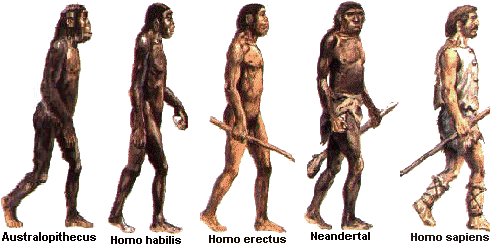
The field of science which studies the human fossil record is known as paleoanthropology. It is the intersection of the disciplines of paleontology (the study of ancient lifeforms) and anthropology (the study of humans).
This page reviews the hominids known so far and puts all the findings into a evolutionary timeline. Here you will be able to find information on:

 Ardipithecus ramidus