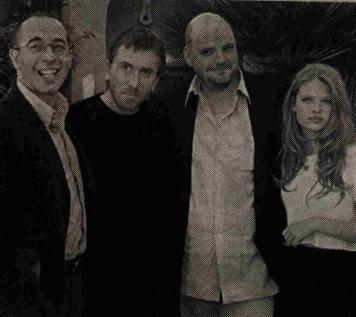
From 'La Stampa', 28 Oct 98. Courtesy of Mia
In the theatres the intimate kolossal by Tornatore taken from Baricco's monologue.
NINETEENHUNDRED, the magic of limitations Roth, an allegoric
pianist on the Virginian
A man is born, grows up, works and dies on a ship, like in a world or in the century: without ever leaving it for almost fifty years, from the beginning of 1900 until after the Second World War. His house is the Ocean on which the ship has its route from Europe to America and viceversa, his job is enchanting the passengers with a fascinating music and with his pianist mastery, "the greatest ivory tickler of all the seas". His refusal to get off derives from the fear towards the unending, uncontrollable, infinite vastity of the earth, when compared to his own definite environment, which is governable and complete (in the pictures on the wall, the pianist appears next to Freud, Einstein, Thomas Mann). His story is told with many flashbacks by a friend and trumpet player. Metaphor of an artist life or perhaps of an existence who's happy of his own limitations, "The Legend of the Pianist on the Ocean" by Giuseppe Tornatore, taken, and most faithfully, from a short theatrical monologue written in 1994 by Alessandro Baricco and published by Feltrinelli with the title Novecento, is a different movie from the others: huge and intimate, immense, productively speaking, and poetic, almost 3 hours long and full of dilemmas, non categorizable in any cinematic genre and maybe close to a literary category of the beautiful story, of a very good story and very well told, too. More than the main character, the real protagonist are the ship and the music: the steamship Virginian, big, deep, inexplorable and a total universe which condenses the rich and the poor, elegance and labour, luxury and poverty, family and interior adventure, in the paradoxical stability of its journey routine and of its changing in time from emigrant ship to hospital ship, to wreck to be destroyed with the explosive; the music by Ennio Morricone is moving, very beautiful and sentimental just as much as the one of 'Once upon a time in the West' by Sergio Leone (to the tonality of that movie also the photography by Lajos Koltai gets real close), while the pieces played by the pianist, even in his duel with Jelly Roll Morton sound less thrilling Tornatore can think big and confirms being very clever at shooting: all the mass scenes and the great sequences -of the dancing piano in the ballroom to the swinging of the ocean in storm, to the one useless attempt of the main character to get off the ship "in order to listen to the sea's voice, to see the sea" to the final meeting with the trumpet player in the belly of the destroyed ship and to the decision of dying with the Virginian. The director is less good as script writer, the passages between past and past-present are often confused and also the sense of the film is not very clear. Tim Roth, always great, and perhaps too little fascinating, with his wiry body and his big round eyes to handle the screen for so long; the model of the ship at times imperfectly used, and at least once one gets the diversity between Roth's hands and someone else's tapering hands flying on the keyboard: but in such a movie these are unimportant details.
Lietta Tornabuoni
The director: tired and satisfied
"The story leads to confrontation. You ask yourself whether you're happy or not"
ROME - Giuseppe Tornatore has a tired and happy face: at last after two years' work, "La leggenda del Pianista sull'oceano" is a movie ready for the screen. Having forgotten the hard work and difficulties, the dozen of times done and redone scenes so that the actors' expressions and the movements of hands on the instruments were perfect, the eternal discussions with Tim Roth searching for an impossible agreement between the interpretation demands and the camera movements. The movie gets released in Italy today shortly afterwards abroad and, if everything goes OK, it should be released in the US by the end of the year in order to be part of the Oscar competition as American movie, considering that also Fine Line, beside Medusa, took part in the financing of the 35-40 billions Italian Lire, the cost of the whole operation. Tim Roth, Pruitt Taylor Vince and Melanie Thierry, the three actors of the film saw it only on Monday evening and they declare to be amazed by its perfection. "Can't find the words to define it" says Roth, "I never took part to a movie of such importance", adds Vince, "I had trembling legs" confesses Melanie. Tim Roth says he's spent 4-5 months studying the piano: "I'm still the world's worst pianist, but at least I learnt where to put the hands on a keyboard". Ennio Morricone, author of the music and editor of the whole soundtrack, explains he has worked side by side with Tornatore for the whole time: from script writing to editing, correcting, cutting, replacing because never as in this case music and images had to go always in the same direction. But who's speaking more and would never stop is Tornatore who considers this movie of his a totalizing work in which everyone had to give all of his/herself. Two lines of Baricco's momologue convinced him to transform the writtwn word to cinematic images. The first is: " If you have a good story and someone to tell it to you're never fucked." The second, never spoken out explicitely in the film, but hidden in the whole narration is: "Who knows Novecento never asks whether he's unhappy: he/she asks whether he/she is happy, instead." Tornatore confesses: "The first came to my mind when I gave up an old project of mine and I started thinking what I could do next. The second is the essence of the story because this Nineteenhundred, for his allegoric value, is really a revealing factor for all of us, sons like him of a century which is dying but, unlike him, unable to find our balance". No relationship with "And the ship goes" nor with "Titanic" or "Shine" of which he's been accused of wanting to repeat the international success because there's a pianist here, too. There are explicit references, instead, to the historical couples of cinema, especially Laurel and Hardy.