Carro ARMATO M. 11/39
Carro Armato M. 11/39 (1940)
|
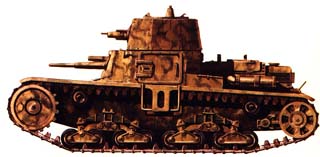 |
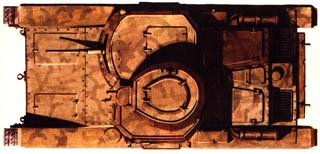 |
| |
|
| Weigth |
10,970 tons |
| Crew |
3 |
| Weapons |
Vickers-Terni 37mm L40 gun with 84 rounds, 2
8mm MG Breda model 38 with 2800 rounds |
| Armor |
hull 8-30mm (nose 30mm, sloped plate 14mm,
front 30mm, sides 14-15mm, top 8mm, bottom 7mm,
rear 14mm); turret 7-30mm (front 30mm, sides and
rear 14mm, top 7mm) |
| Engine |
43hp diesel FIAT Spa 8T, 8-cylinders on V,
liquid cooled |
| Speed |
34Km/h |
| Autonomy |
200Km |
| Length (max) |
4,73m |
| Width |
2,18m |
| Height |
2,25m |
|
Advantages: diesel engine provided a reasonable automy
Disadvantages: weak armor, low speed, limited traverse and
utility gun, suspensions and filters were incompatibles with
desert conditions and need better tropicalization.
In action...
In 1933 it was clear the the tankettes were not the answer for
replacing the overaging FIAT 3000s and a new tank was
commisioned. After experimenting about a bigger and heavier 12
tons tank based on the CV.33 design, a lighter 8 tons tank
version was chosen. In 1935 new tank appeared with its 37mm L40
gun with a limited traverse of 15º on the left and on the right
and 12º on top and bottom thanks to an hydraulic device on the
horizontal plane. The gunner seated on the right and the driver,
lightly reared, on the left while the commander manouvered the
turret two Breda 8mm MGs. The engine, still of commercial
version, transmitted its move through a gear box to the forward
sprocket. The drive was possible because of an epicyclic lever
and the brakes.
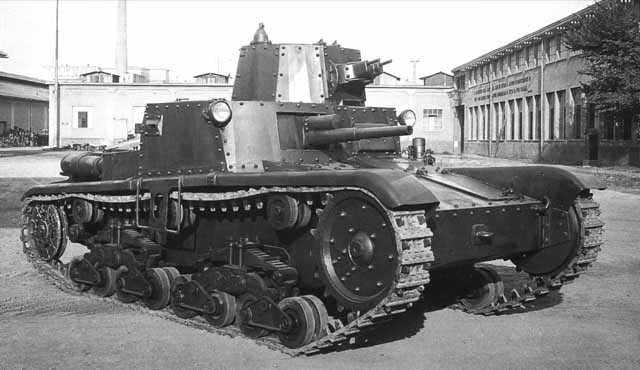 |
The prototype of the M. 11/39
|
Ground tests demonstrated that the vehicle needed improvements
on the engine and transmission systems; a new rounded turret was
designed to speed and make easier the production and so, in 1937,
the new tank, designed "Carro di rottura" (breaktrough
tank) was requested in a first (and only) batch of 100
exemplaries.
Lack of materials delayed the production until 1939 when it
begun to be delivered with the signature M. 11/39 (which states
for "Medium tank weighting 11 tons and accepted in service
in 1939"): this vehicle was taller, heavier (about 10 tons)
and hard to explain the tank was lacking the radio (that instead
was mounted on the prototype).
In May 1940 24 M. 11/39s were sent in A.O.I. ("Africa
Orientale Italiana", Italian Eastern Africa) grouped in a
"Compagnia speciale carri M.", special M. tanks company
to reinforce the Italian positions in the colony. On the start of
the conflict field commands required new tank reinforcements
because the light CV. 33s were unuseful, as demonstrated in first
encounters with British armored units. 70 tanks were placed at
disposal of the 4th Tank Regiment and landed in Bengazi in July
of the same year.
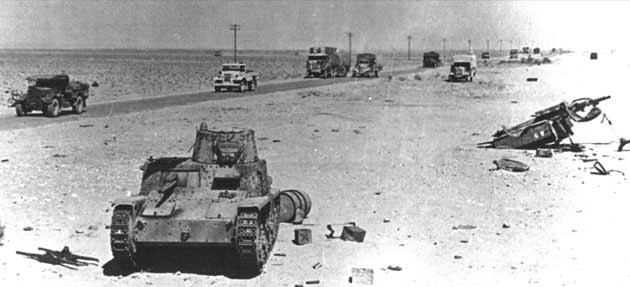 |
A M. 39 abandoned on the side of
the Balbian way, 1941
|
When first employed against the English the M.11/39 got enough
succes while being used in infantry support role during the first
advance to Sidi Barrani. Similarly to the L. 33s this tanks were
mechanically unreliable: in September when the Armored Groups
were re-created the I Battailon of the 4th Tank Regiment's 31
tanks only nine were still in service. The first engagements with
the british tanks immediatly proved the inferiority and weakness
of the M.11 in both gun and armor thickness and shape, without
speaking about the weak trasmission/suspension system.
 |
A shot of the rear of a M. 39
captured by the British in North Africa.
|
The disaster was near: when the British launched their
offensive in December 1940 the II Bataillon (2 M.11 companies)
detached to Maletti Group was surprised near Nibeiwa and 22 of
its tanks were knocked out. The I Battailon, while being part of
the new Special Armored Brigade with a M.13 Battaillon and 2 L.33
battailons, was able to take only a minor part in the fight
because the most part of its tanks were in Tobruk for repairs.
The following defeat in early 1941 took the destruction or the
capture of almost all the M.11/39s: because of their
unreliability and lack of any recovery vehicle the immobilized
vehicles were abandoned in the enemy hands: the Australians
equipped an entire regiment with the captured M.39 but they were
soon put out of service because of their faults. The remnants
six(!) tanks were used in Italy for training purposes and were
officially put out of service after the armistice of September
1943.
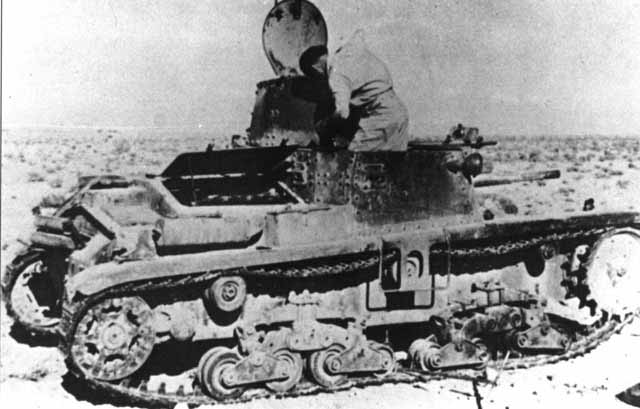 |
Another knocked out M.39 while
being inspected by a British soldier. This photo let to
understand the
tiny dimensions of this "medium" tank.
|

|
This page is online thanks to Geocities, the
largest Web Community! Get your own
free page at Geocities!!!
|