



What are "Fillers"?
By Klaus N. Frick
What are "Fillers"?
There is a term, circulating through fan circles and discussions recently, which kind of bears a negative intonation - and is also meant this way. I'm talking about the so-called "fillers".
Today's generation of Rhofans has coined this term for episodes, which apparently don't do much to the series and don't seem to carry it forward. This term is somehow negative and I'm very much aware of it. Worse though, that this term is used incorrectly - I think.
The word "filler" explains exactly what occurred: If suddenly a gap appeared within the exposé planning, a quickly written novel had to fill this gap. This occurred apparently not just once in the 60's or 70's, but more frequently close to the end of a cycle, when Perry Rhodan authors realized that the story line didn't work out or somebody had fallen ill. The cycle concept suffered and gaps developed, which then needed to be bridged with single episodes, not having much to do with the general scheme of things.
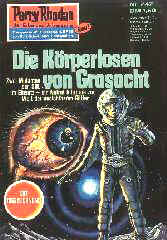
A prime example was Harvey Patton's only Perry Rhodan novel »Die Körperlosen von Grosocht« (The bodiless of Grosocht) issue 747, in the 70's. Among others, this novel also featured Gucky (Pucky) who encountered another Ilt, millions of lightyears away from the Milky Way Galaxy. This novel was labeled a filler, at a time when I was still a Rhofan. Taking a closer look at this novel, then the reader would probably agree. Today, we would possibly call it a "Guest Novel"
Today's Perry Rhodan cycles don't have these fillers anymore. Within the cycle planning process at the Exposé-Factory, there are no gaps, which quickly need to be bridged. The general cycle planning is done and completed way before the real work begins, then individual exposés are being developed according to the wishes of the particular author and according to demands and highlights within the cycle. Considering Robert Feldhoff's imagination and ideas, there is no chance, that at the end of a cycle, he would run out of concepts or ideas, thus leaving a gap that would need bridging.
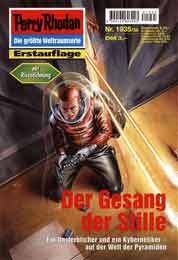
It is correct that new exposés are being developed for guest novels, which tend to have a lose connection to the story line, as in the case of the well written guest novel »Der Gesang der Stille« (Song of silence) PR issue 1935 by Andreas Eschbach, which has been reprinted as part of the PR Gold Edition. This was also the case with guest novel PR 2235 »Todesspiele« (Death games) by Thomas Ziegler. Both novels had been conceived to be loosely connected to the story line beforehand.They are nevertheless, not considered fillers. This term is unfortunately misused. What the critical reader wants to say is that a particular novel doesn't seem to advance the story fast enough, as they like to see it. If a novel doesn't provide the reader with an overdose of information, then some novels get labeled: "Fillers".
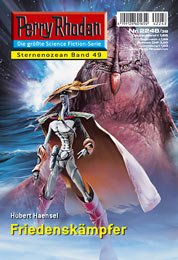
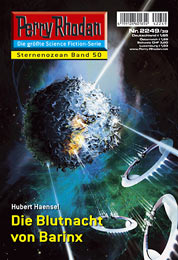
I think it is wrong and not only due to historic reasons. Each novel of the current cycle projects the story line and provides more or less subjects of interest to the readers. Sometimes, cosmic connections are being revealed as in the double issue 2248 »Friedenskämpfer« (Freedom fighters) and issue 2249 »Blutnacht von Barinx« (Blood night of Barinx) by Hubert-Haensel. Some of these novels are meant to "just" introduce the reader to a new extraterrestrial culture, a new weapon system or to further develop a side character of the series. Nevertheless, they are not considered fillers.To say it clearly - and to my best knowledge - we have so far not written a filler within the current cycle, at least not consciously, because it is not part of the story line concept. The odd novel was possibly disappointing to some readers, but that does not - with all due respect - make it a filler.
PMV 2005
Cover PR 747, Materiequelle
Adaptation MK 2005

Issue #10, 30 May 2005

All Perry Rhodan readers are cordially invited to join the TRI Forum (ENGLISH). Besides e-mail message exchanges between forum members and discussions, ideas for card board modeling of space ships etc. can be submitted. There is a file sharing section for pictures and member short stories set aside for members to enjoy.

 United as the Solar Union, humanity faces the challenges of the last unknown realm – space!