
Sunrise on the Ganges (Varanasi, India)


How could I pay attention to his words when, try as I might, I couldn’t stop fixating on his orthodontic nightmare and it’s bleeding gums?
How the hell did this guy manage to chew food?
I cut a sideward glance at Caroline and Natalie, my Dutch friends, to see if they were having the same difficulty. But they appeared to be totally engrossed in the scene unfolding in front of us. I suppose it could have been worse, he could have been our waiter. Instead, he was a member of the lowly Dom caste, responsible for tending the funeral pyres of Manikarnika Ghat.
Earlier that morning, we left our guesthouse and headed down to the banks of the Ganges River. It wasn’t even 6AM, yet scores of boatmen already lined the ghats (wide steps leading down to the river), eagerly vieying for our business. When it came to bargaining, the girls saw me as weak, which admittedly, I was. I’d just as soon avoid all the hassles inherent to negotiating and quickly settle on a price. The girls, however, would have none of such nonsense. Like any self-respecting backpackers, they embraced bargaining with voracity matched only by their counterparts. After a brief period of heated exchange, punctuated by sighs of exasperation, outbursts of laughter, and stern rebukes, we settled on a price and selected a guide.
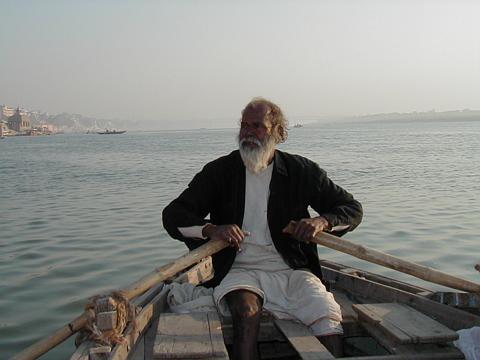
Lining the Ganges’s Eastern Shore are well over 100 individual ghats – most of which are half the length of a football field. Far from mere steps leading down to the river, each is unique – serving a different purpose or segment of society.
They are an anthropologist’s dream.
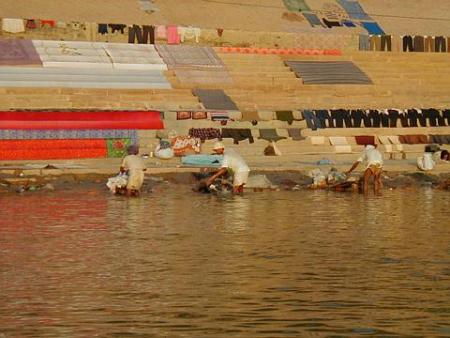
Each year, millions of Hindu pilgrims come to Varanasi to bath in the Ganges, a ritual that is believed to wash away all sins. Although a dip in the river is what leads them here, the throngs of faithful can be seen publicly engaging in the most intimate rituals of life and death.
Nowhere is India’s paradoxical nature more apparent than Varanasi’s ghats. Laid out along the steps, commerce mixes with charity, immortality faces mortality, while the whole and limbless coexist. From sunrise to sunset, pilgrims and profiteers read, lounge, beg and give alms, have a pee, play cricket, wash clothes, offer puja, or get a massage.
Halfway upriver, Babu pointed toward the shore and exclaimed “Manikarnika Ghat! Burning Ghat!”
In the distance, we could see thin strands of blue smoke rising. As we drew closer, we became aware of a particular smell steadily growing stronger. As long as you didn’t fixate on the source, it wasn’t too bad. Actually, it reminded me of barbecue. Babu steered ashore, effectively docking us directly in front of the ghat. Here we were, positioned alongside a handful of other tourists, treating death as a spectator sport.
Moments after we came to rest, an Indian scampered aboard – ‘The Mouth’. Oddly, the rest of him was quite presentable. He was relatively well dressed and meticulously groomed. The Mouth was our unofficial and unsolicited tour guide who, for a few rupees, explained the scene in front of us. I was quite interested in what he had to say and resolved to find a way to do so. As my repulsion subsided, I devised a plan. It was a simple matter of positioning. Instead of facing him, I pivoted, perpendicularly. I listened out of my right ear while taking short shallow breaths from the left side of my mouth. This methodology afforded an unobstructed view of the ghat and spared me from realizing my biggest fear – smelling his breath. Now I was ready to listed and learn.
Manikarnika, the main burning ghat [see forbidden picture], is one of the most auspicious places a Hindu can be cremated. Poised at the top of the stairs rests an ornate stone temple dedicated to Ganesh, the god of new beginnings. On either side of the temple sit identically drab concrete ‘hotels’. These are used to temporarily house many of the elderly who come here to live out their final days. Dying here is believed to relieve one from the cycle of rebirth and grant an instant passport to heaven. Stacked along the hotels are huge piles of sandalwood guarded by merchants armed with scales and calculators.
The deceased’s eldest son, who has shaved his head for the occasion, is in change of the process. Part of his job is to bargain over the quality, quantity, and of course price, of the sandalwood. Since a proper cremation takes at least 3-4 hours, a fair amount of wood is necessary to ensure the job gets done – roughly 2,500 rupees / $50 US. Once an agreement is reached and the Untouchables have constructed the funeral pyre, the son circles 5 times before plunging the torch into the structure. Throughout the day, this ghat’s steps are filled with gatherings of relatives surrounding small fires. Oddly, most resemble your average campfire instead of the homecoming-bonfire I’d expected. Not everyone, however, is lucky enough to be cooked in front of their loved ones and the throngs of sadistic tourists. Children, pregnant women, lepers, and snakebite victims are treated like the thousands of sacred cows that roam, and eventually expire, on the city’s streets – they are brought to the banks of the river and set adrift, intact.
No where are they more closely aligned than Varanasi.
After we thanked The Mouth and resumed our trip, this juxtaposition became glaringly apparent. Our southbound journey took us past Lalita Ghat, Meer Ghat, and Dasawamedh Ghat respectively. On the steps of the first, a handful of Indian teenagers were engaged in a game of cricket [see picture].
At the next, we were greeted by the sight of two dogs tearing into a carcass – upon closer inspection [see picture] it was determined to belong to a cow.
Not 100 yards away, a handful of men were laughing and joking was they bathed on the banks of Dasawamedh Ghat [see picture].
Half an hour later, over a plate of banana pancakes with honey, I planned the rest of the day with Caroline and Natalie. Upon reflection, it seems absurd that we didn’t lock ourselves in our rooms and begin heavily drinking to block out the images we’d just witnessed. But after traveling here for a month, mornings like ours were no longer seen as particularly strange – they are simply taken at face value and chalked up to part of the ‘experience’.
India is an experience. Hands down, it’s the weirdest country I’ve ever visited. Nearly every day I encounter something that should completely freak my shit out. What’s really freaky, when you think about it, is that nothing here is done for the sake of being expressly wired or exotic – it’s just how it is. When I asked a well-traveled friend what to expect of this place, he stated, “I think it will take S.E. Asia and turn it on its head”.
The downside to most experiences are the inherent CHALLENGES involved. Truth be told, this place has beaten me down once or twice. It’s no walk in the park. Although educated estimates place the figures much higher, Deli’s [see picture] official population is nearly 10 million while Bombay’s [see picture] exceeds 15 million. By 2020, Bombay is set to surpass Mexico City as the world’s second largest city (behind Tokyo). Shortly thereafter, India is poised to beat out China and obtain the title of World’s Most Populous Country.
With this distinction comes a few issues:
The pollution in many cities has reached almost apocalyptic levels – you can visibly see the air you’re smelling and tasting.
A number of the older cities I’ve visited [see pictures] appear mainly to be comprised of a disorderly array of filthy, clamoring, cow filled streets filled with the noises, waste, and smells you’d expect.
In such an environment, one of the biggest challenges to foreign travelers is to remain healthy. At least half the travelers I’ve met have become seriously ill at some point. Nothing can take the fight out of your like getting sick. It saps your strength and removes any notions you’ve had about rising to face India’s challenges. When you’re really sick, life sucks and you begin to question the whole point of such an experience.
But like a hangover, you get over it, start to feel better, forget your belly aching, and begin looking forward to the next party (experience).
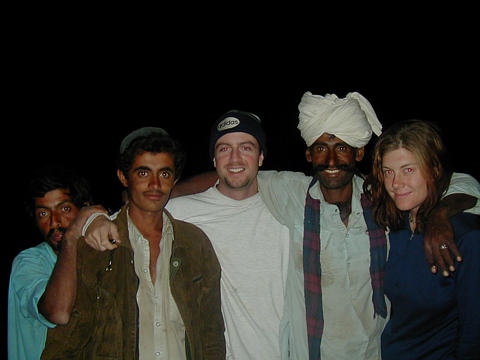
Yeah, this is a freaky fucking place but so was college when I first set foot there and I managed to leave it with a smile on my face and a little bit wiser.
But the experience goes beyond being merely fascinating or educational. Living in this country is EXCITING. Where else are you going to spend an evening in the Thar Desert drinking moonshine with your camel drivers [see picture] then, find yourself a week later watching the sunset behind the Taj Mahal [see pictures]?? One thing’s for certain; life is far from dull here.
Oh, in case anyone is the least bit concerned, I’m currently in Goa – India’s tropical laid-back beach state. This place is a world apart from the trials and tribulations of the rest of the country. Perhaps it’s due to the fact that Goa was a Portuguese colony (as opposed to British like the rest of the country) or maybe it’s because the region is primarily Catholic (instead of Hindu). Regardless of the reasons, this place is about as challenging as Hawaii. I’m currently at my favorite beach bar watching the sunset over the Arabian Sea [see picture]. In the back of my mind, however, I know that sometime soon I’ll get the itch for more of the experiences inherent to India – the land that CHALLENGED, FACINATED, and EXCITED one foreigner to write:
Life is an opportunity, benefit from it.
Life is a beauty, admire it.
Life is bliss, taste it.
Life is a dream, realize it.
Life is a challenge, meet it.
Life is a duty, complete it.
Life is a game, play it.
Life is costly, care for it.
Life is wealth, keep it.
Life is love, enjoy it.
Life is mystery, know it.
Life is a promise, fulfill it.
Life is sorrow, overcome it.
Life is a song, sing it.
Life is a struggle, accept it.
Life is a tragedy, confront it.
Life is an adventure, dare it.
Life is luck, make it.
Life is too precious, do not destroy it.
Life is life, fight for it.
- Mother Teresa
India I - Rajastan, the Desert State
India II - Varanasi / Agra