Relief and Recovery - Gujarat, India

Laughter and child-like cheers fill the cabin as we veer back into our lane narrowly avoiding another head on collision – this time with an oncoming bus. For the umpteenth time today, I’m honestly surprised we are still in one piece. Natural Disaster appears to have had little impact on India’s roads. As usual, they resemble one giant free for all that somehow,
amazingly, seems to work.
Arjan, our 24-year-old driver, finds our chant terribly amusing and breaks into another bout of the giggles. How in the name of God he manages to keep us all alive is beyond me. Ghunshyam, Mukesh, Gupal, Nitin, and I have all joined him in the truck’s cabin (a space designed to safely accommodate 2 or 3 people) and are snacking on relief supplies procured from the back of the truck. Dried dates from Iran and biscuits from Holland are to be our lunch.
During the past few weeks I’ve picked up a bit of Gujaraty (the local dialect) and my new friends have returned the courtesy by learning a few choice English phrases. For some reason, ‘we die, we die, we live’, recited during appropriate road encounters, has quickly become their favorite.
Needless to say, this is not what I’d envisioned when I signed on. Misery and Suffering filled the imaginary brochures that I’d created – not this. Everything turned out so utterly different than expected that I stopped being surprised a long time ago.
Or so I thought…
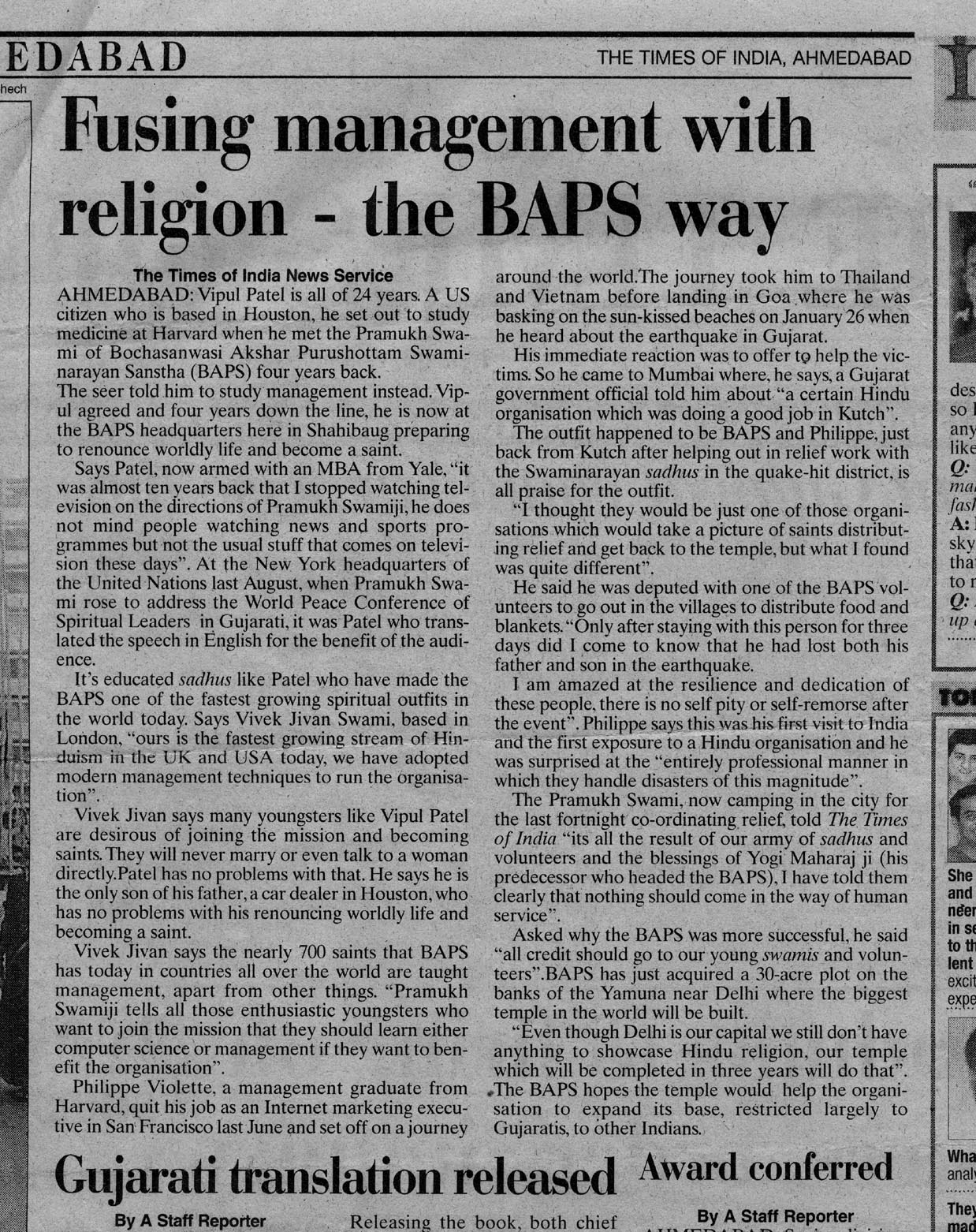
Not in a million years would I have believed that, by the time it was all over, I’d meet God, be brought to tears by a child, and wind up interviewed by the Times or India.
The earth’s crust (Lisophere) is broken up into a number of plates which move about at approximately the speed a toenail grows. Apparently, the one India sits on has been ramming into and under China for a bit too long and with a bit too much force. Something had to give. On January 26th, the tectonic powers that be chose the Kutch Rift (a 200 km fault below the city of Bhuj) as the spot to release said stress. At 8:45 in the morning, the earth began to shake at a mind numbing magnitude of 7.2 on the Richter scale.
The natural calamity that followed wrought unimaginable destruction and unprecedented horror to the Indian state of Gujarat. The cost in monetary terms is staggering, in human life, inestimable.
Down in the Southern State of Goa, I remained fast asleep – oblivious that one of the worst tragedies of our time was unfolding 800 km to the North. For me, it was just another day in paradise – one to be spent in the same
manner I’d passed the last month – slowly cultivating the art of self-indulgence.
The following afternoon found me at my favorite beach bar sipping an ice cold Kingfisher. While waiting for my lunch to arrive, I borrowed the restaurant’s newspaper and scanned the headlines. The entire front page was devoted to the recent earthquake.
Headlines Read:
* Hopes of Finding Quake Survivors Fade, Death Toll reaches 30,000
* Swiss Rescue Team Begins Operation
* There ‘Was’ a City Called Bhuj
* Vultures Share Skies with Helicopters
Stories Told:
* At the moment, the city looks like a graveyard. There is no water, food, medicine, shelter, petrol, or diesel.
* To compound the misery of the survivors, miscreants brandishing knives and swords are reportedly on a robbing spree in the area. With the number of policemen perishing in the quake, there is hardly any law enforcement machinery in place.
* It is the mass cremation sites that define the enormity of the situation. Since nearly 100 villages have been completely wiped out, there is no one to even morn the dead.
* Pilots coming into Bhuj airport say it looks like what hell must.
* 400 school children were buried alive during a Republic Day parade in a narrow lane in Anjar. Only 8 have been rescued.
It all sounded pretty horrible. In a remote way I felt bad for the people of the region. “Sucks to be them”, I thought before turning to the sports section.
Another day brought another paper filled with terrifying images of the earthquake’s devastation. As usual, I felt the typical twinges of guilt that accompany news of human suffering, tales of social injustice, or a Sally Struthers starvation plea. This time was different, though. Somewhere deep in the recesses of my conscience, my Superego was joining forces with my stockpile of guilt – urging me to get off my ass and do something. I was forced to ask why I wasn’t lending a helping hand. I didn’t have any commitments or responsibilities, not even any set travel plans.
The next morning I awoke knowing, as if it were something I’d decided long ago, that I was going to Gujarat.
First, I had to do my homework. The Indian Army had set up checkpoints and was not allowing just anyone to wander into the affected areas. Understandably, they didn’t want the additional liability of a bunch of spectators stumbling around the rubble.
Since I’d done some work with the Red Cross during America’s Mississippi flood of 1995, I decided that the Indian chapter in Bombay would be a good place to start. As I entered their office, I was struck by how disorganized it appeared:
loose papers spilled off the desks, faxes fell to the floor, phones rang unanswered.
I met with the Associate Secretary and was told that I could accompany a relief truck leaving for Bhuj (epicenter) the same day. The afternoon came and went without the truck showing up or anyone seeming to notice.
Following two days of similar nonsense, I decided to explore other avenues and found the government official in charge of collecting donations in Bombay. Mr. Saxena told me about a Hindu Temple (Swaminarayan) that was doing good work in the severely affected areas. Unsure if I wanted to join a religious organization I’d never heard of, I went to the American Embassy and asked their advice.
“Don’t go! It’s dangerous and we don’t want to get calls from your parents demanding we find their son”
After discovering that I was determined to go, I was asked to wait while they called a council officer who had just returned from Bhuj. Zibin Kapacha mentioned a nongovernment organization he was particularly impressed by – The Swaminiaryan Temple. Serendipitously, I was put in contact with two devotees who were driving to the temple’s disaster headquarters that night.
On the road to Bhuj a smorgasbord of disheartening scenes fast-forwarded in my mind while I tried to make sense of the chaos and death tolls in the newspapers. Then the questions began:
* What the hell am I getting myself into?
* Were epidemics really breaking out?
* Whose bright idea was this?
* What exactly is Gastroenteritis?
It was about 7AM when we entered Bhuj. In the early morning light we were greeted by a scene that would soon cease to be unusual. Building after building had fallen to the ground; slabs of concrete rested on flattened cars; Temples, Mosques, and Churches had been crushed alike; tent villages and shantytowns had piled up along the roadside [see pictures].
As we entered the Swaminarayan temple, which looked more like a military compound than a house of worship, my companions began to enthusiastically show me around, as if they were leading me through a historic site, of
tourist interest. Next came the numbers and statistics. Indian’s love facts and figures.
* This temple is one of the over 400 Swaminarayan temples worldwide.
* From London to South Africa, millions of followers belong to this branch of Hinduism.
* Each devotee had dedicated his/her life to follow the teachings of Pramukh Swami Maharaj – the man in charge of it all (more on him later).
* Here in Bhuj, 400 volunteers and 40 Sadus (monks) were currently providing the 3 Rs (Rescue, Relief, & Rehabilitation).
* Swaminarayan temporary kitchens were serving over 15,000 hot meals each day.
* 69 suburbs of Bhuj city and 158 surrounding villages had been assisted.
I had to admit, I was pretty dam impressed. My business experience gave me an idea of the staggering logistics required to manage such an operation. This wasn’t the little temple I’d pictured – its capacity far exceeded anything I could have imagined. These guys had their shit in gear.
A few hours after I arrived, I met a little character who soon became by best friend. Himansu’s home had been destroyed and he now lived in the tent village behind the temple. Although he looked much younger than his 12 years, it was immediately apparent that something about this kid was special. Besides being a bundle of joy, he wore a mischievous smile that belied his witty sense of humor. When, like a total moron, I asked why he had shaved his head he just looked at me with the type of patient understanding teachers reserve for ‘special’ students. I knew, but had somehow forgotten, that in Hindu culture a shaved head signifies a loss in the family.
My stupidity was forgiven and we quickly became inseparable buds. After lunch, Himansu [see picture] took my hand and led me to the temple’s office where I met the Sadu (monk) in charge. Brahmaviharidas Swami was the epitome of confidence and competence; had he swapped his saffron robes for a charcoal suite, he could have easily passed for a CEO.
Following his advice, I tried my hand in various capacities (from security [see picture] to food service [see picture]) before finding my niche = distribution. Twice a day relief trucks loaded with food and blankets left the temple for the outlying villages.
My first run was to be to Ghandidam, which from what I’d heard had been one of the hardest hit areas. It lived up to its reputation. Street after street had been razed to the ground, hardly a structure had been spared. As our truck pulled to a stop, I followed my cohorts’ lead and fastened my mask behind my ears – covering my nose and mouth. White powder resembling faux snow covered everything [see picture]. The chalk-like substance, which I later learned was DDT, had been sprayed on the rubble to reduce the likelihood of epidemics spreading. Decomposing bodies were still trapped beneath the ruble.
As much out of curiosity as of need, a crowd began to gather around our truck. I braced myself and prepared to come face to face with people who had lost everything, including hope. Instead, the villagers were dry-eyed and calm. They came to find out what we had brought and to ask how THEY could help! To my great surprise, many turned away the free clothes, stating that they weren’t needed. In village after village we came across people trying to live in the present and leave the past behind.
From what I could gather, their resourceful, determined, even defiant nature can be attributed to 3 things:
1.) By now, a week had passed since the disaster.
2.) India is a deeply religious country. If you could quantify, measure, and compare this sort of thing, it would likely lead the world. Religion is woven into the country’s fabric and has helped its people make sense of this senseless catastrophe.
3.) Experience. Disaster isn’t something new to the people of Gujarat. Instead of breaking them (The Famine of 87, The Flood of 97, The Cyclone of 98, and The Drought of 00) adversity appears to have bread a culture of resiliency.
As was the case in every town we visited, the children were the most enthusiastic about our arrival and would come out of the woodwork to see what we were doing. Most of the time they were specifically interested in what I was all about. In many of these villages, especially the more remote ones, I was one of the few white men they had actually seen in real life
(Gujarat is far off the tourist track). As such, I resembled and personified many of the personalities they saw on TV. Especially their FAVORITE personalities, the stars of WWF wrestling. The fact that I bear about as close a resemblance to The Rock as I do to, say, Gandhi, didn’t seem to make any difference.
They would stand at a safe distance while the boys slowly mustered the courage to sneak up and touch me before running away giggling. This game would slowly escalate until, by the time we’d distributed our load, we were often surrounded by a mob of frenzied kids [see pictures].
At one point it actually degenerated into a mini Wrestle Mania with Stone Cold Philippe Austin fending off any given number of 4-12 year olds.
Yes, this was all very bizarre but I wasn’t about to suggest:
* Quit going ape-shit.
* Wipe the grins off your face.
* Try to look somber as I take your picture – it’s what the folks back home are expecting.
It sure wasn’t what I’d expected either.
Instead of connecting with the people of Gujarat and experiencing their heart wrenching misery, I found myself playing with their kids and laughing with my fellow volunteers. Don’t get me wrong, the place was no picnic – it was fucked and its people were fucked. I realized that beneath their resilient exteriors they had to be suffering and I felt a great deal for them, but dimly - as though watching TV. As days passed in this dreamlike manner I found myself becoming increasingly desensitized to my surrounding – broken buildings and bandaged people became business as usual. The thing is, I felt bad, but not that bad – as bad as I’d imagined, as I suppose I wished I would feel. A week into it, I nearly stumbled over a severed leg that I wouldn’t have even noticed if a friend hadn’t pointed it out (it looked unreal, like something you’d expect to find in a cheap wax museum). Instead of being revolted, I was bummed that I hadn’t brought my camera.
Had it not been for my little buddy, I might have left Gujarat believing myself to be empathetically deficient. The day before my Amhdabad bound bus was to return me to the real world, Himansu tugged at my shirt and handed me a small slip of paper. I opened it and read [see picture]:
Dear Filip
You are welcome to my tent
- Himansu’s Father
Though his eyes betrayed the lurking fear that somehow ‘I’ would be disappointed, he lead me into his tent and introduced me to what remained of his once upper-class family – his father (both legs in casts), his mother (fine, physically), and his older brother (also sporting a shaved head). Although they were completely at ease and couldn’t have hosted me in a more
friendly manner, I began to feel claustrophobic. After tea, Himansu pulled out a tightly wrapped tin box. With great pride,
he opened it and displayed his most prized possession – his sticker collection. I was shown a Ferrari Testerosa, a Honda Ninja, a cartoon ghost, and few others before he placed a multi-colored star in my hand. It took a few seconds for my mind to register that he was ‘giving’ this to me but my body reacted almost instantly. Avoiding his eyes, I glanced at the rest of his family to see if they noticed I was on the verge of tears but they were absorbed in conversation, or pretending to me.
Himansu looked at me without a trace of uneasiness and placed his hand on mine – the tears started to flow.
As I stared out the bus’ dusty window without seeing anything in particular, images of Himansu and the other volunteers who had become my surrogate family during the past few weeks filled my mind. An almost pleasurable sort of sadness expanded in me as I recalled the times we had shared. My sentimentality began to wane the moment the driver pulled out of Bhuj and hit the open road. After a succession of jars and slams, my attention quickly shifted toward my comfort, or lack thereof. The earthquake hadn’t exactly smoothed out the already pockmarked roads and the seats on this thing were about as comfortable as church pews. Add to this the fact that our bus appeared to lack any semblance of a suspension system and you’ll understand why, 30 min into the 9 hour journey, I dragged my backpack into the middle of the isle and began a frantic search. Only after I’d wrapped a towel around a number of T-shirts and wedged the contraption between my ass
the vibrating pew did I begin to breathe a little easier and slowly, grudgingly get into the road rhythm. As the hours passed, I began to consider the offer I’d received the day before – the more I thought about it the more I realized just how lucky I was.
Being one of the few Westerners in Bhuj, I had stood out and lucked out. I understood that this opportunity resulted more from my skin color then my contribution but that wasn’t about to stop me from taking advantage of it. I was on my way to the main Swaminarayan temple in Amhdabad with a personal invitation to meet Pramukh Swami Maharaj – the man in charge of it all (millions of devotees from 45 countries).
This was a BIG DEAL. To give you an analogy, this was like being granted the opportunity not only to visit the Vatican but meet with the Pope.
Upon arrival, my excitement turned to awe. If the Bhuj temple could be described as impressive, this place was more like unbelievable, and overwhelming. The sheer enormity of it took my breath away [see picture]. It was evident that there were some serious $$ behind this place. Check out the website to get an idea of what I’m talking about here
http://www.swaminarayan.org/
After being fed like a king, I was shown to my room – one of the nicest I’ve seen in India – a Four Seasons Suite compared to the tent I’d shared in Bhuj. Sleep, however, was tough to come by as I was too excited by what lay ahead…………
Following breakfast, a squad of Sadus escorted me past the temple, through the luxuriant gardens, and into a relatively modest marble building. As I waited outside Pramukh Swami Maharaj’s chambers, a sneaking sense of nervousness crept over me.
How should I act in from of the man who had represented the Hindu faith at the United Nations World Peace Summit? – the guy whose nightly sermons drew tens of thousands of devotees from around the globe [see picture]?
These questions didn’t exactly calm my nerves but they weren’t the root of my budding anxiety. It stemmed from what I had heard about this man. His followers go to great lengths to simply catch a glimpse of him because, as the temple literature states, they believe:
‘ In Pramukh Swami Maharaj’s presence, doubts dissolve, confusions clear, hurts heal, and the mind finds peace.’
In Bhuj I’d come to know scores of volunteers who’d renounced it all after meeting him. We’re not talking about old winos who gave up the bottle but rather professionals with medical practices and MBAs. The thing is, Pramukh Swami Maharaj is not simply the head of this religious organization – he’s revered as much much more – divinity. Much in the same way Tibetan Buddhists regard the Dalai Lama, the Swaminarayan Hindus believe Pramukh Swami Maharaj to be the manifestation of God Himself.
This was a BIG DEAL – I was one room away from God incarnate. At this point I half expected the doors to swing open and a booming voice to announce,
“I’ve been waiting for you Philippe”.
Before my imagination had the chance to work out the exact details of the preternatural scene that would surely follow, I was awakened from my daydream, ushered into the receiving room, and seated before Him.
Pramukh Swami Maharaj greeted me warmly, blessed me with Peace and Happiness, and asked about my time in Bhuj. He made me feel like an old friend while simultaneously commanding my respect. Authority effortlessly emanated from this man [sorry no picture - I chickened out. See web site].
For me, however, that’s all he was – a man. Unfortunately, I didn’t experience the beatific bliss that I’d heard so much about, that a small part of me hoped to find. While I was impressed by his presence, I won’t be giving up women or worldly possessions any time soon.
- something to do with a corrupted SmartCard for my digital camera.
See 'Times of India' Article (BELOW) for mention of yours truely (bottom of first colum)
- I have no idea where they came up with Harvard