Valuable
and Good Service
by Philip J. Tobias, Copyright 1997
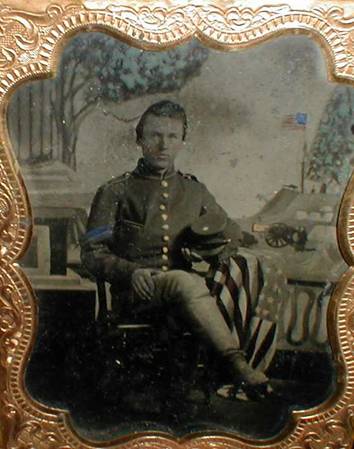
In Cressy Corners cemetery there is a monument
to an insane man. It's almost seven feet tall and is still imposing in spite of
its list. It commands a view of the rolling hills, meadows, and cornfields of
Slawson's final days were briefly
described by the weekly newspaper published in the county seat of Hastings, the
Ira Slawson, of Johnstown, formerly of
Prairieville,
having shown violent symptoms of
insanity, was brought to
this city Tuesday, and placed in jail
until quarters can be
secured for him at the asylum.
Two weeks later, the Banner (
Ira Slawson, the insane man who was being held
in
jail until room could be found in the
asylum, died of a
congestive chill about
It seems ungenerous that nothing is said about his service with the Army
of the
Ira Miles Slawson was born in Potter, Yates
County, New York, on
On August 26 of 1864 he signed up again as a substitute for Mortimer J.
Hoyt, this time with the 71st
On
On
Slowly, Naomi Slawson's search began to pay off
as word spread among "the boys" that the widow of Ira Slawson needed help. From
. . . Our guns were twelve-pounder brass guns
and
the officers always told us not to stand
solid on the ground
when firing, but to stand on our toes and
it would not affect
us so bad. At the
that held the sponge staff at the mouth
of the cannon and I
don't think he had time to think how he
should stand for the
rebels was on one side of the road and we
on the other. I
was driving a wheel team at the time and
the two drivers
ahead of me had run off and left me
alone. When the
hardest of the firing was over I called
to Lieut. Stewart to
send some one to take the lead team. Just
then Slawson
came close to me. He had a cloth tied
over his head. I
asked him if he was wounded. He said no
but there was
something in his ears that kept ringing
and hurt his head.
We had to talk very loud to make him hear. After the battle
was over we camped on the field two or
three weeks and
sometimes he would act in a strange way,
as if he did not
know any person, and he complained about
his head
hurting him.
Foster added in a follow up letter:
. . . Slawson was at the front of the cannon as
sponger. There was two
our battery, and it was one continual
firing of our guns till
they were driven back and this was the
end of the battle.
While the firing was the hottest I left my team to help carry
ammunition. As soon as we had refurbished
them I went to
my team but found both of the other
drivers was gone. I
thought they was killed or wounded. I
called to Lieut.
Stewart and told him. Just then Slawson came
close to us
with a cloth or handkerchief tied over
his head, and on one
side of it was all bloody. I don't
remember which side it
was. Stewart told him to get on one of
the teams but he
could not hear and had to make signs to
him. Whether it
was his ears or the cloth why he could
not hear I could not
tell. But I have seen some of our men
bleed at the nose and
be deaf for a number of days after a hard
battle, and . . . you
know that them twelve pound brass guns is
the worst kind
to be close to when firing. As soon as
Lee crossed the river
back to
and I think we stayed there about three
weeks, I remember.
The reports show that on the morning of
James Stewart, the Scottish second lieutenant who had first joined
Battery B in 1851 as a private, submitted the following account in his battle
report:
I was ordered by General Gibbon to bring my
section forward and place it in position,
about 75 yards
distant from and to the left of the
turnpike, for the purpose
of shelling the woods, distant from 800
to 900 yards,
directly in my front.
After shelling for some time, General Gibbon
ordered the section to be still farther
advanced to a position
in front of some straw-stacks, about 30
yards to the right of
the turnpike. As soon as I came into
battery in this
position, I observed large bodies of the
enemy from 400 to
500 yards distant, and ordered the guns to be loaded with
spherical case, 1 1/4 and 1 1/2 seconds,
because the ground
was undulating, and not suitable for
canister. After firing
two or three rounds from each gun, the
enemy partially
broke, ran across a hollow in front of
the section, crossed to
the left of the turnpike, entered a
corn-field, and under
cover of the fences and corn, crept close
to our guns,
picking off our cannoneers
so rapidly that in less than ten
minutes there were 14 men killed and
wounded in the
section.
About this time Captain Campbell, commanding the
battery, brought the other four guns into
battery on the left
of my section, and commenced firing
canister at the enemy
in the corn-field, on the left of the
turnpike. In less than
twenty minutes Captain Campbell was
severely wounded in
the shoulder, his horse shot in several
places, and the
command of the battery devolved upon me.
General Gibbon was in the battery, and, seeing the
advantage which the enemy had, ordered
one of the guns
which was placed on the turnpike to be
used against the
enemy's infantry in the corn-field,
General Gibbon acting
both as cannoneer
and gunner at this piece. The fire was
continued by the entire battery for about
ten minutes longer
in this position, the enemy part of the
time being but 15 or
20 yards distant. The loss of the entire
company whilst in
this position was 1 captain wounded, 2
sergeants, 4
corporals, 32 privates killed and
wounded, and 26 horses
killed and 7 wounded. While in this
position the battery
was supported by General Gibbon's brigade
and a part of
the Twentieth
As a result of their performance at the
The
On
. . . I knew Ike Slawson as "Mustache
Ike". He
bunked and tented with me. The
what was called the "Old Iron
Brigade." Our Guns were 12
Pound Howitzers. We always were told to
never stand
solid on the ground. At the
was so severe that said Ira M. Slawson after the
often complained to the boys about his
head hurting him
and severe pain also. Said Slawson was a faithful and
efficient soldier and rendered valuable
and good service.
Affiant is informed that said Slawson died of an affection
of the head, and it is not at all
improbable that it was due to
the injury of his head caused by the
excessive firing at said
In his follow up letter he added:
. . . I remember him well tenting and messing with
me before and after
said it came from the heavy firing at
will hunt up the soldiers of 20th
will find among them plenty that remember
a man with the
spring staff at the muzzle of the guns
with his head tied up,
beckoning the regiment to come on. Only
last year I met a
soldier in
that asked me the name of that soldier
that had his head
tied up with a white cloth and called and
beckoned the 20th
N. Y. to come on at your risk.
(signed) John Cook
On
It's hard to say what inspires children to devote themselves to service.
But it is reasonable to assume that the eldest daughter of Ira and Naomi, Mary
Maud Slawson, witnessed the suffering of her father
as he carried on with his life and decided to help relieve the sufferings of
others. Born on the 8th anniversary of the
In the same year Naomi was awarded the widow's pension, 1890, Augustus Buell published the history of
When the
Later in 1890 Naomi Slawson is mentioned in The
As the Battle of Antietam saw the birth of the
Red Cross and began the end for Ira Slawson, perhaps
the death of Slawson and the pursuit of the widow's
pension lead to the first meeting of Mary and the young man who was to become
her husband. For the man she married was the notary public who attested to the
testimonies on several of the affidavits contained in the pension file of Ira Slawson: Jason E. Tobias, my great grandfather.
It is over 110 years since those last weeks in October when Ira Slawson lost his battle to keep his sanity. After the war
he endured the spells of the ringing and rattling in his head. His neighbors
would note that sometimes he would seem affected and "not right in the
head," although he tried to hide it from them. Physicians who have
reviewed the data suggest that he suffered internal bleeding in his head from
the concussion, and over the years the pressure built up and finally caused his
violent behavior. It is mentioned in the application for the insane asylum that
one of his pupils was dilated and the other was not--a symptom of concussion.
At the end, Ira was praying constantly and attacking anyone who approached him.
Perhaps he saw himself as Cyrano de Bergerac, fighting off death and all his
old enemies whom he had eluded for so long. After a week and a half of
struggling against his restraints, the God he never abandoned took His soldier
home.
Today the sun shines on the leaning monument, and the wind makes it
harder to read as it slowly erodes the surface. To the north the corn waves in
the breeze on the land Ira Slawson used to farm. The
loudest sound heard is an occasional thunderstorm. Nearby lie other veterans
and comrades from the Civil War, and there are also men who served in other
times and other places. The monument stands quietly in its simplicity,
revealing little but suggesting much of the valuable and good service rendered
by the one who lies beneath it. Between the stones, placed there by people who
honor him without knowing him, stands an American flag. Through the long dark
nights and the cycle of years, it has stood by one who stood by her.