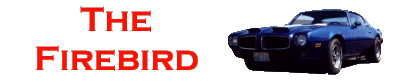
Second Generation
1970 Firebird
It was a new realm for the Firebird in 1970. Actually, it was a 1970-1/2 situation, because of the late arrival of this completely restyled version. Pontiac called the models "1970+" versions that year.
Just about everything was new: the sheet metal, the engines, and, maybe most significanfly, Pontiac's more worldly perception of the model. The new outlook was manifested in the names of the two top Firebirds, the Esprit and the For-mula 400. The competition for these machines would be broadened beyond just the Mustang to include the worldwide market.
The PMD designers did their job well, producing a European design incorporating a perfectly integrated Endura (a plastic material) grille and a sleek, fastback body style. And, for the first time, there would be single headlights.
Change in 1970 went far beyond a new skin, however. There were considerable upgrades to the suspension system, brakes, and steering. There were also beefy stabilizer bars fitted to the Formula 400.
Again, there was sheet metal identical to Camaro's, which also brought the new design into its line. The outerskin similarity between the two models would continue until 1981.
The 1970 Firebird looked smaller than its earlier incarnation, even though it was actually just over 1in longer and a 1/2in narrower than the 1969 model. The wheelbase was identical, but both the front and rear wheels had been moved forward 3.5in.
Even with the new look, sales for this year's model were horrible - only about half of 1969's total. Had Pontiac made a mistake with the new design, or was it just a reflection of the lagging pony car market? The new Firebird sales effort only attracted 45,543 buyers (not including Trans Ams).
The base Firebird used a 250ci Chevy engine, replacing the previous Pontiac powerplant. Although the displacement number were identical with the PMD mill, the performance was down considerably, dropping from 175 to 155hp. This decline was due in part to a lower compression ratio (8.5:1).
But there was hope for the base Firebird, because for the first time it was possible to specify a V-8. Even though the bottom 350ci mill had a woefully low 8.8:1 compression ratio and a two-banel carb, it was still capable of 255hp. That was the same horsepower figure the 1969 L-30 350 had generated, even though that engine had the advantage of a 9.2:1 compression ratio. This 1970 350 version was denoted by "350" numbers in red on the front fenders.
The Sprint was gone, replaced by the Esprit. Suavity and style, not performance, were this machine's selling points. The Esprit was plush inside, with a new ventilation system, sport steering wheel, and custom knit vinyl seat coverings.
The same 350 that was optional for the base Firebird was the Esprit's standard engine. A floor shifter directed the 255 horses which had to push 3,4351b, a portly 2951b more than the base model. The Esprit sticker price was $3,241, a $366 increase above the entry level Firebird. Sales totals for the Esprit weren't bad for its first year, coming to 18,961. Those totals, however, were certainly a far cry from the earlier years. Things were changing in the muscle car market.
All three versions of the 400-powered 1969 Firebirds were replaced by the new 1970 Formula 400, with two versions of the 400 mill available. The engines were identical to the base 400 (330hp) and Ram Air III (335hp) of the previous year. A Ram Air IV version with the same performance as l969's was also available in 1970, but only as a special order. First year production for the flashy Formula was 7,708, of which 4,931 were automatics.
The Formula had the looks and equipment to go with the trendy name. There were both front and rear stabilizer bars, front disc brakes, and high-rate springs.
Externally, the Formula looked like a sleek road racer, with its sport-type wheels and rakish styling. The long, functional snorkel scoops swept the length of the fiberglass hood and terminated just short of the Endura grille piece. Sport mirrors and concealed wipers helped maintain an aerodynamic appearance. The interior was attractive as well, carrying front and rear bucket seats and carpeting.
The car magazines reported favorably on the new designs, both from appearance and performance points of view. Hot Rod magazine tested a 330hp version of the Formula and ran it through the quarter in l5sec flat at 93mph.
|Home|
|The Firebird Intro|
|First Generation|
|Third Generation|
|Fourth Generation|
|Contact Us|
Ron Brown & Associates
Email: mail@pontiac.cjb.net
(c) 1999-2000 Ron Brown & Associates