
1986
Trans Sport Van
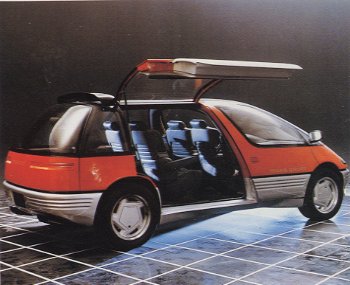
While all car companies were designing scores of experimental cars, no one thought of applying space-age technology to the ordinary van. In 1986 Pontiac became the first U.S. car company to show us a look at what the mini-van of the future might look like. It called the new concept the Trans Sport Mini-Van. The side windows wrapped into the roof, and the windshield extended well back over the driver in a helicopter-like bubble form. The look was adapted in the 1989 Pontiac Transport, Olds Silhouette, and Chevrolet Lumina, but these do not
possess the prototype’s more futuristic elements. The abundance of glass allowed the vehicle to sport a light emitting diode on the windshield, which projected speed and other driver information-known as a "heads-up" display. The Trans Sport Van had a gull-wing door on the right side, and door handles were recessed. Other features included a personal computer recessed into the passenger side of the instrument panel which incorporated a pop-up screen and keyboard access features such as weather reports, accident reports and detours, navigational directions, calculator functions, and the
abilily to schedule air travel and make hotel reservations. A windshield-mounted overhead console with a scanning screen replaced the conventional rear-view mirror. A television-like display featuring a digital readout measured the distance of approaching traffic. Middle and rear-seat passengers could even view a small television mounted in an overhead console centered behind the driver and front passenger seats.
|Home|
|List Concepts By Year|
|Contact Us|
Ron Brown & Associates
Email: mail@pontiac.cjb.net
(c) 1999-2000 Ron Brown & Associates