
1987
Pursuit
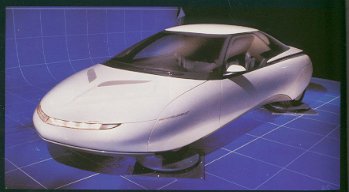
Probably the most outstanding innovation on this car which resembled a space ship from "Star Trek" — was four-wheel steering, a new engineering feat. The rear wheels turned, 1ust ike the front ones. If you look at a picture of this car, you will notice that the rear wheels have a "skirt" or cover over them (as did many cars in the past), and you may wonder how the wheels turn. In actuality the "skirt" moved outward as the rear wheel turned. The entire top half of the car was all glass, with a removable roof panel.
The steering wheel was a twin-grip pod with most push-button controls built right into it. Through a switch on the steering pod, the car could be raised or lowered while driving. It inflated the shocks at lower speeds to avoid bump surfaces and lowered them for improved aerodynamics and fuel economy on smooth high-speed roads. The driver didn’t have to glance down at the instrument panel to check speedometer or other warning signals. There was a "head-on" display-or holographic image—on the windshield of all the instruments.
When entering and exiting the Pursuit, an "exit" button moved the seat rearward and tilted the interface unit upward simultaneously. While the door was open, it exposed a plafform on the seat which assisted the occupants into and out of the car. For entering and exiting the rear seats, the front passengers’ seat back pivoted toward the console so the occupant could step over the front seat cushion instead of around it. The rear seat featured an integrated child seat which folded out of the rear seat back. On the back of the front seats’ headrests, directly
in front of the rear passengers, were two portable mini color television sets with headphones for rear passenger entertainment.
|Home|
|List Concepts By Year|
|Contact Us|
Ron Brown & Associates
Email: mail@pontiac.cjb.net
(c) 1999-2000 Ron Brown & Associates