

 |
 |
 |
 |
|
|


 |
Beethoven studied with this guy named Neefe during
his court apprentice years. And Neefe was a good guy, 'cuz he recognized
the talent in his young apprentice, and often used Beethoven to
assist him, thus building the self-confidence of Ludwig. (Neefe
even wrote an article to Cramers Magaz der Musik, this musical
publication, ABOUT Beethoven, talking about how the boy plays the
piano skillfully and "powerfully." Beethoven also obviously
sight-read very well, because Neefe mentioned that as well) When
Ludwig is fourteen in 1784, he was hired as a court musician, and
received pay. He brought it home, and his dad took it to buy wine.
There is a theory that goes something along the lines that Beethoven
did not like neither of his parents -- his father for obvious reasons,
and his mother for never standing up against the tyrant of the house.
This theory will remain only a theory, though, unless we can travel
back in time and speak to the maestro ourselves.
|
|
His father's voice started deteriorating around this time (No kidding, the old man was drinking most of his life away, and alcohol definitely isn't the best thing for our tender vocal chords. Just listen to what happened to Louis Armstrong!) and Beethoven soon had to find an additional source of income to sustain his family. Therefore, through a connection of a friend, Beethoven started giving piano lessons to the daughters (*Hintwinknudge*) of this royal family named von Breuning. Now, this was a pleasant experience for the boy. Okay okay, so Beethoven got something out of the deal BESIDES the two daughters. *Grin* At von Breuning's place, the young Beethoven learned some very basic social etiquette that his father never was able to demonstrate for him. And I believe that this is part of the reason why Beethoven was well-liked by the royalty -- his genius was not completely smothered by bad taste in clothing and a general sloppiness. He also picked up some literary knowledge from the family, as the parents are trying to get some education into the rich skull-caps of their children. This is the first time Beethoven is introduced to Goethe, a very famous poet, and later in his life there was an unpleasant event between the two. I'll get there when I get there. Those of you frowning at how mellow Beethoven seems to become, don't worry. He's still the haughty, arrogant, isolated soul he is; it's just that that Helene von Breuning (the rich widow) always accepted that as part of his genius. *Sigh* If only more of the royalty would understand Beethoven. Well, anyway, Beethoven traveled to Vienna spring of 1787. It is there the famous story of his encounter with Mozart took place. Mozart had a bunch of students too, and Beethoven went in to play for the genius. (Who had that annoying laugh in the movie Amadeus) First, Beethoven played a prepared repertoire for Wolfie. (WOLFgang Amadeus Mozart) Of course, Luddy played it oh so excellently, but Mozart isn't some easily-impressioned fool either, and merely praised the young musician politely, saying that it's very well-rehearsed. WELL. . . is the talented Beethoven, heart fiery with pride, going to take this non-enthusiastic, dry, cold, useless comment? Never! So Beethoven asked Mozart for a theme to improvise upon. Of course, Wolfie was a little stunned at how bold this nameless pianist is, but agreed and gave Beethoven a theme -- upon which Ludwig improvised so well, that Mozart stood from his seat, opened the door and showed the young man to all of his friends, and praised him (and I paraphrase, slightly exaggeratedly): "Look at this young boy, my friends, and remember him. One day, he music shall fill the world!" |
|
|
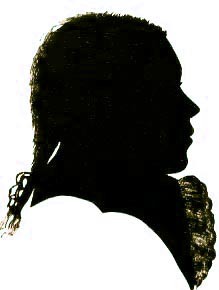
This is a silhouette of Beethoven when he was sixteen. He still looked pretty well-groomed. . . |
|
|
|
|
|
But Beethoven couldn't study with Mozart, no, fate manipulates the young man like a puppeteer laughing at his dominance over the toys. Shortly after the lesson with Mozart, Ludwig received a letter from home telling him his mother is ill. So he rushed back to Bonn, where he witnessed the final suffering of his mother from tuberculosis. She died in July of 1787. *Dramatic silence* There's a letter that Beethoven wrote in October, to his friend Councillor von Schaden in Ausburg: "I must confess to you that from the time I left Augsburg, my joy and with it my health began to vanish. . . . I found my mother still alive, but in such a very deplorable state of health. She had consumption and passed away seven weeks ago after much pain and suffering. She was to me such a good, loving mother, and my best friend. Ah, who was happier than I, when I could still utter the sweet name mother and it was heard? And to whom can I say it now? To the images of her only, which my imagination calls up..." |
|
 |
 |