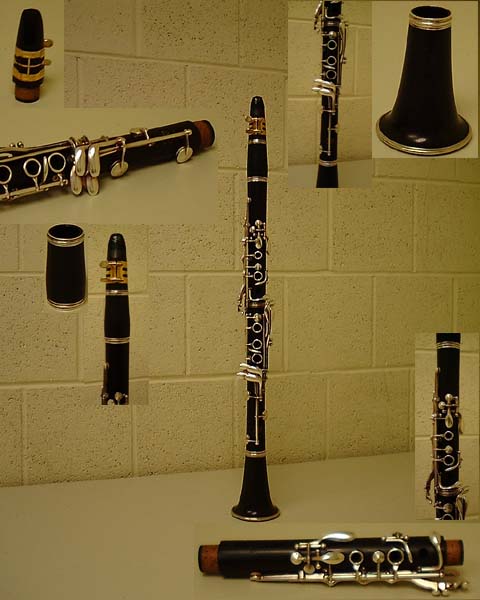
Fine, so maybe these aren't dark secrets of Clare. So they're just mundane facts about a beauty that only diehard, hardcore, thoroughly insane fans such as myself would care to collect and compile and put on a webpage in assumption that anyone else would be remotely interested. But, I guess, in the same attitude as those celebrity-maniacs who would give up twelve bags of doritos to know the exact chest size of Britney Spears, *Shudders at the thought of silicon* I too find mundane information such as this fascinating.
Well, here it is. . .
A Biology of CLARE
Clare is a Buffet RC clarinet. Most American clarinetists use the R-13, which is commonly accepted to have a darker sound. It is also tuned lower, because the Americans use 440 hertz as their concert A, while Taiwan uses 442. There are parts of Europe that go up as high as 446! Anyway, the RC is a 'European model' clarinet, which means it is naturally tuned higher. As a result, tuning is a pain in the @#$@# for me right now. But I love Clare, and don't mind having to work a little. *Grin*
'RC' is the initials of the guy who designed the clarinet. Robert something. . . I think he was French, which means I have to put the accent on the second syllable (!?) to create a more Frency accent, but I digress. In fact, he designed the R-13 first, but made a few modifications and called it the RC. Many many years pass, and in 1997, Clare's soul is embodied on F438744. No, I'm not swearing again, that's just her serial number. Clare is considered a very very young clarinet. Unlike string instruments whose value increases with age, clarinets' values decrease. (Unless they're REALLY old and can be considered antiques) It is rumored that clarinets 'blow out' after about a decade -- which means the wood fibers have somehow been realigned from so much playing, and it starts sounding bad. I shudder at the thought of Clare's soul having to be on another instrument, but a decade is still a ways away, and I need not worry yet.
Mouthpiece and Ligature
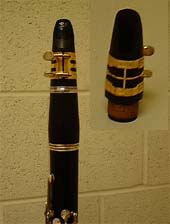
Ligature: Bay gold, without the weird sandpaper stuff that's supposed to absorb brightness
Mouthpiece: Pyne mB (or however you're supposed to write it), subject to change
After coming to Northwestern, my equipment has undergone some changes. . . It seems that everyone here uses a Pyne or a Hawkins mouthpiece, and I have no choice but to conform. (Fine, so it sounds better too) The Pyne mouthpiece are a special breed. According to my professor here, you either love it or hate it. Well. . . I don't love it nor hate it! I picked this one (the little mB sign is James Pyne's personal way of notating how they sound and stuff) out of a box of 12. I think it sounds better than my old mouthpiece, a Vandoren B40 Profile 88, but my prof says it's still a "weird" mouthpiece, to quote her exact words. Oh well. We'll see what happens with this. I've also switched to thicker pads. For one, my razor-sharp buck front teeth no longer bury their presence into the mouthpiece, and it also "opens up the oral cavity," to quote my prof's words once again.
The mouthpiece has some rather seductive curves on it. The way the top bends over to meet each other. The hole on the mouthpiece where the reeds covers is not visible in these pics, but that is more. . . rigid and square.
Barrel
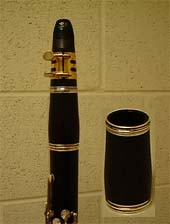
RC B 650, original from purchase, subject to change
Ah, the barrel. . . it has VERY seductive curves. This pic is too pixelated to show that, but running your finger down the side of the barrel induces a content, enchanting feeling. Mmmm. . . .
Well, onto more serious stuff. A lot of people here have very fancy barrels, like Mennig, Chadash, or Scott. Those fancy names are the maker of the barrel, by the way. I didn't realize how much the barrel can alter the sound! The other day I tried out some Mennig and Chadash barrels, and found that the Mennig sounds quite decent! I'm still in a stage of transition, however, with the new emboussure, so we decided not to risk that one hundred dollars.
Ah, so you've noticed the weird number I put down. 650 means 65.0 millimeters, which is the length of the barrel. RC means RC, and B I'm not so sure yet. *Hmm*
Upper Joint
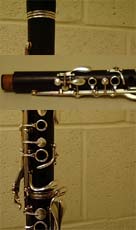
Hmm. . . I just discovered that none of the two pics show the register key, which is outrageously important. You see, the clarinet, like almost all wind instruments, can 'overblow,' which means the sound resonates at the next harmonic up, resulting in a higher pitch despite the same fingering. Unlike the saxophone's cylindrical bore, however, the clarinet has a conical bore, and it overblows at a 12th instead of an octave. So if I finger a low C, it will overblow to a G. The register key helps the overblowing from the chalameau (the lowest register, so-named because forefather of the clarinet back in 1600s or something is called a chalameau. It cannot overblow, and only has, like, one octave range or something. Very sad) to the clarion (the second octave register). From the chalameau to the clarion, all the notes are quite stable. But when you go over to altissimo (which is everything above the concert Bb one leger line above the staff) you can use funky fingerings and stuff because the same fingering no longer produces pitches in the tempered scale. You would open up the left index finger, and that would act as a 'second register key' of some sort, allowing the next series of notes to be overblown.
Understand, however, that you can really play all the notes without the register key. It just takes bizarre emboussure to accomplish, that's all.
Lower Joint
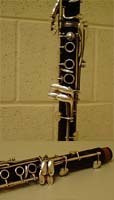
The low notes of the clarinet are beautiful. They're hard to play crystally clear, but they're beautiful when they do. One thing I love most about clarinets is the dynamic range. Unlike the flimsy oboe and flute, or the clumsy tuba, the clarinet has, probably, the widest range of expression! One might argue that the flute can go higher, but a flute can only be high. . . its low notes are just sad, dying coughs while the clarinet can still be strong all the way below the staff! Perhaps the most beautiful low notes are written in the second movement of Horowitz's Sonatina. . .
You might have noticed the two sets of keys on the bottom and on the right (in the upper pic). They really push down the same pads. These alternate fingers are quite essential in playing pieces, as it's very difficult to slide from key to key with your pinky.
Bell
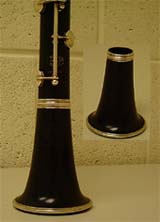
Forgive me while I pant and howl with ecstasy.
*Huff puff huff puff* AROOOOOOOOOO!!
Sorry. But I think the bell is by far the most erotic part of the clarinet. Mmm. . . look at the curve as the grenidella spreads and reaches out to the world. When you slowly run your finger down the bell, it's always a magical moment as it slides across the perfect parabola (or hyperbola). Oooh that curve gets me every time. Contrary to the visual treat, however, very few notes are affected by the bell. Only the lowest couple of pitches on the chalameau and clarion register will be affected in tuning and tone. But hey, the bell is beautiful, so we're gonna leave it there.
Oh yeah, let me mention this too: You see those rings that line the bottom of the bell? Well, they actually come loose! The metal rings around each joint and the bell are placed there to protect the thinnest part of the wood so it doesn't snap when Clare contracts and expands from the weather. The lower ring was loose when I came to Illinois because of the disgusting dryness. The wood shrinks, and the metal ring becomes so loose that you can turn it around. . . it's rather scary, in fact, because if the clarinet contracts and expands too dramatically, it might. . . *Gasp*. . . crack!
Do you have suggestions about what you want on this page? Please e-mail me and let me know.
