At the risk of sounding redundant, the ACR is Dodge's extreme street Viper. The seats wear five-point racing harnesses as part of the $10,000 American Club Racing track package. The moniker doesn't refer to any series; it's just a cute label that fits Chrysler's three-letter option code for the equipment group. Ticking the ACR option box deletes the A/C and the radio, but Chrysler added those for $910, plus a $2500 pair of painted stripes, back into this test Viper. Adding luxury tax, they elevate the bottom line to a lofty $88,814. Vipers will have anti-lock brakes for 2001, but no examples were available to take into the desert.
We have encamped just miles from the front gate of Glen W. Edwards Air Force Base, the old haunt of Chuck Yeager, perhaps the best known of the '50s jet test pilots and a central figure in Tom Wolfe's The Right Stuff. The location is convenient to both the 2.5 miles of undulating asphalt at Willow Springs International Motorsports Park, the twisty public roads above Tehachapi, and the endless straightaways of the deep Mojave. We're pretty keyed up, but the periodic ka-booms, shrieks, and whooshes coming from the eastern horizon are a reminder that we don't have the fastest machines in the desert today. Not even close.THIRD PLACE
Ford SVT Mustang Cobra R
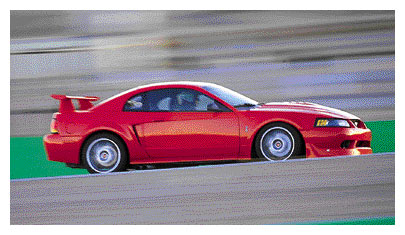
The Occupational Safety & Health Administration says hearing damage occurs at noise levels of 85 or higher decibels. We have no reason to question that wisdom after a few days spent enduring a cochlea-twisting 94 decibels in the cockpit of our SVT Mustang Cobra R at full rant.
The aural blitzkrieg blasting from the sculpted intake runners and four Borla side pipes of the 5.4-liter DOHC V-8 invades the cockpit almost entirely without opposition from sound-deadening material. Enriched with Carillo rods, a Canton Racing Products oil pan, larger valves, and a K & N air filter, the Triton V-8 generates a very angry 385 horsepower and 385 pound-feet of torque. Imagine taking Parnelli Jones's 1970 Trans-Am championship Mustang for a jaunt to the dry cleaner, and you have the picture. After a half-hour on the track, the world becomes a silent movie.Unfortunately, the Cobra R is less popular with our test equipment than it is with the decibel meter. It matches the lighter Corvette in straight-line acceleration to 60 mph and the quarter-mile, propelled by a honking upper range, courtesy of its overhead camshafts. But it is soundly trounced to 100 and 150 as the R's various dams and airfoils sink their teeth into the wind. The Corvette got to the 150 barrier 2.1 seconds quicker, and the Viper was 5.7 seconds fleeter. Worst of all, clean launches were impossible because of rampant wheel hop, the independent axles exciting themselves to a frenzy when stimulated by peak torque.
This serpent also failed to beguile drivers at the track. Ponderously slow and overboosted steering conspires with lazy turn-in to betray the basic stability afforded by the wide stance, Bilstein shocks, Eibach springs, and four slabs of custom-made BFGoodrich g-Force rubber. The Cobra returned the highest lateral acceleration on the skidpad (0.99 g) but the lowest lap time (1:38.7 at 92.1 mph vs. the Corvette's 1:36.3 at 95.4 mph and the Viper's 1:34.9 at 96.7 mph). It requires manhandling in turns and simply doesn't feel fluid despite consistently good performance from the brake calipers, which are Brembo in front and stock SVT Cobra with Akebono pads in the rear. Perhaps too many production parts remain from a chassis tracing its lineage to a 1979 Fairmont.