Ancient Nebraska
Rocks, Bones, and Clues
A huge sea
covered our Nebraska land millions of years ago. The fossil clues
left in a deep limestone layer tell scientists much about the kind of creatures
who lived and then died leaving their skeletons deeply imbedded in stone.
Limestone is formed from the shells of millions of shelled creatures.
As time went
on, the land under the sea began to rise and the land was covered in swamps
in which forests and peat grew. The sky was misty and very rainy.
It was much warmer then. Scientists believe that Nebraska was closer
to the equator. The land masses moved slowly over time. The
plants of the time died and after millions of years were compressed and
became coal. Many parts of Nebraska have layers of coal.
The sea returned
maybe because glaciers were melting, but we know it came again. Another
layer of limestone is found closer to the surface of the soil. In
this layer has been found the fossils of strange large fish and many other
kinds of creatures. Then, the land began to emerge again.
This time
the land was drier. Great herds of three-toed horses, elephants,
rhinoceroses, huge land turtles, camels, and many other now extinct animals
left their imprints in the ash from a giant volcanic eruption. We
know that the land had tall grasses and great trees. The volcano,
which was in Idaho, erupted. It sent so much ash into the atmosphere
that the ash covered plants, filled in water holes, and killed nearly all
living things.
 As
time passed the climate cooled and glaciers moved over the land.
The glaciers ground rocks into fine powder and created blue clay that can
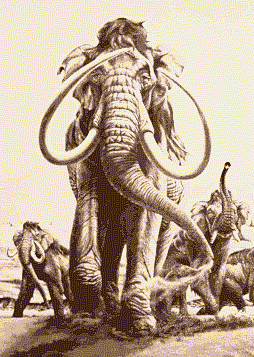
be found in many parts of our state. During these cold times, mastodons
and mammoths roamed our land. Their bone fossils have been found
in almost every part of Nebraska.
As
time passed the climate cooled and glaciers moved over the land.
The glaciers ground rocks into fine powder and created blue clay that can
be found in many parts of our state. During these cold times, mastodons
and mammoths roamed our land. Their bone fossils have been found
in almost every part of Nebraska.
The glaciers
slowly retreated and the land began to look very much as it does today.