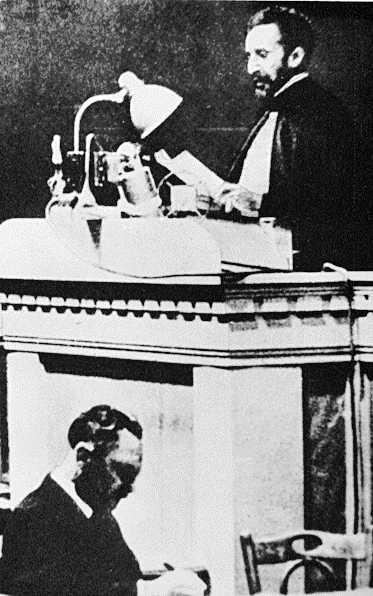
 APPEAL
TO THE LEAGUE OF NATIONS
APPEAL
TO THE LEAGUE OF NATIONS
I, Haile Selassie I, Emperor of Ethiopia, am here today to claim that justice
which is due to my people, and the assistance promised to it eight months ago,
when fifty nations asserted that aggression had been committed in violation
of international treaties.
There is no precedent for a Head of State himself speaking in this assembly.
But there is also no precedent for a people being victim of such injustice and
being at present threatened by abandonment to its aggressor. Also, there has
never before been an example of any Government proceeding to the systematic
extermination of a nation by barbarous means, in violation of the most solemn
promises made by the nations of the earth that there should not be used against
innocent human beings the terrible poison of harmful gases. It is to defend
a people struggling for its age-old independence that the head of the Ethiopian
Empire has come to Geneva to fulfil this supreme duty, after having himself
fought at the head of his armies. I pray to Almighty God that He may spare nations
the terrible sufferings that have just been inflicted on my people, and of which
the chiefs who accompany me here have been the horrified witnesses.
It is my duty to inform the Governments assembled in Geneva, responsible as
they are for the lives of millions of men, women and children, of the deadly
peril which threatens them, by describing to them the fate which has been suffered
by Ethiopia.
It is not only upon warriors that the Italian Government has made war. It has
above all attacked populations far removed from hostilities, in order to terrorize
and exterminate them.
At the beginning, towards the end of 1935, Italian aircraft hurled upon my armies
bombs of tear-gas. Their effects were but slight. The soldiers learned to scatter,
waiting until the wind had rapidly dispersed the poisonous gases. The Italian
aircraft then resorted to mustard gas. Barrels of liquid were hurled upon armed
groups. But this means also was not effective; the liquid affected only a few
soldiers, and barrels upon the ground were themselves a warning to troops and
to the population of the danger.
It was at the time when the operations for the encircling of Makalle were taking
place that the Italian command, fearing a rout, followed the procedure which
it is now my duty to denounce to the world. Special sprayers were installed
on board aircraft so that they could vaporize, over vast areas of territory,
a fine, death-dealing rain. Groups of nine, fifteen, eighteen aircraft followed
one another so that the fog issuing from them formed a continuous sheet. It
was thus that, as from the end of January, 1936, soldiers, women, children,
cattle, rivers, lakes and pastures were drenched continually with this deadly
rain. In order to kill off systematically all living creatures, in order to
more surely to poison waters and pastures, the Italian command made its aircraft
pass over and over again. That was its chief method of warfare.
Ravage and Terror
The very refinement of barbarism consisted in carrying ravage and terror into
the most densely populated parts of the territory, the points farthest removed
from the scene of hostilities. The object was to scatter fear and death over
a great part of the Ethiopian territory.
These fearful tactics succeeded. Men and animals succumbed. The deadly rain
that fell from the aircraft made all those whom it touched fly shrieking with
pain. All those who drank the poisoned water or ate the infected food also succumbed
in dreadful suffering. In tens of thousands, the victims of the Italian mustard
gas fell. It is in order to denounce to the civilized world the tortures inflicted
upon the Ethiopian people that I resolved to come to Geneva. None other than
myself and my brave companions in arms could bring the League of Nations the
undeniable proof. The appeals of my delegates addressed to the League of Nations
had remained without any answer; my delegates had not been witnesses. That is
why I decided to come myself to bear witness against the crime perpetrated against
my people and give Europe a warning of the doom that awaits it, if it should
bow before the accomplished fact.
Is it necessary to remind the Assembly of the various stages of the Ethiopian
drama? For 20 years past, either as Heir Apparent, Regent of the Empire, or
as Emperor, I have never ceased to use all my efforts to bring my country the
benefits of civilization, and in particular to establish relations of good neighbourliness
with adjacent powers. In particular I succeeded in concluding with Italy the
Treaty of Friendship of 1928, which absolutely prohibited the resort, under
any pretext whatsoever, to force of arms, substituting for force and pressure
the conciliation and arbitration on which civilized nations have based international
order.
Country More United
In its report of October 5th 193S, the Committee of Thirteen recognized my effort
and the results that I had achieved. The Governments thought that the entry
of Ethiopia into the League, whilst giving that country a new guarantee for
the maintenance of her territorial integrity and independence, would help her
to reach a higher level of civilization. It does not seem that in Ethiopia today
there is more disorder and insecurity than in 1923. On the contrary, the country
is more united and the central power is better obeyed.
I should have procured still greater results for my people if obstacles of every
kind had not been put in the way by the Italian Government, the Government which
stirred up revolt and armed the rebels. Indeed the Rome Government, as it has
today openly proclaimed, has never ceased to prepare for the conquest of Ethiopia.
The Treaties of Friendship it signed with me were not sincere; their only object
was to hide its real intention from me. The Italian Goverment asserts that for
14 years it has been preparing for its present conquest. It therefore recognizes
today that when it supported the admission of Ethiopia to the League of Nations
in 1923, when it concluded the Treaty of Friendship in 1928, when it signed
the Pact of Paris outlawing war, it was deceiving the whole world. The Ethiopian
Government was, in these solemn treaties, given additional guarantees of security
which would enable it to achieve further progress along the specific path of
reform on which it had set its feet, and to which it was devoting all its strength
and all its heart.
Wal-Wal Pretext
The Wal-Wal incident, in December, 1934, came as a thunderbolt to me. The Italian
provocation was obvious and I did not hesitate to appeal to the League of Nations.
I invoked the provisions of the treaty of 1928, the principles of the Covenant;
I urged the procedure of conciliation and arbitration. Unhappily for Ethiopia
this was the time when a certain Government considered that the European situation
made it imperative at all costs to obtain the friendship of Italy. The price
paid was the abandonment of Ethiopian independence to the greed of the Italian
Government. This secret agreement, contrary to the obligations of the Covenant,
has exerted a great influence over the course of events. Ethiopia and the whole
world have suffered and are still suffering today its disastrous consequences.
This first violation of the Covenant was followed by many others. Feeling itself
encouraged in its policy against Ethiopia, the Rome Government feverishly made
war preparations, thinking that the concerted pressure which was beginning to
be exerted on the Ethiopian Government, might perhaps not overcome the resistance
of my people to Italian domination. The time had to come, thus all sorts of
difficulties were placed in the way with a view to breaking up the procedure;
of conciliation and arbitration. All kinds of obstacles were placed in the way
of that procedure. Governments tried to prevent the Ethiopian Government from
finding arbitrators amongst their nationals: when once the arbitral tribunal
a was set up pressure was exercised so that an award favourable to Italy should
be given.
All this was in vain: the arbitrators, two of whom were Italian officials, were
forced to recognize unanimously that in the Wal-Wal incident, as in the subsequent
incidents, no international responsibility was to be attributed to Ethiopia.
Peace Efforts
Following on this award. the Ethiopian Government sincerely thought that an
era of friendly relations might be opened with Italy. I loyally offered my hand
to the Roman Government.
The Assembly was informed by the report of the Committee of Thirteen, dated
October 5th, 1935, of the details of the events which occurred after the month
of December, 1934, and up to October 3rd, 1935.
It will be sufficient if I quote a few of the conclusions of that report Nos.
24, 25 and 26 "The Italian memorandum (containing the complaints made by
Italy) was laid on the Council table on September 4th, 1935, whereas Ethiopia's
first appeal to the Council had been made on December 14th, 1934. In the interval
between these two dates, the Italian Government opposed the consideration of
the question by the Council on the ground that the only appropriate procedure
was that provided for in the Italo-Ethiopian Treaty of 1928. Throughout the
whole of that period, moreover, the despatch of Italian troops to East Africa
was proceeding. These shipments of troops were represented to the Council by
the Italian Government as necessary for the defense of its colonies menaced
by Ethiopia's preparations. Ethiopia, on the contrary, drew attention to the
official pronouncements made in Italy which, in its opinion, left no doubt "as
to the hostile intentions of the Italian Government." From the outset of
the dispute, the Ethiopian Government has sought a settlement by peaceful means.
It has appealed to the procedures of the Covenant. The Italian Government desiring
to keep strictly to the procedures of the Italo-Ethiopian Treaty of 1928, the
Ethiopian Government assented. It invariably stated that it would faithfully
carry out the arbitral award even if the decision went against it. It agreed
that the question of the ownership of Wal-Wal should not be dealt with by the
arbitrators, because the Italian Government would not agree to such a course.
It asked the Council to despatch neutral observers and offered to lend itself
to any enquiries upon which the Council might decide.
Once the Wal-Wal dispute had been settled by arbiration, however, the Italian
Govemmcnt submitted its detailed memorandum to the Council in support of its
claim to liberty of action. It asserted that a case like that of Ethiopia cannot
be settled by the means provided by the Covenant.
It stated that, "since this question affects vital interest and is of primary
importance to Italian security and civilization" it "would be failing
in its most elementary duty, did it not cease once and for all to place any
confidence in Ethiopia, reserving full liberty to adopt any measures that may
become necessary to ensure the safety of its colonies and to safeguard its own
interests."
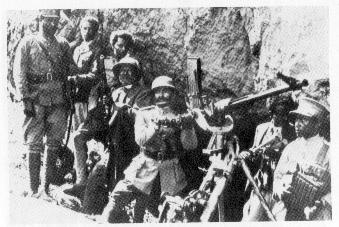
Covenant Violated
Those are the terms of the report of the Committee of Thirteen, The Council
and the Assembly unanimously adopted the conclusion that the Italian Government
had violated the Covenant and was in a state of aggression. I did not hesitate
to declare that I did not wish for war, that it was imposed upon me, and I should
struggle solely for the independence and integrity of my people, and that in
that struggle I was the defender of the cause of all small States exposed to
the greed of a powerful neighbour.
In October, 1935. the 52 nations who are listening to me today gave me an assurance
that the aggressor would not triumph, that the resources of the Covenant would
be employed in order to ensure the reign of right and the failure of violence.
I ask the fifty-two nations not to forget today the policy upon which they embarked
eight months ago, and on faith of which I directed the resistance of my people
against the aggressor whom they had denounced to the world. Despite the inferiority
of my weapons, the complete lack of aircraft, artillery, munitions, hospital
services, my confidence in the League was absolute. I thought it to be impossible
that fifty-two nations, including the most powerful in the world, should be
successfully opposed by a single aggressor. Counting on the faith due to treaties,
I had made no preparation for war, and that is the case with certain small countries
in Europe.
When the danger became more urgent, being aware of my responsibilities towards
my people, during the first six months of 1935 I tried to acquire armaments.
Many Governments proclaimed an embargo to prevent my doing so, whereas the Italian
Government through the Suez Canal, was given all facilities for transporting
without cessation and without protest, troops, arms, and munitions.
Forced to Mobilize
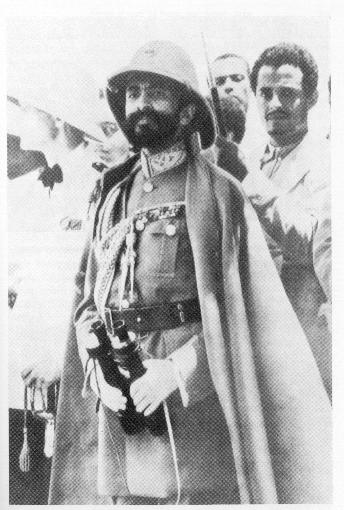
On October 3rd, 1935, the Italian troops invaded my territory. A few hours later
only I decreed general mobilization. In my desire to maintain peace I had, following
the example of a great country in Europe on the eve of the Great War, caused
my troops to withdraw thirty kilometres so as to remove any pretext of provocation.
War then took place in the atrocious conditions which I have laid before the
Assembly. In that unequal struggle between a Government commanding more than
forty-two million inhabitants, having at its disposal financial, industrial
and technical means which enabled it to create unlimited quantities of the most
death-dealing weapons, and, on the other hand, a small people of twelve million
inhabitants, without arms, without resources having on its side only the justice
of its own cause and the promise of the League of Nations. What real assistance
was given to Ethiopia by the fifty two nations who had declared the Rome Government
guilty of a breach of the Covenant and had undertaken to prevent the triumph
of the aggressor? Has each of the States Members, as it was its duty to do in
virtue of its signature appended to Article 15 of the Covenant, considered the
aggressor as having committed an act of war personally directed against itself?
I had placed all my hopes in the execution of these undertakings. My confidence
had been confirmed by the repeated declarations made in the Council to the effect
that aggression must not be rewarded, and that force would end by being compelled
to bow before right.
In December, 1935, the Council made it quite clear that its feelings were in
harmony with those of hundreds of millions of people who, in all parts of the
world, had protested against the proposal to dismember Ethiopia. It was constantly
repeated that there was not merely a conflict between the Italian Government
and the League of Nadons, and that is why I personally refused all proposals
to my personal advantage made to me by the Italian Government, if only I would
betray my people and the Covenant of the League of Nations. I was defending
the cause of all small peoples who are threatened with aggression.
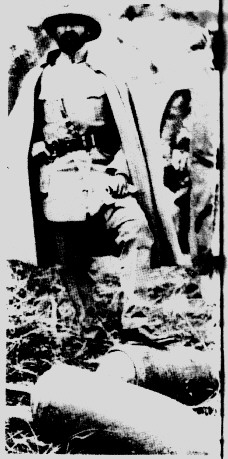
What of Promises?
What have become of the promises made to me as long ago as October, 1935? I
noted with grief, but without surprise that three Powers considered their undertakings
under the Covenant as absolutely of no value. Their connections with Italy impelled
them to refuse to take any measures whatsoever in order to stop Italian aggression.
On the contrary, it was a profound disappointment to me to learn the attitude
of a certain Government which, whilst ever protesting its scrupulous attachment
to the Covenant, has tirelessly used all its efforts to prevent its observance.
As soon as any measure which was likely to be rapidly effective was proposed,
various pretexts were devised in order to postpone even consideration of the
measure. Did the secret agreements of January, 1935, provide for this tireless
obstruction?
The Ethiopian Government never expected other Governments to shed their soldiers'
blood to defend the Covenant when their own immediately personal interests were
not at stake. Ethiopian warriors asked only for means to defend themselves.
On many occasions I have asked for financial assistance for the purchase of
arms That assistance has been constantly refused me. What, then, in practice,
is the meaning of Article 16 of the Covenant and of collective security?
The Ethiopian Government's use of the railway from Djibouti to Addis Ababa was
in practice a hazardous regards transport of arms intended for the Ethiopian
forces. At the present moment this is the chief, if not the only means of supply
of the Italian armies of occupation. The rules of neutrality should have prohibited
transports intended for Italian forces, but there is not even neutrality since
Article 16 lays upon every State Member of the League the duty not to remain
a neutral but to come to the aid not of the aggressor but of the victim of aggression.
Has the Covenant been respected? Is it today being respected?
Finally a statement has just been made in their Parliaments by the Governments
of certain Powers, amongst them the most influential members of the League of
Nations, that since the aggressor has succeeded in occupying a large part of
Ethiopian territory they propose not to continue the application of any economic
and financial measures that may have been decided upon against the Italian Government.
These are the circumstances in which at the request of the Argentine Government,
the Assembly of the League of Nations meets to consider the situation created
by Italian aggression.
I assert that the problem submitted to the Assembly today is a much wider one.
It is not merely a question of the settlement of Italian aggression.
League Threatened
It is collective security: it is the very existence of the League of Nations.
It is the confidence that each State is to place in international treaties.
It is the value of promises made to small States that their integrity and their
independence shall be respected and ensured. It is the principle of the equality
of States on the one hand, or otherwise the obligation laid upon smail Powers
to accept the bonds of vassalship. In a word, it is international morality that
is at stake. Have the signatures appended to a Treaty value only in so far as
the signatory Powers have a personal, direct and immediate interest involved?
No subtlety can change the problem or shift the grounds of the discussion. It
is in all sincerity that I submit these considerations to the Assembly. At a
time when my people are threatened with extermination, when the support of the
League may ward off the final blow, may I be allowed to speak with complete
frankness, without reticence, in all directness such as is demanded by the rule
of equality as between all States Members of the League?
Apart from the Kingdom of the Lord there is not on this earth any nation that
is superior to any other. Should it happen that a strong Government finds it
may with impunity destroy a weak people, then the hour strikes for that weak
people to appeal to the League of Nations to give its judgment in all freedom.
God and history will remember your judgment.
Assistance Refused
I have heard it asserted that the inadequate sanctions already applied have
not achieved their object. At no time, and under no circumstances could sanctions
that were intentionally inadequate, intentionally badly applied, stop an aggressor.
This is not a case of the impossibility of stopping an aggressor but of the
refusal to stop an aggressor. When Ethiopia requested and requests that she
should be given financial assistance, was that a measure which it was impossible
to apply whereas financial assistance of the League has been granted, even in
times of peace, to two countries and exactly to two countries who have refused
to apply sanctions against the aggressor?

Faced by numerous violations by the Italian Government of all international
treaties that prohibit resort to arms, and the use of barbarous methods of warfare,
it is my painful duty to note that the initiative has today been taken with
a view to raising sanctions. Does this initiative not mean in practice the abandonment
of Ethiopia to the aggressor? On the very eve of the day when I was about to
attempt a supreme effort in the defense of my people before this Assembly does
not this initiative deprive Ethiopia of one of her last chances to succeed in
obtaining the support and guarantee of States Members? Is that the guidance
the League of Nations and each of the States Members are entitled to expect
from the great Powers when they assert their right and their duty to guide the
action of the League? Placed by the aggressor face to face with the accomplished
fact, are States going to set up the terrible precendent of bowing before force?
Your Assembly will doubtless have laid before it proposals for the reform of
the Covenant and for rendering more effective the guarantee of collective security.
Is it the Covenant that needs reform? What undertakings can have any value if
the will to keep them is lacking? It is international morality which is at stake
and not the Articles of the Covenant. On behalf of the Ethiopian people, a member
of the League of Nations, I request the Assembly to take all measures proper
to ensure respect for the Covenant. I renew my protest against the violations
of treaties of which the Ethiopian people has been the victim. I declare in
the face of the whole world that the Emperor, the Government and the people
of Ethiopia will not bow before force; that they maintain their claims that
they will use all means in their power to ensure the triumph of right and the
respect of the Covenant.
I ask the fifty-two nations, who have given the Ethiopian people a promise to
help them in their resistance to the aggressor, what are they willing to do
for Ethiopia? And the great Powers who have promised the guarantee of collective
security to small States on whom weighs the threat that they may one day suffer
the fate of Ethiopia, I ask what measures do you intend to take? Representatives
of the World I have come to Geneva to discharge in your midst the most painful
of the duties of the head of a State. What reply shall I have to take back to
my people?
June, 1936.