Back
Home
Bridges and Switches
-
- Bridges and Switches
Bridges and switches are data communications
devices that operate principally at Layer 2 of the OSI
reference model. As such, they are widely referred to as data link layer
devices.
Bridges became commercially available in the early 1980s. At the time of their
introduction, bridges
connected and enabled packet forwarding between homogeneous networks. More
recently, bridging
between different networks has also been defined and standardized.
Several kinds of bridging have proven important as internetworking devices.
Transparent bridging
is found primarily in Ethernet environments, while source-route bridging
occurs primarily in Token
Ring environments. -
- Translational bridging
provides translation between the formats and transit
principles of different media types (usually Ethernet and Token Ring).
Finally, source-route
transparent bridging combines the algorithms of transparent bridging and
source-route bridging to
enable communication in mixed Ethernet/Token Ring environments.
Today, switching technology has emerged as the evolutionary heir to bridging
based internetworking
solutions. Switching implementations now dominate applications in which
bridging technologies
were implemented in prior network designs. Superior throughput performance,
higher port density,
lower per-port cost, and greater flexibility have contributed to the emergence
of switches as
replacement technology for bridges and as complements to routing technology.-
- Link-Layer Device Overview
Bridging and switching occur at the link layer,
which controls data flow, handles transmission errors,
provides physical (as opposed to logical) addressing, and manages access to
the physical medium.
Bridges provide these functions by using various link-layer protocols that
dictate specific flow
control, error handling, addressing, and media-access algorithms. Examples of
popular link-layer
protocols include Ethernet, Token Ring, and FDDI.
Bridges and switches are not complicated devices. They analyze incoming
frames, make forwarding
decisions based on information contained in the frames, and forward the frames
toward the
destination. In some cases, such as source-route bridging, the entire path to
the destination is
contained in each frame. In other cases, such as transparent bridging, frames
are forwarded one hop
at a time toward the destination.
Upper-layer protocol transparency is a primary advantage of both bridging and
switching. Because
both device types operate at the link layer, they are not required to examine
upper-layer information.
This means that they can rapidly forward traffic representing any
network-layer protocol. It is not
uncommon for a bridge to move AppleTalk, DECnet, TCP/IP, XNS, and other
traffic between two
or more networks.
Bridges are capable of filtering frames based on any Layer 2 fields. A bridge,
for example, can be
programmed to reject (not forward) all frames sourced from a particular
network. Because link-layer
information often includes a reference to an upper-layer protocol, bridges
usually can filter on this
parameter. Furthermore, filters can be helpful in dealing with unnecessary
broadcast and multicast
packets.
By dividing large networks into self-contained units, bridges and switches
provide several
advantages. Because only a certain percentage of traffic is forwarded, a
bridge or switch diminishes
the traffic experienced by devices on all connected segments. -
- The bridge or switch will
act as a firewall for some potentially damaging network errors, and both
- accommodate communication
between a larger number of devices than would be supported on any single
- LAN connected to the
bridge. Bridges and switches extend the effective length of a LAN, permitting
the
- attachment of distant
stations that were not previously permitted.
Although bridges and switches share most relevant attributes, several
distinctions differentiate these
technologies. Switches are significantly faster because they switch in
hardware, while bridges switch
in software and can interconnect LANs of unlike bandwidth. -
- A 10-Mbps Ethernet LAN and a
100-Mbps Ethernet LAN, for example, can be connected using a switch.
- Switches also can support
higher port densities than bridges. Some switches support cut-through
switching,
- which reduces latency and
delays in the network, while bridges support only store-and-forward traffic
- switching. Finally, switches
reduce collisions on network segments because they provide dedicated
- bandwidth to each network
segment.
-
- Types of Bridges
Bridges can be grouped into categories based on various product
characteristics. Using one popular
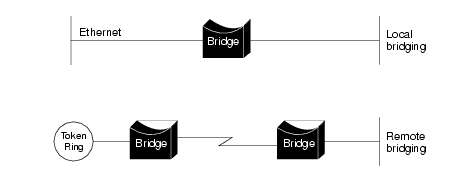
classification scheme, bridges are either local or remote. Local bridges
provide a direct connection
between multiple LAN segments in the same area. Remote bridges connect
multiple LAN segments
in different areas, usually over telecommunications lines. Figure
illustrates these two
configurations.
Local and remote
bridges connect LAN segments in specific areas
- Remote bridging presents
several unique internetworking challenges, one of which is the difference
between LAN and WAN speeds. Although several fast WAN technologies now are
establishing a
presence in geographically dispersed internetworks, LAN speeds are often an
order of magnitude
faster than WAN speeds. Vast differences in LAN and WAN speeds can prevent
users from running
delay-sensitive LAN applications over the WAN.
Remote bridges cannot improve WAN speeds, but they can compensate for speed
discrepancies
through a sufficient buffering capability. If a LAN device capable of a 3-Mbps
transmission rate
wants to communicate with a device on a remote LAN, the local bridge must
regulate the 3-Mbps
data stream so that it does not overwhelm the 64-kbps serial link. This is
done by storing the
incoming data in on-board buffers and sending it over the serial link at a
rate that the serial link can
accommodate. This buffering can be achieved only for short bursts of data that
do not overwhelm
the bridge's buffering capability.
The Institute of Electrical and Electronic Engineers (IEEE) differentiates the
OSI link layer into two
separate sublayers: the Media Access Control (MAC) sublayer and the Logical
Link Control (LLC)
sublayer. The MAC sublayer permits and orchestrates media access, such as
contention and token
passing, while the LLC sublayer deals with framing, flow control, error
control, and MAC-sublayer
addressing.
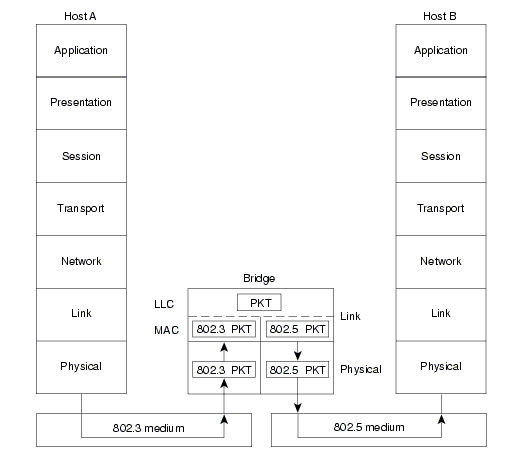
Some bridges are MAC-layer bridges, which bridge between homogeneous networks
(for example,
IEEE 802.3 and IEEE 802.3), while other bridges can translate between
different link-layer
protocols (for example, IEEE 802.3 and IEEE 802.5). The basic mechanics of
such a translation are
shown in Figure.
Figure 4-2 illustrates an IEEE 802.3 host (Host A) formulating a packet that
contains application
information and encapsulating the packet in an IEEE 802.3-compatible frame for
transit over the
IEEE 802.3 medium to the bridge. At the bridge, the frame is stripped of its
IEEE 802.3 header at
the MAC sublayer of the link layer and is subsequently passed up to the LLC
sublayer for further
processing. After this processing, the packet is passed back down to an IEEE
802.5 implementation,
which encapsulates the packet in an IEEE 802.5 header for transmission on the
IEEE 802.5 network
to the IEEE 802.5 host (Host B).
A bridge's translation between networks of different types is never perfect
because one network
likely will support certain frame fields and protocol functions not supported
by the other network.
MAC-layer bridge connects the IEEE 802.3 and IEEE 802.5 networks
- Types of Switches
Switches are data link layer devices that, like bridges, enable multiple
physical LAN segments to be
interconnected into a single larger network. Similar to bridges, switches
forward and flood traffic
based on MAC addresses. Because switching is performed in hardware instead of
in software,
however, it is significantly faster. Switches use either store-and-forward
switching or cut-through
switching when forwarding traffic. Many types of switches exist, including ATM
switches, LAN
switches, and various types of WAN switches.
ATM Switch
Asynchronous Transfer Mode (ATM) switches provide high-speed switching and
scalable
bandwidths in the workgroup, the enterprise network backbone, and the wide
area. ATM switches
support voice, video, and data applications and are designed to switch
fixed-size information units
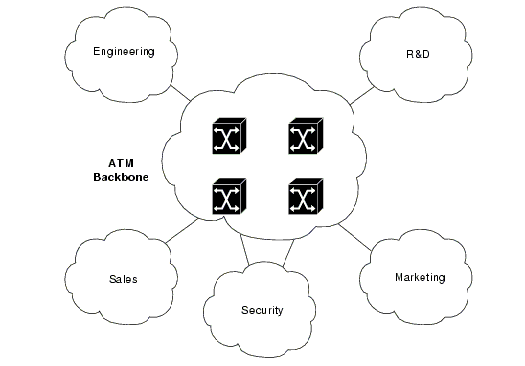
called cells, which are used in ATM communications. Figure illustrates an
enterprise network
comprised of multiple LANs interconnected across an ATM backbone.
Multi-LAN networks can use
an ATM-based backbone when switching cells
-
-
-
- LAN Switch
LAN switches are used to interconnect multiple
LAN segments. LAN switching provides dedicated,
collision-free communication between network devices, with support for
multiple simultaneous
conversations. LAN switches are designed to switch data frames at high speeds.
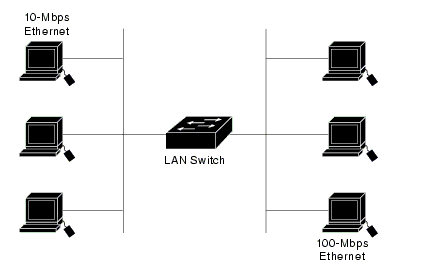
Figure
illustrates a simple network in which a LAN switch interconnects a 10-Mbps and
a 100-Mbps
Ethernet LAN.
-
A LAN switch can
link 10-Mbps and 100-Mbps Ethernet segments
Back
Home