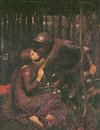
What's it All Mean, Anyway?

. . . well, what's it mean to me at any rate. This is a poem which holds fascination and personal meaning for me. I'm positive that millions of people feel as though it expresses something of themselves, and in that sense I am only one star in a galaxy. However, I am the only one of ME, and I am the only one who experiences life as myself, and thus, in the whole of humanity, I am unique. That's my semi-detached explanation of why it should even matter that these are *my* feelings, instead of merely cutting and pasting someone else's here.
I don't like the poem's spoken meter. Turning "gaped" and "sighed" into two-syllable words makes me cringe. But, even so, if you allow for such things, Keats does maintain a pretty constant eight syllables per line, except for the closing line in each stanza, which is sometimes five, sometimes four. Again . . . grrr. To me, Edgar Allen Poe's The Raven is the epitome of written and spoken metered verse from a technical standpoint. It all flows; you don't have to mispronounce words or make allowances for the omission or addition of a syllable here or there . . . and it has a natural ebb and flow, bordering sing-song but not quite that simplistic. So, as for La Belle Dame Sans Merci, I can overlook certain technical glitches and give it major points for theme and accessibility.
It's generally held that the woman in question is a magical being who lures men to their doom, through enchanting them so powerfully with love for her that they cannot sleep or eat for want of her affection, and starve to death with time as she has already left to attend to her next victim. I was assigned to write a paper on the subject for an English class at UMCP, and figured that the poor Elven beauty had been beat up enough by scholars and students over the years, and it was about time someone made an alternate interpretation a little less . . . condemnatory and prejudicial. Heck, I agreed with the majority (read, "everyone") interpretation; but I thought it would be more fun to argue from a different perspective. So I stretch a little in places. Overall, I thought I made a good case with the material at hand. *sigh* Chalk up yet another 'D' for daring to question the establishment. Seems to be a pattern with certain teachers. Of course, then it becomes a challenge. How technically and contentually excellent can I make a paper and still get a 'D' because I disagree or appear to disagree with the teacher? Ask me about Paul's Case by Willa Cather sometime for an energetic second example of this phenomena. I swear Ms. Carnevalli missed the boat by being one of the very incomprehending philistine bastions of banality the story was written to criticize, expose, and mourn.
The way I personally relate to La Belle Dame Sans Merci is somewhere between the face value interpretation and the overly generous "defense attorney" approach I took in my paper. I have a knack for falling in love with exquisitely beautiful ideals which do not exist . . . and nor do I set myself up for it by reading those ideals into others, but rather I seem to find the ones who are capable of presenting and sustaining the illusion of those ideals all on their own, and just like the fish who sees on the hook a wriggling meal far better than ever he would have caught on his own, I cautiously nibble, then commit myself to the "bite" and find myself gasping, pierced and all but helpless to withdraw. Is it because I fall for consciously cruel women?
No, I do not see this to be the case. However, there have been three significant females in my life for whom true kinship of souls has been made impossible because the one I loved was not at her soul the person whom she made herself to be. The one true love whom I trust without reservation or doubt to be the persona she has proven herself to be is now, appropriately, destined for another. As for the others, the first and third were/are what I term "social chameleons." They have an inherent, uncanny ability to be exactly who you need them to be when you're with them. Sometimes it's because they don't know who they are, either, and find a little peace and acceptance with each person they're with. The ones who don't know what they're doing are far more dangerous, because their sincerity is all the more effortless. They don't simply play the perfect role . . .while they're with you, they become the character, and truly, deeply believe all that they say and express. I'm betting they could play some impressive games with lie detectors, depending on who was asking the questions.
What are you supposed to say to the character? "You're not real . . . as soon as I leave you'll be an entirely different person." For the most part, that won't make sense to the individual, because they really have become who they appear to be.
. . .for *you,* that is. The first chameleon I met was something of a mix . . . she was aware and loved what she was doing . . attempting to manipulate people was something of a hobby and art to her, but she also had no grounding in life, either. Call her "insufficiently self-actualized" for the proper psycho-babble. I fell for her in fifth grade, and woke up in seventh. So I was inexperienced. They say this doesn't happen, but I literally woke up one day and had no feelings for her anymore. Everything had apparently clicked during the night, and I was free to go, released on my own recognizance.
As for the middle girl, that was a more protracted case, in that she didn't have a separate personality for each person, but rather created one new personality which she then used as her own for five or six years before it broke down. For a little more on that, you can read some on my 04JUL2001 journal page .
This third girl is far more Keatsian, in that I don't believe she's intentionally malicious, she doesn't know what she's looking for, -- or, rather, isn't willing to accept certain avenues of discovery-- and truly cares for those she entraps. Well, cares for them for a time . . . She's the one who's induced me to think all this through again. She tries on different manners and attitudes and feelings with different people, searching for a comfortable fit she wants to stay with. She hasn't found it yet, and I don't believe that, without significant change, she will. She might get lonely enough I suppose that eventually when she goes through the entrapment cycle with someone that she'll fall prey to her own lure, and then, having committed herself to someone while unknowingly "trying them on," will try to make it work. But, when she's with you, how beautiful and exquisitely crafted she is, as if lovingly designed by God Himself for you alone!
Just don't buy it.
In her current state, which, sadly, became a portion of my state for a time (nope, I'm not out of it yet, although I'm at least in control of my actions, if not my feelings), she will never find someone to satisfy what she's ultimately looking for, but, as I said, she may fall prey to her own illusion and accept someone nonetheless.
That's the neatened, short, and practically antiseptic version. In reality, the above paragraphs represent an overwhelming amount of love, hope, fear, dreams, prayer, and tears over a long period of time, extending to the present. How I can have so much love for someone who is fundamentally incapable of being who even she thinks she is, is incredible to me. A fundamental root stasis of personhood is so basic to our understanding of others that when you meet someone so unintentionally destructive through lack of true identity, denial and disbelief are the first and strongest reactions.
How to Get a 'D' in "Introduction to Poetry"
for Independent Thought
[Evil grin] Now, about that essay for English 241 on the *sadly* misunderstood title character of La Belle Dame Sans Merci , it is reproduced below in stunningly flawless HTML by yours truly. Well, the HTML's flawless . . . the essay . . . not so much. I'll critique it up front. The assignment was a 3-5 page paper discussing the poem. Yes, it was that open-ended. That was the teacher's mistake. MY mistake came in thinking that my paper would be graded on grammar, construction, readability, internal consistency and logic. My bad. To be fair, perhaps I didn't deserve an 'A,' or if I did, an 'A-.' Nonetheless, in talking to the teacher after receiving it back, she made it clear that I got a 'D' because she didn't like my point. THAT'S petty and cheap.
So, I'll critique myself on all the things she didn't and should have, being so appalled at my waywardness from the accepted interpretation. Overall, it's well done, given that it's a classic example of the paper written the day before it's due, although I *did* run it past both parents, who, on the whole, have intelligence and brain cells to spare. The spelling and grammar ought to be above reproach (easy there, Eric!), the style is easy to read, familiar but not proletariat casual, there is a clear train of thought throughout, paragraphs have clear subjects and topic sentences, there is excellent use of Keats' larger body of work to establish credibility for the view portrayed, and, most importantly, it was a full five pages to fulfill the requirement for length, at double-spaced 12-point Arial.
After that rousing pat on the back, it's important to highlight the weaknesses of the paper. And, in reviewing the paper again, there are some painful weaknesses. What on Earth was I doing making the overly specific Brigadoon suggestion? If I'd left it merely at the level of general principle, as in a fairy curse of some sort which necesitated that she leave behind her mortal lovers, it would have sufficed. No, instead I must launch into a protracted and ill-supported single-platform argument which is about as intellectually satisfying as eating a copy of the Norton Anthology of Poetry in a bowl of warm milk.
Second, right after I point out that "merci" is more commonly used in French to mean "thanks," and that the French word for "mercy" is "misericorde," I have completed all immediate usefulness on the matter of semantics. Once I suggest four possible understandings of the title, I have embarked on a space-filling journey of barely profitable relevance, far better served as a discreet paragraph abbreviated as ruthlessly as possible.
Thirdly, and perhaps minorly, the first sentence of the paper lacks a certain desired "oomph," a hook to grab interest and draw a laser focus to the issue at hand. It may be a useful establishing sentence, but as an opening line it leaves much to be desired.
There. Oh, and one last thing . . about my closing paragraph . . . if I'm going to bring up Keats' reliance on Greek mythology, I really could have stood to have mentioned it elsewhere in the paper besides the aforementioned travesty of the "Brigadoon" statement.
So, with little further ado
"Ado"
Dang, one slipped in there. As I was saying, here below is the paper, as delivered to Ms. Anne Benvenudo on 3/16/1998 as partial fulfillment of the requirements for English 241, Introduction to Poetry. Darn her.
The Beautiful Woman, Without Mercy
An important theme to John Keats is unrequited or unresolved love. Drawing on the examples of Keats' work in The Norton Anthology of Poetry and the course packet, eight of the eighteen poems address this theme directly. His own life tragically exemplifies this, as he falls ill and dies before he can wed his beloved Fanny Brawne. The same year his brother Tom died at age eighteen, Keats met Fanny and penned "When I Have Fears," a sonnet describing his fear of dying before his work was done, and never again seeing the one he loved. Afterward he wrote "The Eve of St. Agnes," "Ode to Psyche," "Bright Star," "This Living Hand," and, importantly,
"La Belle Dame sans Merci."
In these and others, a protagonist, invariably male (with the addition of a female in "The Eve of Saint Agnes"), is forced to endure the pain of separation from the object of his desire. This separation is caused by many things, primarily death, and once, deity. "When I Have Fears" is a prime example of death's anticipated intervention. "This Living Hand" says, in essence, "When I'm dead, then you'll be sorry." "Bright Star" envies the heavenly bodies, which will remain with his love long after he is gone. "La Belle Dame sans Merci" features a knight starving to death, hoping for one more look at the fairy woman who has captured his heart. Clearly Keats felt a sense of futility in love, somehow knowing he would never fully experience its sanctuary, and thus granting the same cursed state upon the subjects of his poems.
Nevertheless, love seems to be one of Keats' most prized ideals, if only one can attain it. His ill-fated suitors understand the transcendent glory to be had, always just out of reach, yet always sought for with an earnest desire worthy of the noble Galahad. However, while the love of these men for their respective women is never met with satisfaction, it is clear that the women are not responsible for this. The unfortunate situations are dictated by fate, as in Keats' own life. This is important to remember in one's interpretation of "La Belle Dame sans Merci."
It is tempting to understand the ballad to concern a woman who ensnares unsuspecting travelers, much as the ancient Sirens were said to lure seafarers to their doom; indeed The Norton Anthology of Poetry conveniently translates the title for its readers in that view. Yet, in fact the term "merci" is more commonly "thanks," and the French word for "mercy" is "misericorde." The worst which may be afforded this woman then is "The Beautiful, Thankless Woman," or even more kindly, "The Beautiful Woman Without Thanks." These two translations are distinct from each other, and far different from what meaning was given by the compilers of Norton. This means there are four ways which the title may be read. The first, translating "merci" as "mercy" declares the woman to be without mercy, which in itself can mean two things. Traditionally, it means she gives no mercy. Alternatively, can not the phrase "La Belle Dame sans Merci" refer to a woman who is allowed no mercy? As for translating "merci" as "thanks," the same thing may done, rendering her a thankless woman, or a woman without thanks.
Of these four possibilities, some are more logical than others. Take, for instance, the "Woman Without Thanks." What did she do to deserve thanks? She fell in love with a knight and disappeared while he slept. Surely no thanks were deserved nor expected for that. This, then, may be ruled out. What of the "Thankless Woman?" It should be pointed out that while the knight certainly did things for her, they were entirely unsolicited. He took the initiative in making for her a garland, and bracelets, and belt, and in putting her on his horse. Nowhere is mention made of her requesting this treatment. Still, one may say that common courtesy requires an acknowledgment of some sort when one party goes out of his/her way to assist the happiness of another. In reply—she told him she loved him, took him to her home, and sang him to sleep. What man would not understand thankfulness in those terms?
This leaves two more readings. First, of course, is the idea that the woman is merciless, a venus flytrap for humans. While this is certainly an understandable view on one's first encounter with "La Belle Dame sans Merci," there are several reasons why this is not the case. These will be found within the following argument for the final interpretation—"The Beautiful Woman Without Mercy." . . . Mercy of her own, that is.
The first reason supporting this is an argument of Keats' nature. It would be out of character for Keats to write about a merciless woman. This violates what he knows and believes of love. Remember, it is Fate, not a woman which consigns Keats to life with unresolved love. Consistently Keats writes of worthy recipients of desire who remain unattainable through the arbitrary whim of Fate. In "The Eve of St. Agnes," it is the woman, Madeline, as well as the man who desires love, but neither can find it because of Fate's tragic intervention. Even more importantly, in stanza thirty-three of "Agnes" the young man plays a tune called "La belle dame sans merci" to Madeline as she sleeps. The woman here was played a cruel trick, and denied grace by Fate. Keats' world view has no place for a succubus in La Belle.
Second, there is no evidence of malicious intent in the woman's actions in La Belle. She does not transform into a demon as the knight drifts to sleep, she does not allow herself a cruel smile in consideration of his fate, nor does she even appear indifferent to him. Indeed, in stanza eight she cries and groans. This is not the behavior of a conquering temptress. After all, she already has him "in thrall." There is nothing more she needs to do at that point to ensure his capture. Weeping for sympathy would be merely a waste of energy. Her actions are not suggestive of a "merciless woman."
Since she does nothing to imply mercilessness, what of reading her actions at face value? The first that is seen of her is as she plays in the meadows. Nothing is said of her age, although it is likely that as a fairy she is immortal, and forever young. She is beautiful, light of foot, with animated eyes. The knight meets her and is taken. He makes ornaments for her, probably of flowers, and she begins to fall in love with him, and "makes sweet moan," a term used by Keats in other poems to refer to singing. The knight lets her ride his horse, and spent the day watching her ride and listening to her sing. The fairy woman gathers for him a meal of the woods—"roots of relish sweet, and honey wild, and manna dew, and sure in language strange she said ‘I love thee true.'" She takes him to her home, where she "wept and sighed full sore, and there I shut her wild eyes with kisses four." The knight, uncomprehending, tries to comfort her. She then sings him to sleep, and he dreams of his dead predecessors.
Applying Keats' principles of love and Fate, does it not make sense that both of them are victims? How more Keatsian could it be? The knight is doomed to fall in love with a woman he can never have. The woman is doomed to fall in love with men she can never have. Worse, because of attributes she cannot help nor is the reader told she asked for, she must know that the men she loves are condemned to die alone, wasting away in eternal hope of seeing her once more. There are few things more ghastly and heart-rending than to know that you are the cause of your lover's demise.
Why does she disappear in the night? It is not stated, but perhaps one should think "Brigadoon." Keats does not explain the ways of the fairies, but there is certainly enough fairy lore (not to mention how exquisitely fitting with his love of classical Greek myth it is) for him draw from it an elfin woman; punished by the gods (Fate) to appear for perhaps a single day once every hundred years to meet and fall in love with a human who must die as described above, she must spend eternity with the deaths of these innocent souls on her conscience, drawn as moths to the flame by her beauty and grace.
It is this explanation which best fits with what is known of Keats. It is consistent with his understanding of the lot Fate had given him, which he expressed in so many others of his works, and which we can see by simply reading of his life. It matches his view of how love must be for him, and thus the noble men of his poetry. It fits the wording of the poem. Lastly, it is reflective of the ancient Greek legends which so impressed him, and pervade his writing.
La Belle Dame sans Merci: The Beautiful Woman, Without Mercy.