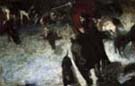
On "Wild Chase"
I find myself drawn to Wild Chase for a number of reasons--for the reaction it produces, for its similarity to many dreams I've had throughout my life, and for its composition. The first time I saw it, I was struck by how keenly von Stuck took the horror and breathlessness of terror and condensed it onto canvas. Of course, that process was the entire point of the Symbolist movement, characterized by evocative paintings depicting primal emotions or concepts. It's possible to forget to breathe when looking at this one. The strange men in dark clothing and red capes are clearly coming for you. There is maybe the breadth of one more second before the dogs have you and the man has either caught you up or run you through.
Not so much of late (this is written as of 08/30/2001), but frequently over my life I have had dreams about being chased or hunted. I rarely get caught, and when I do the dream doesn't stop, and there's always a little room in the narrative for a possible escape. Sometimes the chase takes place in a mall, sometimes it's a car chase, but more often it's an involved and complicated conspiracy plot ranging over a city-like college campus or a park in the great outdoors. Wild Chase has a surreal, dreamlike atmosphere familiar in tone, although less "civilized" than my own dreams.
When I first came across the painting, I saw a horde of pursuers, some barely human, in flight through the ether. I actually like it better that way. For example, if that subject to our left of the rider had been one of the pursuers, flying toward the viewer like a demonic fiend, rather than one of the pursued, *I* thought it would have been more terrifying. As it is, the painting is a tad more mundane than I thought at first glance, to my mild disappointment. Nonetheless, painted as it is, I find no fault in composition. The frame of reference is slightly skewed relative to the ground, the viewer is outflanked by the riders, and there are ample subjects either captured or in imminent danger of capture to suggest one's own likely fate. The living subjects are arrayed across the top of the painting, down the right, and back up to the center, in an implied three dimensional spiral, used quite effectively in conjunction with the angled ground to give a sense of disorientation and to convey forward motion.
I wonder where these unfortunates are being carted off to? It looks as though their hands are bound, and they're being retrieved.