Onam
A
King Returns
In
the golden days of King Mahabali, the lush green land of kerala flourished and
prospered. Everyone in this southern Utopia lived in happiness.
According
to mythology, the gods feared the wise and good rule of Mahabali, the Asura
(demon) king, thinking that he might become too powerful. So they sought help
from Vishnu, the preserver of the Hindu trinity in order to curb Mahabali's
power. Vishnu took the form of a Brahmin boy called Vamana and approached
Mahabali, who was pleased to receive him. "It is my good fortune that you
have chosen to honour me with your presence. Whatever you desire, I am here
ready to fulfil the same." and Vamana smiled and said, "You need not
give me anything great. It is enough if you give my that extent of land covered
by three foot steps [of mine]."
True
to his promise, and in spite of his guru's advice, he acceded to Vamana's
wish. Vamana, the dwarf began to grow. He grew so big that he reached the
sky. Then he lifted one foot and with it he covered the whole earth. Lifting the
other foot, he covered the sky. Vamana then asked where he should
stand next, since his third step would destroy the world. So Mahabali
offered his head, knowing that he would die. Vamana granted him one wish, to
which he replied that he would like to be allowed to return once a year to see
his people. Finally with the third step, Vamana trod upon Mahabali's head,
pushing him down to the underworld (Pathalam) where he went into eternal exile.
However, by virtue of his wish, the gods allow him to visit Kerala every year on
the day of the Sravana asterism in the month of Sravan.
|
Many believe that Kerala is sacred on account of his sacrifice and remains fertile and prosperous on account of his noble action.
|
 |
An
ancient thanksgiving celebration
So Onam or Thiruvonam is primarily a harvest festival, in commemoration and thanksgiving for the bounties of nature, and has been faithfully celebrated since ancient time by the Keralites. During mid-August, for ten days the verdant green land reverberates to the sounds of celebration, feasting, boating, dancing and singing to honour the return of Mahabali from the nether world to visit his people.
At
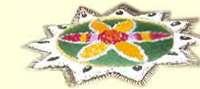
that time of new beginnings, in the king's honour, houses are cleaned, lit and
decorated with exotic floral displays called pookkalam; the people dress
up in new clothes, and families prepare special meals and spend the holy day
together.
A
number of special festivities form an intergral part of the Onam celebrations
including a spectacular procession of caparisoned elephants at Trichur,
colourful kathakali dancers who re-enact the well-loved stories of epic heroes
and virtuous women, and young girls perform the kaikotikali dance (group dance)
around a brass lamp or vellaku in the evenings. A magnificent display of
fireworks marks the end of the festivities.
The
vallamkali or snake boat race is probably one of the main attractions of
Onam and is held at several places
on the palmfringed lagoons at Alapuzha, Aranmlai and Kottayam. These thrilling
contests test the strength of hundreds of ores-men in snake-shaped boats decked
in colourful silk umbrellas, which with their coins and tassles, denote the
affluence of the owning family, The boats speed past each other encouraged by
cheering crowds and a symphony of cymbals and drums.
Traditional Onam food
In keeping with
the significance of the occasion, the food for Onam is also special, and while
the people of Kerala are traditionally fish and rice eaters, the food for Onam
is strictly vegetarian.
Served on a plantain leaf, the traditional sadya or feast is a vegetarian
extravaganza. Steaming red rice is accompanied by a huge selection of vegetable
side dishes, including parippu (a liquid curry made with mung dal), sambhar,
kootu and mango curries, puli and inji, upperi(banana chips) and yellow Kerala
plantains. These are followed by a delectable array of sweets
and desserts, including ada pradaman and pal payasam To end things off,
hot rasam is served over some more rice.