| . |
Reading, PA
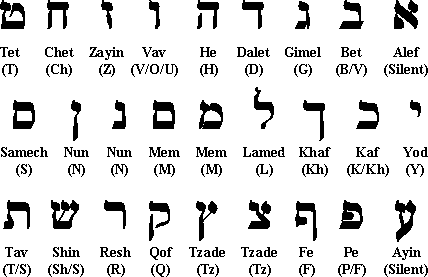
The Hebrew and Yiddish languages use a different alphabet than English. The picture below illustrates the Hebrew alphabet, in Hebrew alphabetical order. Note that Hebrew is written from right to left, rather than left to right as in English, so Alef is the first letter of the Hebrew alphabet and Tav is the last. The Hebrew alphabet is often called the "alefbet," because of its first two letters. Letters of the Alefbet
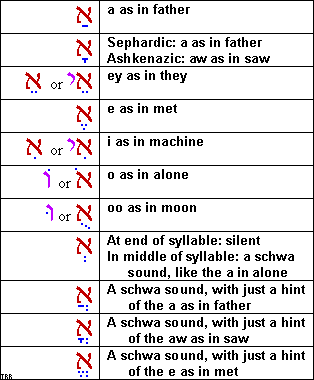
If you are familiar with Greek, you will no doubt notice substantial similarities in letter names and in the order of the alphabet. The "Kh" and the "Ch" are pronounced as in German or Scottish, a throat clearing noise, not as the "ch" in "chair." Note that there are two versions of some letters. Kaf, Mem, Nun, Pe and Tzade all are written differently when they appear at the end of a word than when they appear in the beginning or middle of the word. The version used at the end of a word is referred to as Final Kaf, Final Mem, etc. The version of the letter on the left is the final version. In all cases except Final Mem, the final version has a long tail. Vowels and PointsLike most early Semitic alphabetic writing systems, the alefbet has no vowels. People who are fluent in the language do not need vowels to read Hebrew, and most things written in Hebrew in Israel are written without vowels. However, as Hebrew literacy declined, particularly after the Romans expelled the Jews from Israel, the rabbis recognized the need for aids to pronunciation, so they developed a system of dots and dashes called nikkudim (points). These dots and dashes are written above, below or inside the letter, in ways that do not alter the spacing of the line. Text containing these markings is referred to as "pointed" text.
Numerical Values
The number 11 would be rendered Yod-Alef, the number 12 would be Yod-Bet, the number 21 would be Kaf-Alef, the word Torah (Tav-Vav-Resh-He) has the numerical value 611, etc. The only significant oddity in this pattern is the numbers 15 and 16, which if rendered as 10+5 or 10+6 would be a name of G-d, so they are normally written Tet-Vav (9+6) and Tet-Zayin (9+7). The order of the letters is irrelevant to their value; letters are simply added to determine the total numerical value. The number 11 could be written as Yod-Alef, Alef-Yod, Heh-Vav, Dalet-Dalet-Gimmel or many other combinations of letters. Fun Facts Are Always Changing!! |





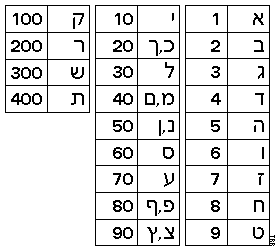 Each
letter in the alefbet has a numerical value. These values can be used to
write numbers, as the Romans used some of their letters (I, V, X, L, C,
M) to represent numbers. Alef through Yod have the values 1 through 10.
Yod through Qof have the values 10 through 100, counting by 10s. Qof
through Tav have the values 100 through 400, counting by 100s. Final
letters have the same value as their non-final counterparts.
Each
letter in the alefbet has a numerical value. These values can be used to
write numbers, as the Romans used some of their letters (I, V, X, L, C,
M) to represent numbers. Alef through Yod have the values 1 through 10.
Yod through Qof have the values 10 through 100, counting by 10s. Qof
through Tav have the values 100 through 400, counting by 100s. Final
letters have the same value as their non-final counterparts.
 RATING