
Introduction
Mesopotamia means ?the land between rivers?. It is the name of a region were the world?s first empires and cities grew. It now lies in Modern Iraq. The first cities first bloomed around 3,500 years ago. Farmers settled there were there was enough rainfall to grow crops. Chaldea, Sumer and Babylonia are the previous civilisations in Mesopotamia.
Assyria was in one way the daughter of Babylonia because they have identical religion, race, literature, language and civilisation. They were considered the most cruel and war-like and cruel in the ancient world.
Geography/Climate

Assyria is located in the Northern and middle part of Mesopotamia, between the rivers Euphrates and Tigris where Iraq is now located, while the southern part is occupied by Babylon and Chaldea. Assyria had only a small piece of land but as time past, it extended to the whole valley of Mesopotamia. The area of Assyria is about 50, 000 square miles. Assyria is mountainous and well watered but the southern part of Assyria is more levelled, alluvial, and fertile.
The winters were cool and wet and there were heavy rainfalls that made the crops and plants grow.
The principal cities were: Assur, the main trade city, Calah, Nineveh, Nasibina, and Tarbis.
Primary and Secondary Sources
The primary source of information are in the monumental records and remains found in the past 50 years from the Assyrians and Babylonians, the Chronologically notices scattered throughout the historical inscriptions, the Genealogies of the Kings and The ?Synchronous history? of Babylonia and Assyria, which consists of a brief summary of the relations between the two countries from the earliest times in regard to their respective boundary lines. The secondary sources of information are in the Old Testament Fourth Book of Kings, and the Greek, Latin and Oriental writers- Chaldeo-Babylonian priest and historian Berosus.
Short Timeline Assyria
It is probable that the beginning of an independent Assyrian kingdom may be placed towards the 17th century BC. The 2 cities of Nineveh and Assur were certainly in existence at the time of Hammurabi (approx. 1760 BC).
In 2000 BC, the Sumerian Empire falls. In the same year, Assyria becomes independent. In 1595 BC, the Hittite king, Mursulis, conquers North Syria and destroys Babylon but does not take over the city. In 1570, Babylon becomes a world power, which is equal to Egypt?s power. In 1500, the people of Mitanni, a new state, conquer the land from the Mediterranean Sea to the Zagros Mountains, which included Assyria. In 1365 BC, king Ashur-uballit, gains the independence from the Mitanni. In 1000 BC, Assyria is attacked by many enemies. One of them, the nomadic Aramaeans, move into Mesopotamia and take over large areas. Their alphabet replaced the Akkadian one. In 911 BC, Assyria recovers from losses. The Assyrians take control of most of the land under the rule of Tiglath-pilester III (745-727BC).
Assyria was finally destroyed when several tribes got together to fight them. The Assyrians were easily defeated because the empire was very big and it was hard to control. The fall of the city of Nineveh in 612 BC marks the fall of the Assyrian empire. This event is recorded in the Old Testament.
Warfare
The Assyrians were the most cruel and warlike civilisation in the ancient world.
The army was originally made up of farmer when they were not needed at the farms. Since the Empire got bigger, Tiglath-pileser III made a permanent army made up of thousands of men from conquered lands. They were well trained and they used wooden siege machines to attack the enemy cities.
Military campaigns were planed with lots of details. The king often led his men into battle. The soldiers on foot did the most of the dangerous fighting, which is why probably most of the army was made up of foot soldiers. They used bows, swords, slings, spears, and battles axes. They also carried shields to protect themselves. To get across a river, lake or pond, the soldiers used inflated goatskins. After a successful battle, there was a grand procession through the city to the temple. There, the king reported the good news to the God. The Assyrian Empire reached its greatest extend under the rule of Ashurbanipal (reigned 668 - 627 BC). The extend included most of Egypt.
Between 880 and 626 BC, the Empire extended. It dominated all of Mesopotamia, the eastern cost of the Mediterranean Sea and the North of Egypt.
They hired foreign men to fight in their army and they paid the soldiers based on success. The people from defeated cities were often hung on poles to warn the others. They built permanent roads for military movement.
The Assyrians won most battles. The Assyrian Civilisation ended when the Empire was too big and the Government couldn?t control the civilisation well enough.
Economy
The Assyrians took most of the riches from the lands defeated by the army. They already had a good source of rock for building. But they also needed metal supplies to make weapons and tools, copper for building boats, horses for the army and food for the soldiers. As a token of submission to the Assyrian masters, the conquered people had to pay any amount of goods the Assyrians wanted. Since these demands were not popular, the army had to use their force to obtain the amount the people had to pay.
The heavy rainfalls made the growing crops grow fast and it brought money by the trade. The main city in which the Trade occurred was Assur.
The more the army conquered, the more the Assyrian people demanded food from their ?subjects?. That permitted the farmers to neglect their fields.
Education and communication

In the alphabet, there were over 5000 signs or symbols, the marks were neatly practiced, and proper grammar and style had to be developed. The Assyrians were the first ones to establish a postal system.
The alphabet is so beautiful and bizarre that some early European explorers thought that they were decorations. Assyro-Babylon language is not written alphabetically but syllabically or ideographically. It belongs to the so-called Semitic family of languages.
Culture and Religion
The culture of Assyria is almost identical to Babylonia's.
The religion and civilisation of Assyria have been derived from Babylonia?s ones thus they were almost identical with those of Babylonia. Assyrian religion, therefore, is largely Sumerian. Although the Assyrians made notable contributions to architecture, art, science, and literature, these were essentially a Babylonian importation. Assyrian temples and palaces were modelled like those of Babylonia, although the building material stone was employed with more imagination. More richness and originality was put in sculptural decorations and in statuary than by the Babylonians.The Assyrians adopted Babylonian doctrines, cults, and rites, with slight modifications. When the citizens of one city entered into political relations with the citizens of another, popular imagination soon created the relation of father and son, brother and sister, or man and wife, between their respective gods.
The principal deities of both countries are: the three chief deities, Anu, the god of the heavenly expanse; Bel, the earth god and creator of mankind; Ea, the god of humanity by excellence, and of the water. Unlike the Babylonians, the Assyrians possessed a female deity. Ishtar was the mother of mankind and the consort of Bel; Sin, firstborn son of Bel, the father of wisdom personified in the moon; Shamash, the sun-god; Ninib, the hero of the heavenly and earthly spirits; and Nergal, chief of the netherworld and of the subterranean demons, and god of pestilence and fevers.
Kings? Life
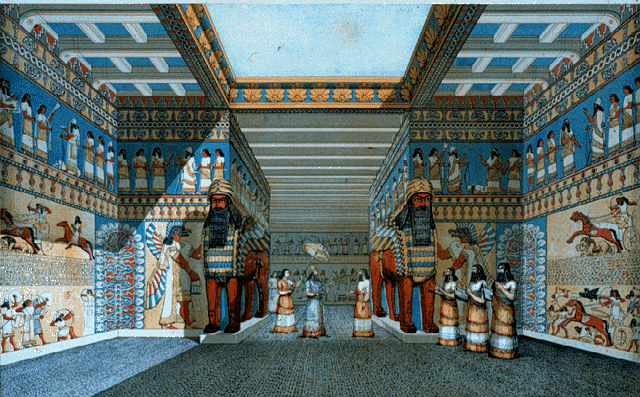
The Kings had grand titles. They all believed that they were chosen to bring wealth to the country. The king was responsible for his subjects but had to serve the gods as well. He was in charge of priests and temples as well as taking the lead in religious events. At one ceremony, the high priest had to slap the king to remind him that he was only a servant of the Gods. Lion hunting was reserved to the kings only so they could demonstrate their power over the king of animals.
Sennacherib (705 to 681 B.C.) created a new capital at Nineveh and destroyed Babylon and Jerusalem. He was an exceptionally cruel, arrogant, revengeful, and despotic ruler, but, at the same time, a monarch of wonderful power and ability.
Tiglath-pileser III seized the throne of Assyria, at Nineveh in the year 745 BC. He is said to have begun life as gardener, to have distinguished himself as a soldier, and to have been elevated to the throne by the army. He was a most capable monarch, enterprising, energetic, wise, and daring.
The last great king was Ashurbanipal who was known for his cruelty and ferocity.
Bibliography
Cultures of the Past- Mesopotamia by Pamela F. Service
Step Into Mesopotamia by Lorna Oakes
The Children?s Atlas of Ancient Civilisations by Antony Mason
The Atlas of Ancient Worlds by Dr Anne Millard
http://www.terrambiente.org/archeologia/images/mesopotamia.jpg
http://carlos.emory.edu/ODYSSEY/gif-still/tablet.gif
http://home.att.net/~Atrahasis/images/MesopotamiaMap.jpg
http://www.guardians.net/egypt/meidum/images/s_meidum.gif
http://www.learningsites.com/NWPalace/New-images/Layard_MNI-pl2_Th-Rm_render.GIF