(Because of the large number of graphics, this page may take up to 2 minutes to load.)
|
The legends surrounding the life of the
Buddha have been the principal sources of inspiration for the creators of
Buddhist art. A knowledge of these are needed for a meaningful insight into
the nuances of Buddhist art, since each stage of the Buddha's many existences
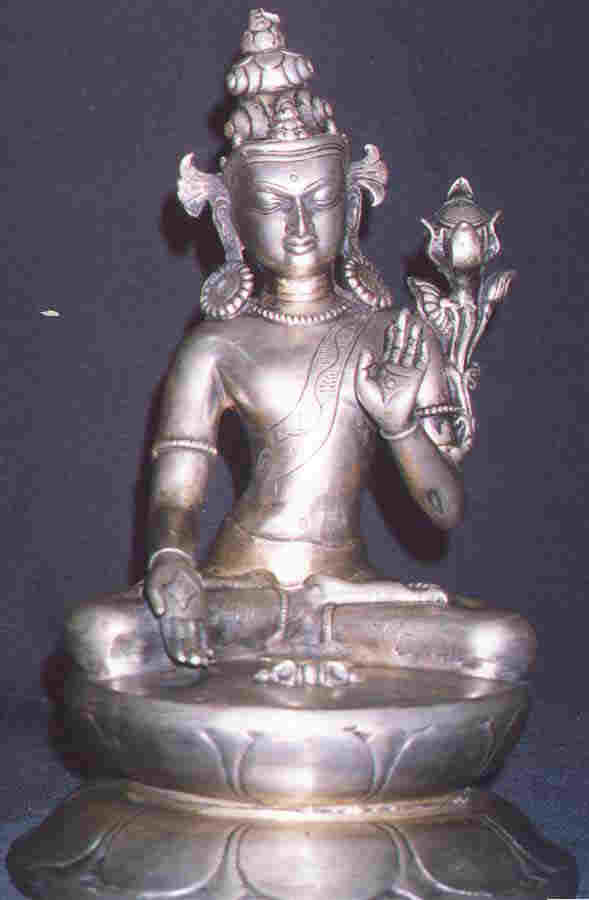
plays a part in the development of this art. The young prince Gautama Siddhartha was born into the ancient Sakya clan, whose symbol was the lion; hence he is often known as "Sakyamuni" (the Sage of the Sakya), or as "Sakyasimha" (the Lion of the Sakya). His father belonged to the warrior caste. Soon after the young prince's birth, a wise sage named Asita predicted that the child would grow up to be a holy man, rather than following his father as ruler. Suddhodana, father of Gautama, tried to prevent this from happening by making sure that the prince lived a sequestered life of ease and luxury in the royal palace, ignorant of the world outside. |
Illustration : http://www.exoticindiaart.com/sculptures/zb69.jpg
|
|
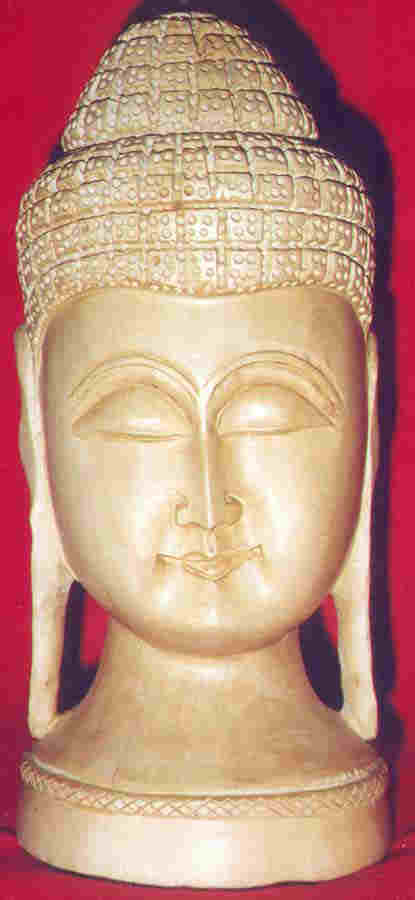
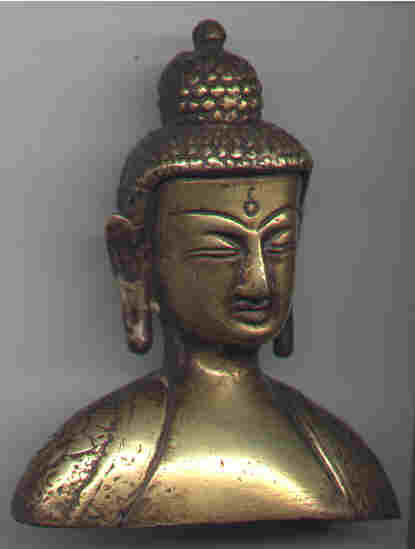
Even to this day Buddha is represented with extended earlobes, now empty of adornment, but which were once stretched out of shape by the weight of the costly jewelry he wore before renouncing his princely status.
When the young prince Gautama had
passed childhood and reached middle youth, he learned in a few days the
sciences suitable to his race, which others require many years to master; and
the king, his father, sought for him from a family of unblemished moral
excellence a bride possessed of beauty, modesty and gentle bearing, Yashodhara
by name, after which the prince rejoiced in that princess. Gautama was sixteen
then, and in due course, to the fair-bosomed Yashodhara there was born a son
Rahula. One day he came across an ascetic
mendicant. "What art thou?" he asked. To which the other answered,
"Terrified by birth and death, desiring liberation, I became an ascetic.
As a beggar, wandering without family and without hope, accepting any fare, I
live now for nothing but the highest good." Convinced that herein lay the
way to quell his mental agitation, Gautama resolved to follow this holy man's
example. Having made the decision he requested his father to allow him to
proceed in his search for truth. On hearing of Gautama's resolve, his father
became extremely anxious and entreated him to revert his decision. To which
Gautama replied thus: "Father if you can fulfill my four desires, I
promise not to leave you. These are:First, I should not die,Secondly, No
disease should ever afflict me, youth should never desert me, and finally
prosperity should always be my companion." Hearing these impossible
demands, the king was extremely dejected and became resigned to his fate.
Gautama left the luxurious palace of his father in the middle of the night. |
|
|
Illustration : http://www.exoticindiaart.com/brass/zf79.jpg |
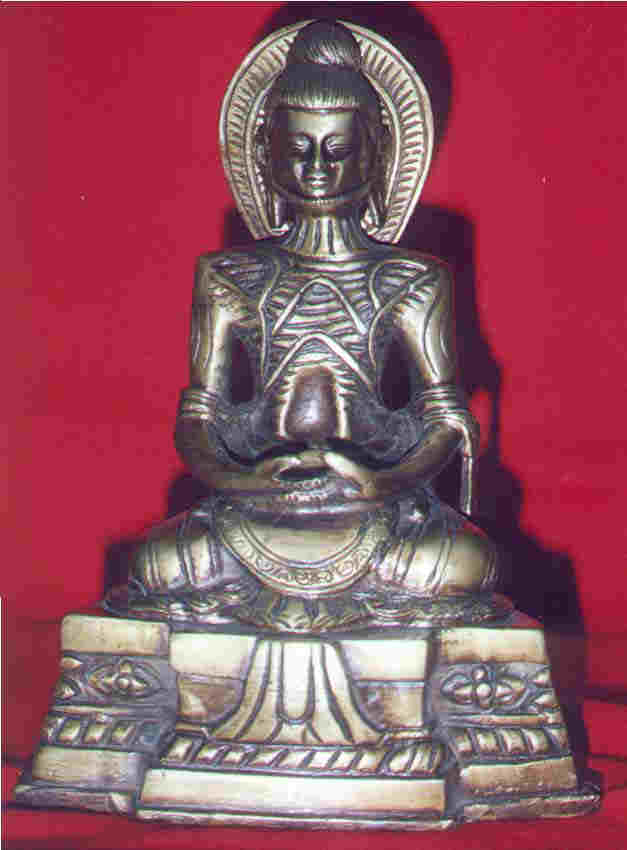
Wandering in his search for meaning, he came to a pleasant hermitage by the lovely stream Nairanjana, where he joined five mendicants in a way of discipline based on progressively severe fasting; until having only skin and bone remaining, emaciated to no purpose, he considered: "But this, certainly, is not the way to knowledge and liberation, which cannot be attained without strength." The Buddha then further thought "Perfect calm, the mind's self possession, can be gained only by the constant, perfect satisfaction of the senses. Contemplation is produced when the mind, self possessed, is at rest. And through contemplation that supremely calm, undecaying state is eventually gained which is so difficult to attain. All of which is based upon eating food." |
|
Engaged in these thoughts, he was offered a
rich bowl of milk, by the lovely and delicate maiden Nandabala the daughter of
a leader of herdsman. This refreshing nourishment restored his body. But the
five mendicants, scandalized, and considering him to have returned to the
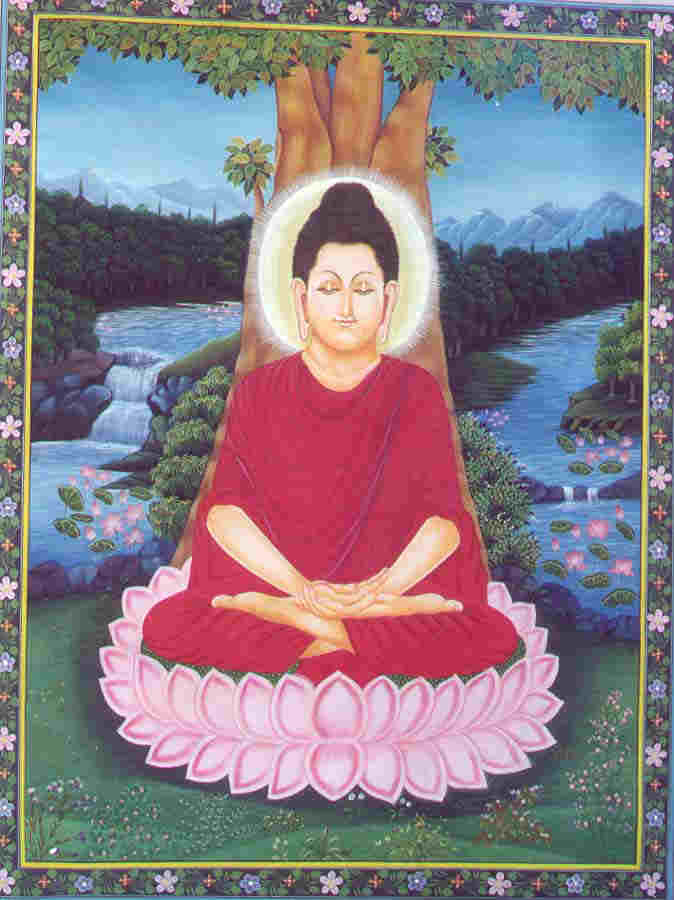
material world, departed. And he, Gautama arose and alone went to the Bodhi-tree,
accompanied only by his own resolve and abandoned himself to meditation,
vowing not to move from that spot until he attained full enlightenment. Illustration : http://www.exoticindiaart.com/panels/wp27.jpg
|
|
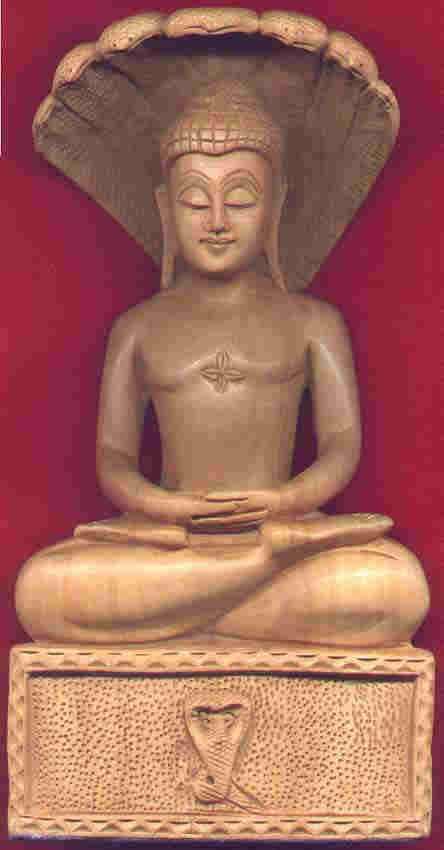
| Four weeks after he began meditating under the Bodhi tree, the heavens darkened for seven days, and a prodigious rain descended. However, the mighty king of serpents, Muchalinda, came from beneath the earth and protected with his hood the one who is the source of all protection. When the great storm had cleared, the serpent king assumed his human form, bowed before the Buddha, and returned in joy to his palace. But as the great prince Shakyamuni was about to penetrate the last mystery of being, a light began to shine from his forehead over all the earth. Beholding this Mara, the Evil One, shuddered: he knew that his power to mislead humankind was threatened. | |
|
Illustration : http://www.exoticindiaart.com/sculptures/zb47.jpg
|
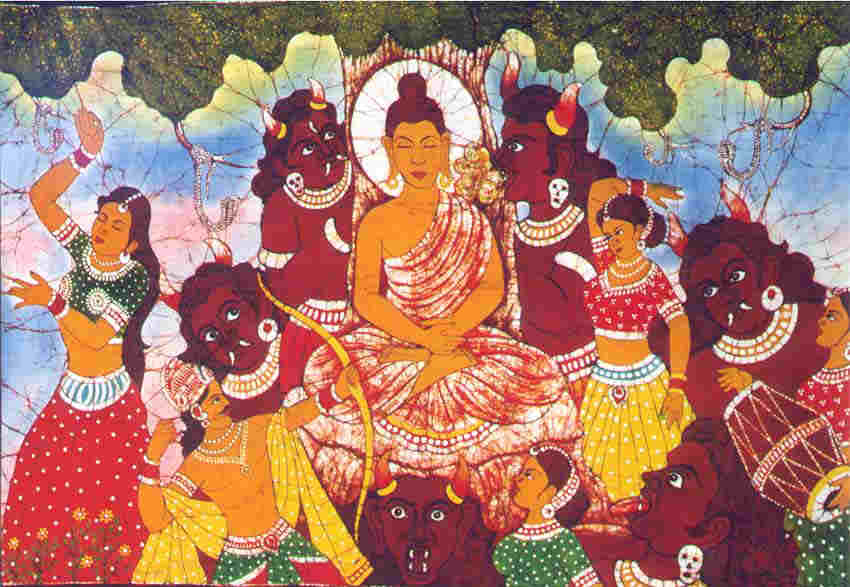
Deciding to confront his opponent directly, he summoned his three
attractive sons and his three voluptuous daughters (lust,delight and
pining) to make Gautama abandon his meditations. Accompanied by his
offsprings he repaired to the spot where Gautama was engaged in meditation: " Up, up, O noble prince!" he ordered, with a voice of divine authority. "Recall the duties of your caste and abandon this dissolute quest for disengagement. The mendicant life is ill suited for anyone born of a noble house; but rather, by devotion to the duties of your caste, you are to serve the order the good society, maintain the laws of the revealed religion, combat wickedness in the world, and merit thereby a residence in the highest heaven as a god." |
|
Observing that the blessed one failed to move by his words, he fixed an arrow to his bow: "If you are stubborn, stiff-necked, and abide by your resolve, this arrow that I am notching to my string, which has once inflamed Lord Shiva himself, shall be let fly. It is already darting out its tongue at you, like a serpent". And, threatening, he released the shaft, but without result. Perceiving that his weapon had failed, Mara wondered " He doesn't notice even the arrow that set the sun aflame ! Can he be destitute of sense? He is worthy neither of my flowery shaft, nor of my daughters: let me send against him my army." Immediately around the Shakyamuni, a demonic army crystallized, wearing frightening shapes and bearing deadly weapons. But lo! Amidst all these terrors, sights, sounds, and odors, the mind of the Blessed One was no more shaken than the wits of Garuda, the golden -feathered sun-bird, among crows. And a voice cried from the sky: " O Mara, take not upon thyself this vain fatigue! Put aside thy malice and go in peace! For though fire may one day give up its heat, water its fluidity, earth solidity; never will this Great being abandon his resolution. And the god Mara, discomfited, together with his army disappeared. The Buddha's superior powers of intellect and yogic control enabled him to overcome the temptations of illusion and evil, personified as the demon Mara.
Illustration : http://www.exoticindiaart.com/batik/ba21.jpg
|
|
Siddhartha becomes the Enlightened One |
|
|
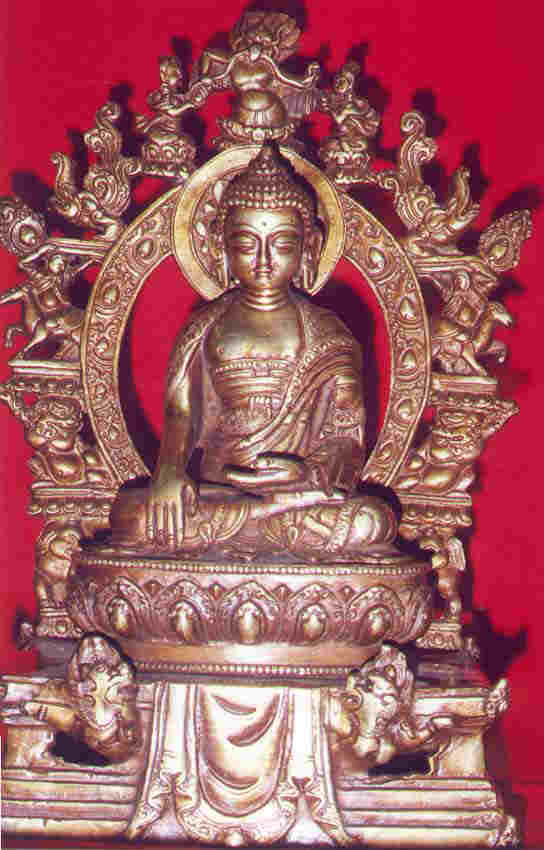
Finally, at age 35, on the night of a full
moon, Sakyamuni attained enlightenment. (From this time forward, the pipal
tree under which he sat would be known as the Bodhi tree, or tree of
enlightenment.) As he was alone with no one to witness this momentous event,
he called the Earth itself to be his witness by touching the ground with his
right hand in a gesture known as the Bhumisparsa mudra. |
|
The Buddha's First Sermon |
|
|
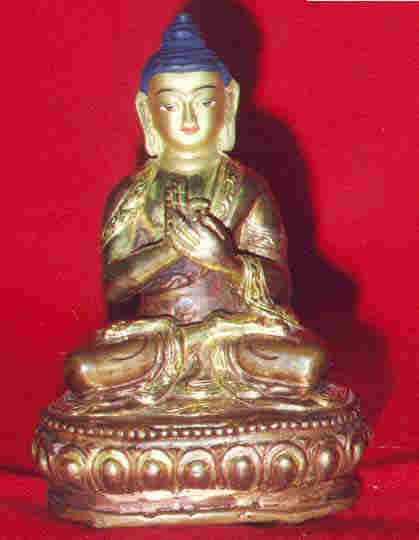
Illustration : http://www.exoticindiaart.com/brass/zf76.jpg |
The Enlightened One gave his first
public sermon in the Deer Park at Sarnath, near Benares, setting in
motion the wheel of the Dharma (or spiritual law) as he expounded the
doctrine of the Four Noble Truths and the Eightfold Path. This first
sermon is represented by the Dharmachakra Mudra, a two-handed gesture
symbolizing the setting in motion of a wheel. This mudra is also used to
show the Buddha in his role as a teacher. |
|
In Mahayana Buddhist art, the Buddha is
typically represented as a young, ideally proportioned man dressed in simple
monk's robes. But he is distinguished from ordinary humans by thirty-two
sacred identifying features, or Lakshana. Among the most frequently observed
are: the Ushnisha, a cranial bump on the head of the Buddha symbolizing
wisdom; the Urna, an auspicious tuft of hair between the eyebrows of the
Buddha which looks very much like a third eye on his forehead, and which
represents his power to illuminate the world; |
Illustration : |
Death of the Buddha |
|
|
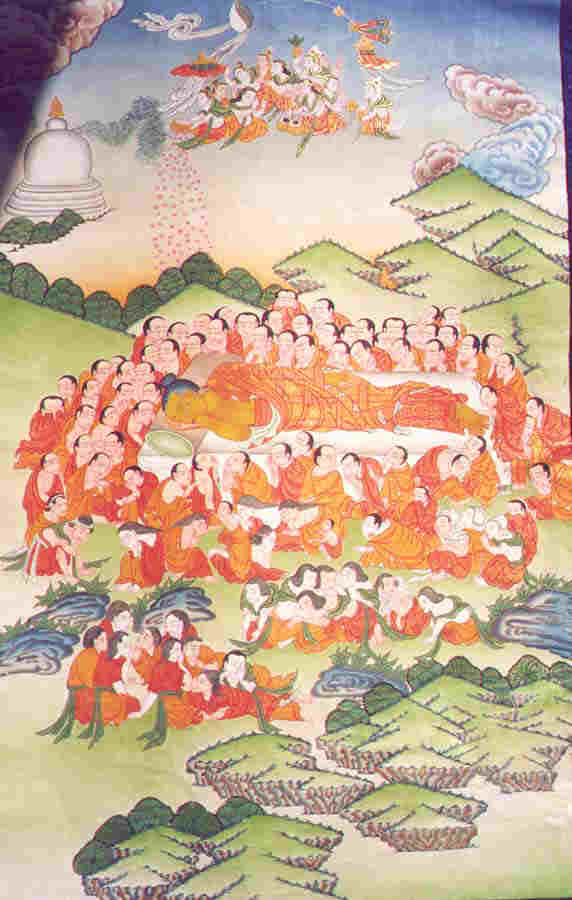
At the age of 80, after 45 years of teaching, the Buddha entered into a deep trance and died peacefully in the Sala Grove in Kushinagara. This event, often called the (Maha)parinirvana, is depicted with the Buddha reclining gently on his right side, often surrounded by sorrowing attendants and disciples. Sometimes his body appears already shrouded with muslin, as his follower Ananda prepares for his master's funeral.
Illustration : http://www.exoticindiaart.com/brass/zf78.jpg
|
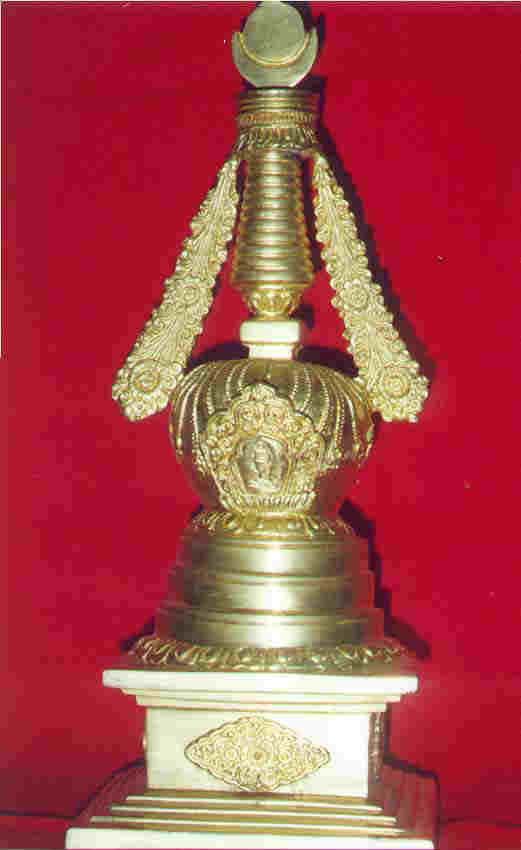
Illustration : http://www.exoticindiaart.com/buddha/ze12.jpg The Buddha's coffin proved impervious to
ordinary fire, but a divine flame came from within; it burned for seven
days and reduced Buddha's earthly remains to ashes. These remains, or
sharira, were divided into eight parts, and sent throughout the
world. The recipients reverently enshrined these holy relics in special
mounded shrines called stupas, where they became the subject of
worshipful reverence, often serving as the focal points of Buddhist
monasteries. |
|
In time, Mahayana Buddhist iconography
incorporated many more obvious characteristics of divinity into
representations of the Buddha -- perhaps in order to compete with the images
of Hindu deities. A halo-like aureole often surrounded the Buddha's head.
Flamelike projections sprang from his shoulders, and streams of water flowed
from his feet, recalling the miracle at Sravasti which had made manifest the
Buddha's transcendent power in the face of those who doubted him. Wheel-like
chakras appeared on his palms, and on the soles of his feet. |
|
|
The largest collection of Buddhist Art on the
internet is available at http://www.exoticindiaart.com/buddha Any comments or feedback that you may have will be greatly appreciated. |