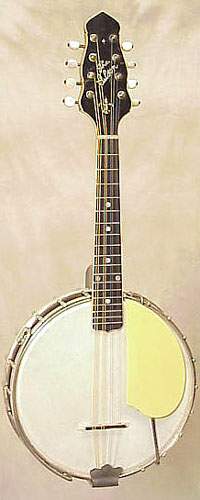
Gibson MB-4
(1924)
| MF3890 Gibson MB-4 mandolin-banjo, 1924, EXF, 9" head diameter, trap door resonator, silver plated metal hardware, pearl tuner buttons, Cremona brown sunburst finish, OHC......$1000 |
 |
|
Gibson MB-4 (1924) |
|
The hayday of the mandolin in the United States began in the 1880s and continued until the First World War. After that war, the banjo returned to popularity and became the most popular fretted instrument of the 1920s. This change in fashion left a lot of mandolin players out of a job, and looking for a way to conform to the new trend. Instrument makers offered two solutions: 1) the tenor banjo, and 2) the mandolin banjo. Both of these instruments are tuned like a mandolin (G-D-A-E) and can be played as a mandolin. It was the tenor banjo which became the popular instrument of ragtime jazz in the 1920s, but this instrument has a longer scale than the mandolin, and was not as easy to play for those mandolinists with smaller hands.
Virtually all mandolin (and, to a lesser extent, tenor) banjos were made before 1930. Why?
|
|
|||||||||


