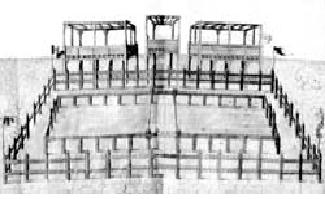
| Entering the Lists For Melee First the Marshal in charge shall enter the list followed by the Knight (or Squire) of Honor. When he has taken his place, the appellant ___________________, and those fighting under his banner shall approach and ask the judges to prepare a place in the list for him and his men. When all are in place the defendant,_______________, and those fighting under his banner approaches the same way. "...and they should go a pace with trumpets sounding and minstrels singing, as soon as someone opens the passage into the lists, by which they should enter: and when it is open, they should enter within, and their servants should make a great cry, and the journeyers should lift their arms high over their heads, making threatening motions with their swords or maces" René of Anjou, King René's tournament book: Traictie de la forme et devis d'ung tournoy. Translated by Elizabeth Bennett and illustrated by Will McLean. 2nd ed. rev., 1997. |
| Your Array First, examine your harness. Is it of one consistent period? Can you find a picture of a medieval Knight that looks like you do? Are there glaring anachronisms? Few harnesses conceal enough of blue jeans to hide their essential nature. The use of Hose, medieval shoes, or boots covered by sabattons are required by all members of the Company. The right covering can conceal a multitude of sins. Essentially, you have two approaches. Before 1350, the armor was less challenging, but the surcoats were usually sleeveless, so they covered less of it. When sleeves were worn, they were rarely longer than elbow length. After 1350, the armor was more sophisticated, but garments called jupons or coat-armors, often with long sleeves, sometimes covered much of it. From 1400 on uncovered plate armor became increasingly popular. The later a period you choose, the more dependent you become on a good armorer. For more details see the Armor, and Clothing sections of this web page. Your Retinue From the 14th century on, great persons often equipped their followers in livery, that is distinctive clothing, either of distinctive colors of fabric, or distinguished by badges, or both. The colors might be the same as the lord's arms, or they might not, and the colors of clothing delivered to the lords followers might vary from year to year depending on the whim of the lord, the availability of fabric, and so on. Liveries were often parti-colored, and sometimes tri-colored. The colors were not restricted to the pure colors of heraldry. Other options included light green, tawney (orange-brown), russet (rusty red-brown) and murrey (purple-red, or mulberry color). Liveries might consist of complete suites of clothing, sleeveless jackets, or sometimes simply hoods. Badges might be made from metal, appliquéd, or embroidered. Popular locations included upon the sleeve or hat, the middle of the chest and back, or upon what would now be the lapel, usually on the wearer's left side. A noble that really wanted to show off at a tournament would put his retinue not simply into matching clothes, but into elaborate costumes. Besides the examples I mentioned earlier, Claude de Vauldrey came to one 15th c. Burgundian tournament with a retinue of wildmen and wildwomen. Another had costumed moors in his train. This does present some opportunities for people with personas that aren't your standard late-middle ages West-European types. A Celt might come as "The King of Lyonesse" with a retinue in fringed cloaks, carrying Irish javelins. A Berber from the Maghreb might be followed by turbaned moors with nakers and kettledrums. (A real 15th century Burgundian doing this would of course try to find an elephant or pair of camels to add to the procession.) |
 |
 |
 |