
It is widely known that the T25
turbo which is fitted as standard to the Rover T16 engine can be somewhat
restrictive when
it comes to trying to realise serious power. It's relatively small size does
mean that there is extremely little in the way of
turbo lag, but while it may make for good responsiveness for the average driver,
it can mean getting more power a
difficult project. While I have spent a fair bit of time and money reducing the
inlet temperatures, a good deal of the heat
produced is due to the actual size of the turbo itself. Even though I may
actually be using relatively low boost pressure
levels, the inlet charge is still being compressed enough to produce unwanted
heat. One way around this is to prevent the
inlet charge from being compressed so much while still running the same (or
higher) boost levels and this can be done by
using a turbo with a larger compressor wheel and housing. This is the step I
chose.
The question next was which size
turbo to use. I liked the minimal lag that the T25 produced and while a much
larger
turbo would be used, I did not want to increase so much lag that the car would
not be as responsive in standard form.
The answer was to simply step up a size and use a T28. It was large enough to
make a difference while still retaining a
certain amount of responsiveness which I felt would be lost using a T3 or
larger.
The next step was to find a
suitable unit. One was soon found in the shape of a T28 which was fitted as
standard to a
Nissan Pulsar (Sunny) GTi-R. Both the T25 and T28 are manufactured by Garrett
which meant a certain commonality of
parts used which would make fitting of the new unit relatively easy.
Despite having a larger compressor wheel and housings,
the centre core of the turbo was essentially the same as was the exhaust
housing. This meant that the turbo would bolt up
to the exhaust manifold and the OE turbo outlet elbow which also contained the
Lambda sensor could be used. The
compressor wheel housings on both the inlet and outlet sides needed to be
adjusted slightly so that they could be lined up
as per OE settings. All that then remained was to connect the water feed and
drain as well as the oil feed and drain. While
the water side of things along with the oil drain all utilised the OE pipework,
the thread tapped into the centre housing for
the oil feed was found to be different. This meant adapting a union connection
from the spares box. A minor problem.
One final difference was on the exhaust housing which bolts up to the exhaust
manifold. On the OE T25, the mating surface
is drilled and tapped and 4 studs are inserted. With the Nissan set-up, the
studs are inserted into the exhaust manifold. This
was simply overcome by using bolts with 'deformed' nuts. 'Deformed' nuts are
used due to the extreme heat generated by the
exhaust. Thread lock is not an option and neither are locking washers as they
will quickly lose their 'spring' capabilities.
With everything now bolted up in
place, it was time to start the engine. When fitting a new turbo, it is vital to
allow oil
pressure to build up so as not to damage the bearings. The easiest way to do
this is to disconnect the main ignition lead
and crank the engine over until the oil pressure warning light goes out. I then
crank the engine for a further 30 seconds just
to make sure. The lead is then reconnected and the engine started as per normal.
The engine is left to idle until normal
normal operating temperature is reached and the entire assembly is checked for
any leaks.
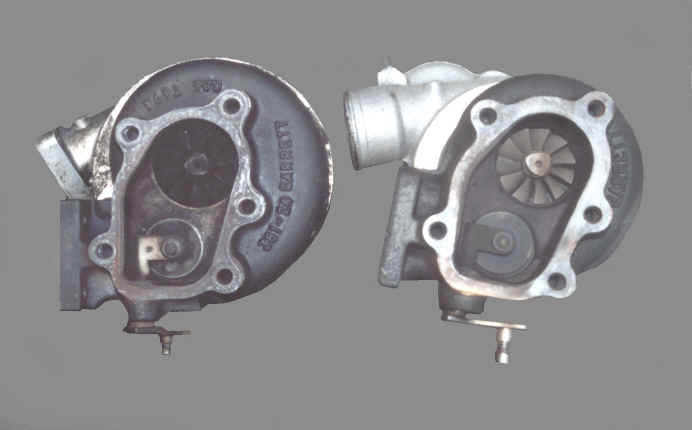
The picture above and below
compares the T28 (right) and the T25. (All pictures were taken before the inlet
and exhaust housings were
adjusted) Note that the mounting holes for the exhaust elbow is identical on
both turbos. It is also obvious that the T28 exhaust
compressor wheel is larger.

The T28 and T28 from the inlet
end. The most obvious difference here is the inlet compressor housing. Not only
is it considerably
larger on the T28, but is also lacks the recyclable dump valve which is fitted
to the T25 unit. The absence of this necessitates the
fitment of a valve elsewhere in the system.

The next two pictures (above and
below) show the top and bottom views of the turbos. The difference in size of
the exhaust
compressor housing is more evident here. Note the identical size of the casting
which bolts onto the exhaust manifold. You can
see that the inlet hosing has a flange. The Nissan uses an alloy pipe which
bolts directly onto this - this pipe was also utilised in
the conversion.


The pictures above show the alloy
90 deg elbow which is OE on the Nissan. This was simply bolted onto the turbine
housing and
a thin layer of gasket sealant guards against leakage. A short piece of hose was
then used to connect to the pipe which goes to
the chargecooler. When time allows, I fully intend removing this elbow so that
it can be polished smooth.

As you will notice from the
pictures above of the turbos, the T28 has a different casting on the inlet side
which connects
to the pipe from the air filter. A simple short alloy pipe with a flange is used
on the Nissan set-up and, again, this was
carried over to this conversion. The picture above shows this held in place with
two bolts and a gasket seals the joint. A
short piece of hose is then used to connect to the air filter pipework.


As the T28 does not have an integral
dump valve, a new one was going to have to be installed into the system. A lot
of literature will advise that the best place for a dump valve is as close to
the throttle body as possible. Due to the
chargecooler set-up, this was not a viable option. It was decided to mount it in
the easiest place possible which was
between the turbo and chargecooler. Once again, I turned to Quest4 and to their
range of excellent dump valves (also
know as 'blow off valves here). It is a piston type and sounds very nice. A
piece of alloy pipe was welded onto the boost
pipe after a hole was cut out. The dump valve could then be attached using a
short piece of hose. The OE hose which
attached to the dump valve on the T25 was retained and simply re-routed. Job
done.

A HUGE thank you to Kyrie and Dan at Quest4 for their help with the above. Click on their logo above to visit the Q4 website.