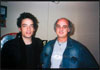
Jakob Dylan interview, october 2002
Too cool for rock’n’roll
(Published on JAM Magazine)
Last time we spoke I remember that I asked you 'Please don't make us wait another four years for a new album' and you did it...
J: But yeah, got done in two.
But this time you have to come to play in Italy.
J: Yeah, we blew it last time.
Did you play some dates in Europe?
J: No, Japan the first time, that's it.
How was it?
J: Japan’s great. We have a lot of fun. But yeah we haven't played in Europe in so long, but hopefully February.
I heard that, I don’t know if ití’s true, that the Buckcherry guitar player is playing with you.
J: Yeah, he's with us.
Oh wow he's great.
J: Have you seen Buckcherry play lately?
I’ve never seen him playing live but I really love their albums.
J: Yeah, he's a phenomenal player. I mean Buckcherry's doing that one rock thing which he can obviously do but he's an extremely well rounded player.
Great but does it mean Buckcherry have split up?
J: Over.
Really? that’s too bad.
J: Yeah, he quit and then the other guy quit and the two main guys went on for a few more months and just split up.
So, I want to be honest. The first time that I listened to the album I didn't like it so much.
J: Yeah.
I was quite shocked by the sound and...
J: Uh huh.
And then I listened and listened again and I have to say that I love it.
J: Oh good. That’s the best way to get something
I have to say that Breach was a step toward this sound.
J: Good
And so now it makes perfect sense to me.
J: Yeah, cool.
I heard that you wrote most of the songs on the road.
J: I wrote a bunch of them on tour. We did, as you requested, your four-year problem, to have a new album out soon as it was possibile. I wanted to take advantage of the touring time coz there's so much time that you're out there. I wanted to make sure that I was using it all. So when we got home from the tour I didn't have to spend six months writing a record. So I was writing during breaks and I finished writing a lot of it on tour and we did a lot of recording on tour. We took out some portable equipment. Just tried to stay ahead.
How was it? Because speaking with musicians, most of the musicians always say that they are not comfortable to write songs while on the road.
J: That’s why I’ve never done it because it's very hard but really, I know it's possible. You can get lazy on tour in that way and when you get a chance to sleep you just sleep. So this time I just spent all my extra time working on the songs.
Judging by how good the songs are, do you feel more comfortable now writing this way or was it just....
J: Yeah, it was a good time really. I just really wanted to make sure that...you know, we were doing our last tour and it was like a two month tour and my mind was already on the next record and I just didn't want to go on tour and do these shows and just...you know, I was already thinking about it so I just got right into it, the writing of it. For that purpose again I would try it. It’s a lot of work, a lot of discipline to write on tour. It’s not in your little area so for time purposes I could do it again but hopefully I can just stay ahead of the game.
I heard that it was recorded in Jackson Browne studios?
J: Yeah well actually we recorded 'Bringing Down the Horse' at Jackson’s studio also. It’s not really a public studio. You can't just call up and use the room but since we recorded part of, a lot, most of 'Bringing Down the Horse' there and he likes the group, he lets us use his studio coz it's in a great part of town. It’s not in Hollywood; it's towards the beach. It’s just more comfortable there.
What are the 'red letter days'?
J: In calendars, they marked important days in red ink, days that were memorable in calendars
Ok so they are specifically for..
J: Yeah, I thought the title...you know a lot of these songs...or all these songs are written about today and I think we are living in important times, obviously.
You are working with Toby Miller again. Your old friend Toby Miller. I bet that you guys always remain in touch.
J: Yeah, we've always been in touch. You know I started this group when I was 18 years old and once I had this record written and the band had already worked out the songs I’ve already met all the producers, all the big names. I just didn't want to meet anybody else. I didn't feel the need to use any of them. He’s been very successful. I think he knows me better than anybody else. He knows this band better than anybody else having started it
So now that he's proven himself as a producer it was fantastic to get him.
Of course there is the great Mike McCready on guitar. I saw the Pearl Jam on stage a few times. I think he's absolutely one of the best guitar players
J: Yeah he is.
How he happened ot have him on the album..
J: Right before we started this record we removed our guitar player. So I played a lot more guitar on this record than usual and another guy Val McCallum, from Los Angeles, came in to play and there were just some spots that were open on the record that we couldn't really fill in yet and I heard that Mike was in town and I’d met him a few times and just invited him to come play.
I think that 'Everybody out of the water' is probably your hard rocks, hardest, heavy rock song that you've ever recorded.
J: Yeah, it might be.
How did the song came out? I mean it came out because there was Mike in the studio with you or you were looking for...
J: No, I’m not even really sure if Mike's on that song. It’s just every song writes itself. Every song tells you how to play it, you know, and that song just wanted to be like that. Not a lot of theory behind it, you know. The song just sounded right being played like that.
Last time we talked you also told me that your main goal was to look for songs that you would be proud for the rest of your life. I mean, looking back in years..
J: Yeah. Looking at these songs, they become your catalog, they become your life when you go out there and once you put them on record, people want to hear them forever if they come to your shows so I certainly got songs on the other records that I don't want to sing anymore. You know and that's always going to happen but hopefully you get so many on each record that you're going to want to continue to sing.
Also I read, I think it was on Billboard, that you were talking about the new songs and you were saying that most of the new songs have a happy mood to them. Is this....
J: Billboard said that?
I think, I’d have to check.
J: People keep asking me why the record's such a happy record. The titles appear happy, you know, the titles look happy but I don't think it's a happy record at all. I mean I think it's...I think in every song there's positivity, you know there's a willingness in every song to persevere but I don't think each situation of the song is...I don't think I’d quote any of them as happy thoughts, really but they're just not terribly negative.
I asked you this because I was thinking that maybe it was a kind of reaction to the tragedy that America’s has been thru after September the 11th.
J: The record definitely it's not a direct response to any of that like Bruce Springsteen's record, I didn't do anything like that. His is very direct that but the rest of us as well as any writer in any country, those are devastating results of where we are today and it affects everything we do, it affects the way I write songs, it affects my outlook of the future but it doesn't really...I didn't write any songs about that though.
How do you like the Bruce Springsteen new album?
J: I like it. You know it's very direct. It’s not a lot of imagination involved. He’s singing very direct about these situations and you know probably the only one who could pull it off is Bruce. I think he did a great job.
Because I listened to your songs, this time more than ever, I have a thought that your voice has a natural sadness...this time more than ever...that's why I asked you about the happy mood because there is a beautiful sadness in the way you are singing. More than ever you are a rock musician but you make me think about a soul singer: your voice, your singing. It is natural for you to sing or...
J: Ah well you know, I open my mouth and whatever comes out comes out. I can see what you are talking about myself but I know the qualities you're talking about that I feel in other artists. There’s nothing methodical about it, I mean that's just the way I sing but I’ve listened to a lot of soul music. I can't sing like that. You know I’m no Otis Redding. They are some of my favorite singers, Sam Cooke is one of my favorites of all time.
This time really...your voice is the thing that really got me on this album.
J: Oh cool.
The song 'Pleasantville' is it in any way related to the movie?
J: No, no, it got mislabeled on here. I knew that would be confusing to people. The actual title, this is an advance copy, the actual title is 'Here in Pleasantville' just to make sure nobody is confused.
Is just a term for something that appears to be an ideal place but a lot of irony though, involved with that title.
Sorry I have too few questions. I was hoping to work much more about this interview during the weekend but I was in the hospital, my new childre just born the other night
J: Oh well congratulations, man. Don’t worry about it!
How old are your children?
J: Our kids are 2, 4 and 8
8, the first?
Yeah, Elvis is 8.
It’s been ten years since your first album. It’s quite a long time. You are not anymore the new kid on the block...I mean you have a career now. How do you feel about these ten years making records?
J: You know, the only regret I have in ten years is that there’s only four records. You know I wish maybe we would have used the time a little bit differently but looking back on it there was never...I did them as quick as I could. You know, I mean we did a lot of touring and lost a couple record deals early on that set us back. The pace we've had in the last couple years are the ones I’d like to maintain. Touring for a year and then right back in the studio. For ten years has been pretty colorful. It’s a pretty interesting career. You know there's nothing in the career that I’m not proud of. It’s all part of it. It’s not really; I mean I’m not looking at any one moment as the defining moment. It’s going to be, hopefully a very lengthy time to look back on.
You’ve had some great moments in these ten years.
J: Oh, I’ve had a lot of good times, yeah.
Apart from the Grammy’s, you have played with great artists, with The Who. There was a moment where you sang with Bruce Springsteen as well.
J: Yeah, there are certain things... Is there a moment you have...the reason for doing this work, the moment that you would say... Yeah, there's been a bunch of them. You know they're all, you know...opening for The Who, as well as the Rolling Stones and Bruce playing with us. Yeah, it's like catching a wave. You know it's been a lot of cool things like that. One of the things that stands out was when we did play with Bruce, yeah I figured we'd play a bunch of older songs. We played 'My Girl' and he knows all those songs. 'Tears of a Clown’ and 'The Tracks of my Tears' whatever and he...you know I said 'What else do you want to play?' and he said 'play God Don't Make Lonely Girls' which was a song on 'Bringing Down the Horse' and you know, it was...I realized then that he actually listened to the whole record. He hadn't just heard the radio songs. He heard the whole record.
Cool.
J: Yeah, it was very cool.
And I mean of course you are satisfied with the new album but are you planning to go on? Because I was talking to Sheryl Crow some months ago and she was...I was very surprised she told me that she was thinkin’ to retire, quit being a musician, some kind of retire. I was quite shocked about this.
J: She’ll never quit. Don’t worry about her quitting. No, what else am I going to do? You know? It’s the only think I like to do and it's really the only thing I know how to do. You know, one way or another I’m always going to be writing music and playing music so if I can combine that with the work ethic and make a living at it and tour around the world, I mean who's to complain? I’m not going to complain. Thatí’s a gift.
J: I asked you this because many musicians sometimes they think to do something else, like producing other artists
J: That’s true, that's true there are certainly times where you think I don't want to be the guy up there anymore. I don't want to be the guy who's got to entertain people. I don't want to be the guy in the videos anymore. I don't want to be the guy giving interviews anymore. I want to be the guy who just kind of does the work and gets to go home and watch it all and pull the strings, you know? But you know, I don't know if I would be as happy helping somebody out in that way. Because the rewards that you get from doing something that reaches people, once you realize the power of it, it's just something that you want to keep doing.
I heard rumors about the collaboration with Beck, is it? Did it ever happen?
J: No, we've never worked together.
Have you worked with John Doe?
J: Yeah, I’ve worked with John Doe, yeah.
You co-wrote something or you just...
J: No, I just sang on his new record.
Is it out?
J: His record is out in the US, yeah, I don't know if it's here. That’s another cool thing we talked about before, working with the Rolling Stones and that kind of stuff. You know John Doe was a hero of mine as a kid. You know X was one of my favorite groups. He came out with us last year and toured a little tour with us by himself, rode on the bus with us and I got to become friends with him and he's a very inspiring guy. I was real excited when he called me to come down
I see that you are quite involved with your official web site.
J: I try to be.
Sometimes you wrote the letters and stats.
J: I try to be. You know that's where kids get their information now. It wasn't like that when I was a kid but I didn't even understand the Internet until about a year ago. You know I had no idea this world had existed on there. When I was a kid you joined fan clubs and write letters and now you can just respond to people right away. It’s convenient.
It’s such a fast way to talk with people.
J: Yeah, it's cool, I like it.
I always appreciated the video you guys do for your songs. How is it ,you enjoy?
J: Oh good. It’s very hit and miss. You never know, you never know if it's going to work.
But are you involved in some way with the ideas? Because I think it was 'Three Marlenas' the video where you were coming out of the water... What was the idea behind the video?
J: I don't know, that video...I got sick making that video. They kept throwing me in the water and I did, I turned blue. We had to stop. My lips turned blue. But if I remember that video, those directors had the concept of the three-dimensional look that you see in that. How things move around. That was the first time it had ever been used and since then it's been commercial in the videos, but at that time it had something to do with using multiple cameras all around but it hadn't been done yet. No one had make a video using that concept yet. And you know that's what I look for in videos I mean for the most part. I look for a story line, I look for a look. You know, just a visual.
The Wallflowers' videos are always so strong. There is a video from Breach which is very cool; the one with clips of you guys in back stage and playing. It’s just powerful. I always thought that you were involved with the idea but...
J: Oh yeah, I always...you can't just show up. I mean you got to...usually you know, you just send out a song to four or five directors that you like and they write something. If it's something terrible you just throw them right out. And a couple of them, like well the guy's got something going on here and you know you just talk with them and you tweak the idea a little bit and you know we always...I don't want to direct the video. I can't do that but I like to know what's going on. I like to have my say.
I had a chance to listen to your unplugged you did for MTV. I think that some songs came out as B-sides, if I’m not wrong. Why did you never publish it as a complete recording?
J: No one really does that anymore. I think that was a popular series. But by the time we started doing unplugged they changed the show. It used to be an hour show. The year that we did it they made them a half hour. It just...MTV is the one who releases those records and I don't think they do them anymore.
And you, the artist can't decide?
J: I suppose I could. I just...I never even listened to it. I don't know if it was any good. I’ve never listened to it, you know.
It was so good.
J: Oh? I’ll have to take a listen.
Is there any chance in the future to do a live album?
J: Oh yeah, I’d like to do that, sure.
How about the lyrics which can be short pictures of the... I don't want to ask you about each songs but there is a particular song...
J: No, just in general. The lyrics in general, the record you know it was about the perseverance more than anything and it's about the need to see something positive in what is obviously not, and I don't think any of the ideas in these songs hit a dead end or depression. I think that my obligation in writing songs is to tell truth and say it the way I see it and I got to be honest and do that and you know it has not been a really uplifting year for anybody. So you're left with the choice of lying and writing a good positive record or you know you key on to the real obvious and write a depressing record. So there's a middle ground somewhere I just try to tell the truth and I need to see that the world can keep turning and that everybody gets a future, which is not how we always thought last year. So I think all the songs, you know, are just for myself, you know, about perseverance.
J: 'When you're on top' is a song related to the big success of 'Bringing down the horse' or maybe it is some way related to your personal experience?
J: Yeah it is, but not so much my career as the realization that it can always be worse. No matter how bad you think it is, you can feel left behind but, you know, things can always get worse.
I have to say that I love 'When you're on top' even if, as I told you, the first listen...the first thing I thought was what's happened here? electronic drums??
J: A lot of people said that and that was one of the reasons I had to start the record with it and had it be the first single. It’s just... you know, but the second song is much more familiar to people as a Wallflowers song, I wanted to... I’m not protecting my sound. I’m not looking back on anything. That song was right where we're at and I wanted to get on with it and start with it. If it shocked somebody, it's ok, move aside. You know, you don't have to buy it. You know it represents the group really well this time.
This is what the best artists have to do. You have to do what you believe.
J: That’s right, exactly.