SELF-DEFENSE
Index:
Thoughts
On Self-Defense
Simple Techniques
for Self-Defense
"Size Doesn't
Matter"
Self-defense
isn't about doing moves or using techniques, is the way you think.
Techniques are the easier part, as every one can learn the basics in a very
short time. Self-defense techniques are simple, efficient, and straightforward.
The hardest part is in your mind. Self-defense is about your body being yours
and no one else's, about making your own choices and controlling your own life,
and about doing whatever is necessary to stop other people from hurting you.
Self-defense is what you do to keep yourself safe, and in control of your own
choices.
"Could I do that to stop someone else from hurting me? From hurting someone
I care about?" That's the real question. When we are talking about
self-defense, we are talking about doing what you have to, to stop someone else
from hurting you or someone you care about. It wasn't YOUR choice to be forced
to defend yourself. The other person made their choice to hurt you, but your
body is YOURS, and NO ONE has the right to hurt you. You DO have the right to do
whatever is needed to stop them from hurting you.
If someone is actively trying to hurt me, or someone I care about, I will do
whatever is necessary to stop them, and if the easiest, most efficient, and
safest way to do that is to stick my thumbs in the attacker's eyes, I'll do
that. I won't be happy about it, but, you can bet on it, I'll do it.
And I'll stop him from hurting me. Efficiently, with a minimum of effort, a
maximum of effect, and a minimum of danger to you and the people you care about.
I really can't emphasize enough how much of self-defense is in the mind.
The techniques I can tell you, and that you
could learn from a weekend seminar, will help you get out of "casual"
attacks, and the medium-type attacks, where someone just gets out of hand, or
picks starts a fight, or is stupid and grabs you. Even then, no training is
perfect, and without practice, no one gets good. But the most important part is
still the mindset.
Just reading these won't do you much good. Practice with someone. Anyone. Even
if you only take 15 minutes once and try these things out three times each,
that's something, yet. They are simple, and effective on anyone. But to know
what you are doing, you need to TRY THEM. I mean practice with a friend. And the
more you practice, the more chance you will have when using them.
A few thoughts, first.
I'm NOT saying these will get you out of a situation all the time, and I'm NOT
saying they will work in each case, and I'm NOT saying that once you learn these
you can do what you want, and I AM saying to be careful when practicing with
friends, and I AM saying if you use any of this it's your own choice, and I AM
saying that if you maim or kill someone by accident it isn't my fault.
Short, blunt form: Nothing works all the time, folks. None of this stuff is
guaranteed. You make your own choices, and do what you decide. I'm not telling
you what to do. And if you practice with a friend full-force like an idiot, what
happens is YOUR fault. Don't be sorry. Be controlled. Don't be stupid. Think.
2) This stuff works but: a) you need to know when to use it, b) you need to have
the confidence to use it, and c) sometimes, it just isn't enough.
People, like I said, this little drabble won't teach you to defend yourself in
all situations. If you want to know how to do that, take a self-defense class.
Do NOT think that just because you read this (or anything, for that matter) that
you can handle yourself in any situation, because you "read that
self-defense thing, and know a couple moves".
3) These techniques are for escape and evasion. There are other things you can
do with them, but the main idea here is to give yourself some room to run, and
some time to do it in. Simple as that.
These are NOT for attack. These are nasty---that's what makes them work. You do
NOT walk up to someone and just do any of these. These are for defense. But you
get the idea, I'm sure.
Okay, technique time:
BUT FIRST, one tactical thought: Women, if a guy grabs you, where will you
probably try to hit him first?
I bet you said, "I'm going to kick him in the groin. Of course."
Would like like to know the one place you should NEVER attempt to first strike a
guy? The groin.
Why? Simple. Every guy in the world has been
kicked in the groin at least once---and he KNOWS that if a female gets mad at
him, that is the FIRST place she is going to try to hit.
Plus, every self-defense class in the world trains people to kick the groin. And
every guy out there knows it. It's a great target----for the second or third
shot. But not the first one---he's expecting it.
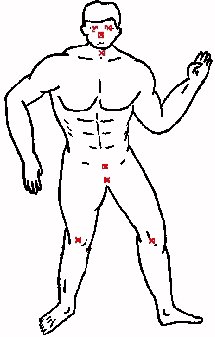
Enough playing around: STANDARD TARGETS
There are certain points on the human body where no matter how big you are, how
strong you are, or whatever, it STILL hurts to get hit there. This is, of
course, where we want to strike.
This is a diagram (a VERY basic diagram) of the human body. The red points are
where you want to strike.
 |
STRIKE
POINTS:
The nice things about these is that you already know where they are, and
what they do. You've known since grade school. (You may not admit this,
but it's true.) If you poke someone in the eye, in the throat, hit them
with a palm on the bridge of the nose, strike to the groin, kick them in
the front or side of the knee----these will all hurt, distract,
whatever----and it works on everyone. None of these points are covered by
muscle, fat, whatever---size and condition does not matter. The only thing
that matters is how hard you strike.
|
Striking eyes and throat:
Put index and third finger together, curl others to palm. Do NOT hyperextend
your fingers, merely hold them rigid. Strike (think like a spear)
straightforward into the eye or right above the hollow of the throat. Don't
strike directly into the hollow---strike about 1/2 to 3/4 of an inch above it.
(Note: you can also strike these points using only the thumb).
Bridge of the nose:
Hold out your hand, and spread your fingers wide. This tightens the hand,
and pushes forward the palm side of the large knuckles. Feel how hard they are?
Push your hand forward and strike with that area right below where the nose
joins the brow ridge----basically the center of the nose.
Groin areas:
Many ways you can strike here: Knees, feet, or hands.
KNEES: If using a knee, simply bring it upward as hard as you can----but think
of the end of your knee as a point---and drive that point into the groin. If
your hands are free, before striking, grab the attacker's hips, and pull the
attacker into the strike as your drive the knee.
FEET: Simple. Bring your instep up into your attackers groin. However, if you
are too close for that, but too far to use a knee, kicking straight up and
striking with the shinbone of your leg works just fine also.
HANDS: Swing your arm in a straight-arm upward strike into the groin, either
using an open-hand palm strike, or a closed fist----the closed fist strikes just
the same as the open palm strike, except the fingers are curled---still a
straight-arm strike.
Striking the knees:
Striking the knee is something self-defense classes always teach, because it
is a serious weak point on the human body. However, it can be harder than it
sounds.
If striking the front of the knee (the kneecap) drive your HEEL forward into the
kneecap, and drive it far forwards---just tapping it won't give you enough time
to get away.
If striking the side of the knee, there are a couple of different ways to do it,
but the easiest (note: this is according to me) is to sweep the INSIDE of your
foot in a circular motion, striking the side of the knee---and strike hard,
again. (That was for if you were standing in front of the attacker.)
If you are standing beside the attacker, pick up your foot, and drive your heel
sideways and downward (at about a 45 degree angle) into the side of his knee.
Hard.
Note: all of the knee attacks can be difficult without practice---AND, you will
be off balance more than if you were using a hand technique. So, they
work----but practice them. Don't try something and fall over. That's not a good
thing.
Now, remember----the idea here is not to destroy your attacker, beat him up and
drag him by his collar to the nearest police station. Your mission here is to
ESCAPE UNHARMED. That is your goal. So, if you hit him once, and he's clutching
his eyes and can't see, then run. No sense staying around and giving him time to
recover, hmm?
You might have to hit him a couple of times, and do some serious damage----but
as soon as you have a chance, GET AWAY.
That's your goal. Get away unharmed. Remember----all you are doing is stopping
this person from harming you. Do what is necessary, then escape.
"Size and strength don't matter."
It is true in a way, but not really.
For certain techniques it doesn't matter how big or strong the other person is.
Poke them in the eye, jab them in the throat, lock back the knee, size won't
matter. So people aren't lying when they tell you size doesn't matter. Not
necessarily. But don't believe it never matters.
When you are just starting out, it matters. When you've only been doing it
awhile, it matters. When you are sparring people in your martial arts class, it
matters.
A good big guy, in general, will beat a good small guy up to a certain point of
experience and knowledge.
Size does matter. If I'm fighting against a guy twice my strength and size, I'm
NOT going to try punching him in the chest. I'm also definitely NOT going to
stand there and attempt to trade punches with him. I'm not going to use strength
moves, I'll use soft tissue techniques and I will NOT close with him until I
have him stunned or off balance, because if he grabs me, I'm in trouble. A
small person can defend himself against a big person. But it's an uphill battle,
make no mistake. The trick to winning is fairly simple: Be smarter, and be
nasty.
What that means against bigger people is simple: you are probably going to have
to upgrade the seriousness of your techniques, and go for soft tissue (fairly
damaging) targets instead of simple disables. Because your margin for error just
went down: a big guy hits harder than a small guy.
Page made by R.Palandri
You're visitor  since 08/17/2000
Last update 08/17/01 06.36