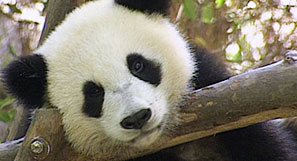

Giant Panda
Classification

Kingdom: Animalia
Phylum: Chordata
Class: Mammalia
Order: Carnivora
Family: Ursidae
Subfamily: Ailurinae
Genus: Ailuropoda
Species: Ailuropoda melanoleuca


Habitat

	Giant pandas are found the in the mountains of central China – in the
isolated north and central of Sichuan Province, mountains bordering southern
most of Gansu Province and in the Qinling Mountains of Shannxi Province. Giant
pandas require a dense bamboo and coniferous forests at altitudes of 5,000 to
0,000 feet where mountains are shrouded in heavy clouds with torrential rains
or dense mist throughout the year.

	Giant pandas believe to have existed since the mid-Miocene Era – about
3 million years ago. Their geographic range extended throughout southern China
and fossil remains of their ancestors are found in present-day Myanmar and
Vietnam.

	Giant pandas home range is rather small compared to other bear species.
In general, they requires from 3.8 to 6.5 square kilometers. Giant panda home
ranges are shared with other bears. Females stay in small discrete range of 30
to 40 hectares (75 to 100 acres) in size while the males have larger home
ranges that overlap the home range of several females.


Physical

	For more than a century, scientists have debated whether giant pandas
belong to the bear family or raccoon family or a separate family of their own.
The reason is that the giant panda and its cousin, the lesser or red panda,
share many characteristics with both bears and raccoons. Recent generic code
(DNA) analysis indicates that giant pandas are closely related to bears while
the red pandas are closely related to raccoons.

	Giant pandas look like a bear with striking blank and white markings.
Their rounded ears, eye patches, shoulder band, chest, legs and feet are
black while the rest of the body is whitish. Within its natural environment,
its mottled coloring provides camouflage. There is also speculation that it's
striking color pattern may be a clear message to other pandas to stay away as
the giant panda is an extremely solitary animal.

	There is an ancient Chinese story about how giant pandas got their
unique markings. A young girl who was a friend of these bears died and the
pandas were struck with sorrow. They wept at the funeral and rubbed their
eyes with their arms. The dark color from their arm bands was wiped onto
their eyes. The bears then hugged themselves and marked their ears,
shoulders, hind legs and rumps, resulting in the pattern seen today.

	On average, an adult giant panda can grow up to 4 to 6 feet long
and may weigh up to 350 pounds. Males are typically weighing about 10% to
20% more than females. Male are also slightly longer than females and
have stronger forelegs. At birth, a baby giant panda weigh only 85 to
140 grams. They are active mainly at twilight and at night.

	The fur of the giant panda is thick and coarse. It consists of a
coarse outer layer and a very dense, wooly-like under fur. To the touch,
the fur feels oily. This oily protective coating helps protects giant pandas
from the cool and damp climate in which the bear lives.

	Giant panda’s skull characteristics are similar to other bear species.
They have a massive head and develop large molars that are designed
specifically to crush fibrous plant material. It has powerful muscles that
extend from the top of its head to the jaws giving it the capacity to crush
tough stalks. They also have very powerful teeth.

	Giant panda also has a very furry tails of 10 to 15 cm long and is
pressed close to the body makes it not easy to see.

	The giant panda has unique and extremely flexible front paws with 5
fingers. One of the wrist bones (the radial sesamoid) is enlarged and
elongated and is used like a thumb; this is called pseudothumb, enabling the
giant panda to grasp stalks of bamboo stems and leaves with dexterity and
precision. This also allows them to direct bamboo stalks (or culms) and
leaves to their mouths in a sitting position.

	They have plantigrade feet (i.e. both heel and toe make contact with
the ground when walking in a manner similar to humans). The way giant pandas
walk and climb are very similar to other bears. The hind feet of the giant
panda lack the heel pad found in the other seven bear species.

	Being a sedentary bear, giant pandas usually stay in selected
feeding are eating large amounts of bamboo and they generally move in a slow,
determined manner. When startled, they will move at a slow trot to escape
danger. With their short claws, they are capable of climbing trees very easily.

	The throat of the giant panda has undergone significant evolution as
the esophagus has a tough, horny lining to protect the bear from injury due to
bamboo splinters. The stomach is similarly, protected with thick muscular wall
linings. However, their short intestine is still not sufficiently developed to
remove all the available nutrients from the fibrous bamboo on which they feed.


Behavior

	Unlike other bears, giant pandas cannot walk on their hind legs and
do not hibernate because there is not much fat on a bamboo diet. However, it
will descend to lower elevations during the winter. Giant pandas do not build
permanent dens but rather take shelter in trees and caves. They are primarily
terrestrial, though good climbers and capable of swimming. They live in a
solitary life except during breeding season. Mother pandas play with their
cubs and some actually woken the cub to start to play.

	Pandas communicate by rubbing an acetic-smelling substance secreted
by glands surrounding the anogenital area onto tree trunks and stones. They
also scratch trees. Male giant panda marks their territories.

	Giant panda seem quiet, but they can bleat, roar, growl and honk.
In the wild, there are 12 distinct vocal calls identified, however the
function of each is unknown / not understood. In captivity, females vocalize
during estrus as well.

	Giant pandas are curious and playful especially when they are young.
In zoos, they like to play with enrichment items like piles of ice or sawdust,
puzzles made of bamboo with food inside and different scents like spices. They
have unusually thick and heavy bones for their size but they are also very
flexible and like to do summersaults.


Diets

	Giant panda is omnivorous. However, bamboos represent 98% of the giant
pandas diet. They must eat 20 to 40 pounds of bamboo each day to survive as
bamboo is low in nutrients (bamboo leaves contain the highest protein levels,
stems have less) and spend 12 to 20 hours each day feeding. However, they have
been known to consume as much as 84 pounds of fresh bamboo shoots at one
sitting. They eat rapidly and select the tastiest parts of the bamboo. Giant
pandas only digest about 20% of what they eat because of the inefficient
intestinal system.

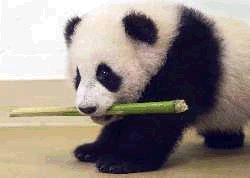
	Pandas grasp bamboo stalks with their five fingers and a special
wrist bone, then use their teeth to peel off the tough outer layers to reveal
the soft inner tissue. Strong jaw bones and cheek muscles help pandas crush
and chew the thick stalks with their flattened back teeth. Bamboo leaves are
also on the menu, as pandas strip them off the stalks, wad them up, and
swallow them.

	A giant panda only eats 25 species of bamboo in the wild. However,
only a few bamboo species are widespread at the high altitudes pandas now
inhabit: -

	•Fargesia spathacea		•Sinarundinaria fangiana
	•Sinarundinaria chungii		•Sinarundinaria nitida

Other bamboos includes: -
	•Bambusa glaucescens		•Bambusa tuldoides
	•Bambusa textiles		•Fargesia fungosa
	•Bambusa beechyana		•Phyllostachys aurea
	•Bambusa ventricosa		•Phyllostachys nigra
	•Bambusa vulgaris		•Phyllostachys bambusoides
	•Bambusa oldhamii		•Phyllostachys aureosulcata

	Because of the synchronous flowering, death, and regeneration of all
bamboo species, pandas must have a least two different species available in
their range to avoid starvation.

	Throughout most of the year pandas have a water imbalance because
their feces eliminate more water than the food brings in. Pandas drink a
lot, presumably to help push all that tough and woody bamboo through their
digestive system.

	Other than bamboos, giant pandas also feed on rice grasses, bulbs,
gentians, irises, fruits, crocuses, fish, pikas, vines, mushrooms, carrots,
yams, small insects and rodents; and carrion.


Reproduction

	Giant pandas have an average lifespan of 15 years in the wild but
known to live into their 20s in captivity. A panda named “Du Du” in Wuhan
Zoo in central China lived to be 37 years old. She holds the record for
the oldest panda to have ever lived.

	Giant pandas reach sexual maturity from 4 to 10 years of age and
mate during spring from March to May. Pandas usually reproduce once every
two years. Females are estrus for 1 to 3 weeks but peak receptiveness last
for only a few days, normally 2 to 7 days. Unlike other bears, males will
often roar to announce their presence to receptive females. Females may
mate with several males during the breeding season.

	Through a remarkable process referred to as delayed implantation,
the fertilized ovum divides a few time and then floats free within the
uterus for a few months with its development arrested. Females are less
active as estrous begins, however they become relentless, lose their
appetite, and their vulva swells. Sometimes around June or July, the
embryo will attaché itself to the uterine wall and after a gestation
period of 8 weeks, giant pandas give birth to 1 or 2 occasionally 3 cubs
in August or September in a sheltered den, usually in a hollow tree or
cave. Normally only 1 cub is raised / survives. The eyes of the baby giant
panda open at 1 ½ to 2 months and the cub becomes mobile at approximately
3 months of age. Cubs usually weaned about 9 months of age. They remain
with their mothers for up to 18 months.

	A baby cub only about the size of a stick of butter at birth and
they’re hairless and helpless. They weigh from 85 to 140 grams. The young
 cubs will have acquired the typical giant panda fur coloration within a
month of their birth.

	The mother will use the maternity den for a month to a month and
a half and gives great care to her tiny cub. For several days after birth,
the mother does not eave the den not even to eat or drink. Yet despite
the attention they receive from their mothers, many young pandas do not
survive.

	Immediately after birth, the mother cradle the new born in one
forepaw and holding it close to her chest so that it is able to suckle
similar to a human mother nursing her child. Suckling takes place up to
14 times a day and last for periods of up to 30 minutes.

	The cubs open their eyes at 3 weeks and cannot move around on
their own until 3 to 4 months. Giant panda cubs will start eating bamboo
by the time they are 6 months old. Panda cubs start to climb trees when
they are only six months old.

	At 3 months old, giant panda generally weighs between 5 to 5.5kg,
while a 6 months old panda weighs between 12.2 to 12.5kg. A panda aged
1, 2, 3, 4 years old weighs about 38kg, 72kg, 87kg and 97kg respectively.


Natural Enemies

	Some animals, such as jackals and leopards prey on pandas. The
yellow throated marten, a relative of the weasel, sometimes eats giant
panda cubs. Healthy adult giant pandas seem strong enough to defend
themselves against the attack of most other animals. Researchers once
observed a female giant panda chasing a black bear that was too close
to her cub.


Reason for Extinction

	Today, there are only around 1,000 giant pandas survive on earth.
There are several reasons why giant pandas are endangered.

	• Habitat destruction
	  China has more than one billion people. As people build more
	  cities and farms and use more natural resources, giant pandas
          lose their homes.
	• Hunting
	  When hunters set snares for other animals, like musk deer, the
          traps often kill pandas instead.
	• Low reproductive rate
	  Pandas like to be by themselves most of the year, and they have
          a very short breeding season when a male will look for a female
	  to mate with. Females give birth to one or two cubs, which are
	  very dependent on their mothers during the first few years of
	  life. In the wild, mother pandas will care for only one of the
          young. In panda facilities in China, keepers help to hand raise
	  the cubs. One baby is left with the mother and the keepers switch
	  the twins every few days so each one gets care and milk directly
	  from the mother.
	• Bamboo Shortage
	  When bamboo plants reach maturity, they flower and produce seeds,
	  and then the mature plant dies. The seeds grow slowly into plants
	  large enough for pandas to eat. Giant pandas can eat 25 different
	  types of bamboo, but they usually eat only the 4 or 5 kinds that
	  grow in their home range. The unusual thing about bamboo is that
	  all of the plants of one species growing in an area will bloom and
	  die at the same time. When those plants die, pandas move to
	  another area. But now, with humans taking up much of the panda’s
	  habitat, pandas are often unable to move to another area and may
	  face starvation.
	• Economic Importance for humans
	  Giant pandas have been hunted for their fur. In recent years the
	  pelt has been considered a valuable sleeping mat. It is not only
	  comfortable but also believed to have supernatural marking which
	  prevent ghost and help predict the future through dreams. Their
	  skins are highly valuable and carries a price tag equal to
	  $176,000. Giant pandas are also popular zoo exhibits attracting
	  many zoo goers.


Giant Panda Conservation

	1957	First effort where taken to protect the giant pandas

	1963	First giant panda reserves were established. There are 13
		reserves in 6 remaining forest fragments currently.

	1980	The first successful panda breeding at the Mexico City Zoo,
		however	the infant died after 8 days.

	1986	The American Zoo and Aquarium Association (AZA) issued
		guideline for short-term loans to ensure that pandas were
		not being removed form breeding programs in China or recently
		taken from the wild.

	1987	The Giant Panda Task Force was established by the AZA to
		collaborate with the U.S. Fish and Wildlife Department, the
		International Union of Conservation and Nature, and the
		Chinese Government. It established a research and propagation
		program with the Chinese Association of Zoological Gardens,
		the Chinese Forest Ministry and institutional holders of giant
		pandas.

	1989	The Chinese Forest Ministry and the World Wildlife Fund
		formulated the “National Conservation Management Plan for the
		Giant Panda and its Habitat”. It provided for:
		  1. Reduction of human activities in panda habitat (removal
		     of human settlements, modification of forestry operations,
     		     control of poaching)
		  2. Management of bamboo habitat
		  3. Extension of the panda reserve system
		  4. Out breeding between panda populations (establishing
 		     forest / bamboo corridors to link separate population
		     units, introduction of captive-born young to existing
		     wild populations)
		  5. Maintenance of a captive population

	1992	First giant panda studbook was completed to assist in breeding
		programs.

	1993	The AZA's "Giant Panda Conservation Action Plan" was completed.
		A consortium of 28 zoos formed to share in research and study
		of future panda loans.

	1996	Marked the beginning of a 12-year giant panda loan agreement
		between the San Diego Zoo and the People's Republic of China.
		The Zoological Society of San Diego contributes one million
		dollars annually to further the cause of wild giant panda
		habitat protection. Funds specifically go to three of China's
		nature reserves in Sichuan Province: Wujiao, Baodinggou, and
		Yele. In addition, behaviorists, endocrinologists, reproductive
		physiologists, geneticists, and others at the Zoo's Center for
		Reproduction of Endangered Species began in-depth studies of
		panda behavior and reproductive biology.

	1999	Another giant panda cub was born at San Diego Zoo.
Last Updated: 1st July 2003
