| Vital Statistics |
| Interior |
| History |
| Cruise Log |
| Up | About Us | Album | Contact Us |
|
Dione
Below
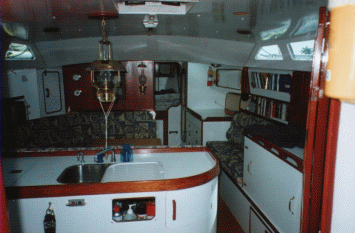
Decks Due to her 12' beam being carried a long way aft and her shallow bilge, "Dione" has significant interior volume for her length and draught. This makes for very comfortable living for the 2 of us. Even when cruising New Caledonia with 2 friends on board for several weeks nobody felt cramped. The original interior layout was designed to accommodate a family of 7, but has been re-configured to suit our needs. Accommodation now comprises a double-berth forepeak cabin, a double-berth guest cabin and a single sea-berth cabin. In all, the layout is roomy and welcoming. Due to the large, open-plan design, we have added posts, hand-holds and safety bars to enhance safety and comfort in heavy conditions. A divider also reduces the size of the galley while at sea and provides additional hand-holds and brace points. The interior is divided roughly into 3 sections: Forward, Centre Living Area and Aft. Looking Forward from Galley
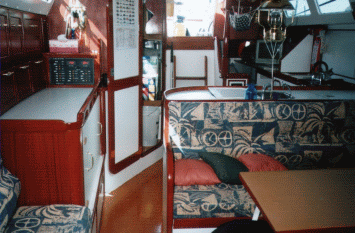
FOREWARD LIVING AREAS Forward Cabin: Furthest foward is the forepeak cabin with a large double bunk. At the far end of the bunk is the access hatch to the dry chain locker. Above this locker, on deck, is the wet chain/anchor well with a hawse pipe leading to the dry chain locker below. The chain runs from the bower, (main anchor on the bow), around the on-deck electric windlass and into the hawse pipe. The chain is lead into the anchor well first so remaining mud can be hosed off & to allow it to dry. For passage-making, it is fed through the hawse pipe for stowage in the dry locker below. This system helps keep mud and water out of the interior of the yacht and also moves the weight of the chain down and aft, helping to keep good bow trim and reducing the typical 'hobby-horse' motion in rough head seas. Below the forward bunk are the rope locker (furthest forward) and the sail locker (back from that), which holds 4 sails and their rigging. Down either length of the bunk, the cabin sides have been 'squared off' and 3 shelves fitted 'port-hole style' each side to hold clothes. An overhead locker is fitted wall-to-wall across the forward end of the cabin; it is a good spot for linen as it's very dry up there. A radio cassette player and 12v fan grace the locker front while each bed-head has a dimming reading lamp. A 500mm square, tinted overhead opening hatch provides light and ventilation (in harbour) with an insect screen that snaps on from the inside. At sea, this bunk area is stripped of bedding and covered with canvas to allow sails to be passed to and from the deck without water damaging the cabin or contents. The assymetric spinnaker, being in a 'sock' launching bag, can be launched and stowed from inside the cabin by raising or lowering it directly through the hatch. This access is very handy in good conditions, but there is a need for speed when changing hanked sails in a head sea! Bathroom: Aft of the forward cabin, to port, is the 'bathroom' (obscured). This comprises a 12v head and full vanity with hot & cold pressure fresh water to the sink and shower. A large locker below the vanity stores all cleaning gear and the hot water storage tank. Large lockers above & behind the vanity store towels and all personal hygiene gear. The shower floor is ceramic tiled and, like the vanity, drains to a holding tank. Opposite the bathroom, to starboard, is a long hanging wardrobe & the original navigation area. Charts curently in use are still stowed in a locker under the full-size chart table here, but the rest of the navigation equipment has been relocated aft to the sea berth for easier access from the cockpit. Above the chart table a long overhead locker stores sail & canvas repair gear & material, rigging equipment and sewing gear. Below the chart table & chart locker are 6 clothing drawers. CENTRE LIVING AREA The centre area below decks comprises a large 'C'-shaped lounge with central dining table. Under the seats, moving clockwise while facing port, are the engine, 2 x 100ah batteries; the desalinator, wash-down pump, fresh water pump & diaphragm, fresh water carbon filter (for water to the galley drinking faucet) and intake filters for the desalinator; and the 200 litre fibreglass fresh water tank (moulded to the hull). Behind the portside seats are lockers for rolled charts, plumbing & electrical spares. Bookshelves line the port and starboard sides above the lounges. The bilge beneath the lounge contains, besides the engine, the shower sump; head & galley saltwater intakes & drain outlets and sea cocks; and access to the keel diesel tank. Opposite the main lounge is a reading sofa (can be a child's berth, with lee cloth fitted); storage below this holds 2 x 70ah batteries, the 12 - 240v inverter and safety gear. Behind the seats are 4 large food storage lockers. Adjacent to and aft of the starboard sofa is a 4' bench top. At the back of the bench are 2 rows of 5 lockers. The upper rows house the TV, Stereo & CD's, VCR & tapes & speakers. The lower lockers house, electrical & electronic equipment and small fittings & spares. The main switchboard sits at the aft end of the bench with a small bookshelf above. Below the bench is a huge locker that, during passages, stores the 10' inflatable dinghy, the outboard, paddle, manual & electric pump and chain & anchor for the dinghy. Miscellanous snorkling & dive gear usually finds its way in here as well. The dinghy & motor stay on deck inshore, when the locker stores 6 x 30 litre, plastic bulk food boxes (these are stored in the guest berth at sea). A smaller locker beneath holds water sports gear, spare harnesses & tethers. AFT AREAS Looking Aft from Lounge
The Galley: Dividing the aft living quarters and galley from the lounge area is a 6' long, 700mm wide galley bench running athwartships from port, finishing short enough of the dinghy locker to allow passage fore & aft. To port, a deep, 90 litre eutectic freezer reaches down almost to the bilge, opening through the benchtop. A double sink & draining & prep area take up the rest of the bench top. Lockers let into the bench hold galley equpiment. The tiny eutectic fridge takes up the area below the sinks, opening outward to port. Under the inboard end of the bench is the drive end of the engine accessed through a hinged door. The galley floor hatches provide access to the stern seal, shaft and storage. The LPG/Propane stove, with 2 burners, grill & oven, sits next to the freeze, to port. It has a short bench beside it with large lockers for cooking pans, plastic ware & alcohol. Behind the freezer, stove & short bench, along the port side, are more very large lockers for food & dining wear. A tiny transverse bulkhead at the aft end of the short bench holds a spice rack, fire extinguisher and fire blanket; it also separates the galley from the sea berth. The Guest Cabin: Diagonally opposite the galley, to starboard, a large private cabin (originally the main cabin) doubles as an all-purpose storage area while waiting to welcome guests on board. Then, a mass of gear has to be moved to the sea berth or pitched out on deck. Luckily, we have only had guests for coastal cruising as this arrangement would not work at sea. This cabin had a very large built-in hanging robe but we have converted it to store tools and spares for ease of access. The original vanity and drawers have also been converted to a double, shelved locker for 1st Aid Kits, engine and general lubricants, camping and other gear. Its top makes a great A4 bookshelf and we have fitted a standard bookshelf above that (where the mirror used to be!). Aft, under the starboard cockpit seat, a double berth tapers towards a stern locker (full of fenders). A myriad of items are stowed under the berth and even more on top, including separate 12/240v fridge & freezer (the eutectic system expired the minute we berthed in Auckland!), 2 mountain bikes, tent, liferaft, foul weather gear, camping & hiking gear, etc. Two more bookshelves are mounted on the main bulkhead between the cabin & companionway. The Sea Berth: This cabin was originally a double bunk and no more. We had to vault a third galley bench (now removed) to climb into it. Like the guest cabin, there is a locker right aft for access to the steering gear and autopilot. We keep backpacks in there. Once we ripped out the bench we built a narrow bench-level cabinet to house the engine switch (we moved this from under the sink to further aft so we could read the revs from the cockpit) and two tiny lockers (for touch-up painting gear and flares). Between this and the short galley bench we created access to the cabin. Next, We cut the double berth down to a 6' single that lies inboard away from the side of the hull. To hold the off-watch crew in place, we built lockers beside the bunk, against the hull, along almost the full length of the cabin. At the galley end, the lockers give way to a desk with hinged lid and good storage below for the sextant, books etc. At the back of the desk a cabinet was built to house all the main navigation and communication equipment. We sit on the end of the bunk, at the desk, to use the radios, radar, computers, GPS, take weather faxes & skeds, plot courses etc. Two short bookshelves hold pilots & essential references. We finished the cabin with a turned post between the engine switch cabinet and an overhead cabinet that houses the wind instrument, auto pilot control unit, external light s & equipment switch board and our sailing essentials (hats, sunnies, sun block, gloves, watch caps, torches, etc). Both the sea berth and guest cabin has an opening, screened, portlight and reading lamps, while the sea berth has a 12v fan. There are teak steps leading up into the cockpit between the 2 aft cabins with the turned post to hang on to in the rough. The steps are mounted on a removable hatch that provides access beneath the centre of the cockpit, where the diesel tanks and fuel pumps & filters hide. CONCLUSION Despite her generous interior volume (for her size), there still never seems to be enough space to stow everything or to find things when you need them, especially without having to up-end a few dozen other neatly stowed items first! We have way too many books on board (due to my in-discipline) and way too many tools on board due to Glen's incurable need for six of everything 'just in case' and his abject inability to thrown anything out that could possibly be of some obscure use sometime in the great, un-mapped future. That, in a nutshell, is Dione. |