Initializing...
The Conflict Of Kashmir
 Kashmir the last of the defiant states, was reserve
of Hyderabad. It had a Hindu Maharaja, Hari Singh, but his subjects were
Muslims, accounting to 78 %. He was reluctant either to join India or Pakistan,
but Lord Mountbatten urged hime to take decision to join either states before
August 15, 1947.
Kashmir the last of the defiant states, was reserve
of Hyderabad. It had a Hindu Maharaja, Hari Singh, but his subjects were
Muslims, accounting to 78 %. He was reluctant either to join India or Pakistan,
but Lord Mountbatten urged hime to take decision to join either states before
August 15, 1947.
|
|
|
|
|
|
| By
October 1947, the war of Kashmir had began in earnest. The Pathans
tribesman from the North Frontier Province wanted to avenge the deaths
of their brothers. Thousands of Pathans warriors invaded the valley
and on reaching the valley of Kashmir, they routed the Maharaja's
troops and reached the gates of Srinagar, the Capital. |
 |
 The
Maharaja sensing defeat took refuge in Jammu. From there, he appealed to
India to send troops to hald the relentless onslaught of the tribesman.
India agreed on the condition that Kashmir would accede to India. Lord Mountbatten
accepted the acession on behalf of India. On
October 27, 1947 India began to air-lift her troops to Srinagar, and launched
a full-scale attack on the tribesman. Pakistan was stunned. Despite her
slender militry resources, she was prepared to send in its troops, but the
British General, Gracey, Commander in Chief of the Pakistan Army advised
against it. Jinnah also proposed an immediate case-fire and later that a
plebiscite should be held. In
January, 1948 India took the dispute to the Security Council. There it accused
Pakistan of aggression and demanded that Pakistan withdraw its tribesman,
but Pakistan held that accession of Kasmire has been brought about by force
and requested the Security Council to arrange a cease-fire and ask both
the tribesman and the Indian troops to withdraw, so that a free and impartial
plebiscite could be held to ascertain the wishes of the people of Kasmir.While
the Kashmir's issue was still at the table, the Indian troops launched a
full scale attack and drove tribesman right back to the Pakistani border.Pakistan,
rushed its regular troops into Kashmir and had a full -scale war with India.
It took control on Azad Kashmir. but the Security Council on August 13,
1948 called for an immediate cease-fire, the withdrawal of all Pakistani
and Indian troops and holding of plebiscite under the UN supervision. Both
the Indian and Pakistani government accepted the resolution.In
January, 1949, the resolution began to be implemented. In July, 1949 the
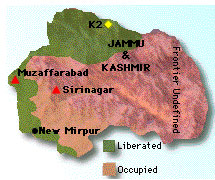
cease-fire line was demarcated. Pakistan's side of Kashmir consisted of
some parts of Jammu, Poonch, Some areas of Western Kashmir, Gilgit and in
the North a great chunk of Ladakh territory near the chinease border. India
kept the valley of Kashmir, Jammu and remainder of Ladakh territory near
the Tibet border. The
cease-fire has remained in existence since 1949. No plebiscite has been
held and thus the Kashmir issue remains unresolved to-date.
The
Maharaja sensing defeat took refuge in Jammu. From there, he appealed to
India to send troops to hald the relentless onslaught of the tribesman.
India agreed on the condition that Kashmir would accede to India. Lord Mountbatten
accepted the acession on behalf of India. On
October 27, 1947 India began to air-lift her troops to Srinagar, and launched
a full-scale attack on the tribesman. Pakistan was stunned. Despite her
slender militry resources, she was prepared to send in its troops, but the
British General, Gracey, Commander in Chief of the Pakistan Army advised
against it. Jinnah also proposed an immediate case-fire and later that a
plebiscite should be held. In
January, 1948 India took the dispute to the Security Council. There it accused
Pakistan of aggression and demanded that Pakistan withdraw its tribesman,
but Pakistan held that accession of Kasmire has been brought about by force
and requested the Security Council to arrange a cease-fire and ask both
the tribesman and the Indian troops to withdraw, so that a free and impartial
plebiscite could be held to ascertain the wishes of the people of Kasmir.While
the Kashmir's issue was still at the table, the Indian troops launched a
full scale attack and drove tribesman right back to the Pakistani border.Pakistan,
rushed its regular troops into Kashmir and had a full -scale war with India.
It took control on Azad Kashmir. but the Security Council on August 13,
1948 called for an immediate cease-fire, the withdrawal of all Pakistani
and Indian troops and holding of plebiscite under the UN supervision. Both
the Indian and Pakistani government accepted the resolution.In
January, 1949, the resolution began to be implemented. In July, 1949 the
cease-fire line was demarcated. Pakistan's side of Kashmir consisted of
some parts of Jammu, Poonch, Some areas of Western Kashmir, Gilgit and in
the North a great chunk of Ladakh territory near the chinease border. India
kept the valley of Kashmir, Jammu and remainder of Ladakh territory near
the Tibet border. The
cease-fire has remained in existence since 1949. No plebiscite has been
held and thus the Kashmir issue remains unresolved to-date.
**!!!Important!!!**
The
issue of Kashmir is not a new thing. Kashmiris are fighting from last 50
years to take back their homeland from the India.They are fighting against
the wilderness of Indian Army, who is killing Kashmiris every year on the
names of terrorists. According to official records, till January 1, 1997
over 16,898 people were kille by Indian Army in Kashmir on the name of terrorists,
which included 7,727 civilians and 1,31 security personnel, while more than
12,000 were injured.Unofficial record is more terrible than this.Nearly
5,000 young ones are in jails without any reason and 3,00,000 Kashmiris
are outside the valley as immigrants.
| Kashmir
Liberation |
KCC |
Kashmir
Council |
| Kashmir
watch |
Jammu
& Kashmir |
Book
on Kashmir |
| Kashmir
information service |
Pak
News Service |
Amnesty
Kashmir |





Note: All Graphics on this page are created by Sarah Qureshi
All Rights Reserved. Copy Rights © 2000-2001
Last modified July 12, 2001
