ABSTRACT
Quantity and quality of wastewater from pharmaceutical industry varies depending on the product and process selected. Biological treatment methods are preferred to physico-chemical methods for safe disposal due to their cost effectiveness and efficient treatability of wastes. Anaerobic digestion of the organic waste is known to reduce the pollution load and simultaneously produce biogas, which is a valuable byproduct. Wastes with high BOD: COD ratios are studied in a batch anaerobic digester with acclimatized seed sludge. In the present study an attempt has been made to evaluate the efficiency of batch type anaerobic reactor for pharmaceutical wastewater. Continuous monitoring of parameters like BOD, COD, pH, volatile acids, alkalinity, sulfates, ORP were carried out to evaluate the performance of the reactor. The study is carried out for five different organic loading rates ranging from 1.9 kg/m 3 -5.8 kg/m 3 as COD. The studies revealed that a maximum COD reduction of 83% is obtained at an organic loading of 1.9 kg/m 3 as COD, 80% reduction at 2.45 kg/m 3 as COD. The efficiency reduced gradually to 65% at 5.0 kg/m 3 as COD. A lowest of 43% COD reduction is observed at 5.8 kg/m 3 . The COD: sulfate ratio for all the concentrations studied ranged between 4.8-3.3. However, the optimum loading rate was found to be 5.0 kg/m 3 as COD where 65% COD reduction was observed.
INTRODUCTION
Increased industrial activity, over the past 40-50 years, has resulted in the generation of increasing quantities of wastewater containing high levels of organic pollutants. Production processes used in the pharmaceutical industries give rise to wastewater containing inorganic and organic substances, suspended solids and significant levels of organic solvents. These organic solvents are potentially toxic to aquatic life and thus require elimination by treatment system for the wastes. Pharmaceutical wastewater has traditionally been treated using physical, chemical and aerobic biological processes. Application of anaerobic treatment to pharmaceutical wastewater has been hindered by the lack of knowledge of both the biodegradability and the potential toxicity of the constituents of this wastewater under anaerobic conditions. Recently anaerobic process has been used for the treatment of Pharmaceutical wastewater (Michael P. Henry, 1996). The major advantages are the high degree of waste stabilization achieved with very little sludge production, Maximum amount of biodegradable fraction can be converted to useful end product in the form of methane, and high strength waste can be employed because oxygen transfer is not a limiting factor. The bench scale studies are useful to determine effects of various process parameters and to suggest controls promoting optimum purification. Applicability of laboratory results for scale up results depends on input, and on experimental designing, simulating anticipated operating conditions as field conditions, etc.
OBJECTIVE
The objective of the present work is to study the treatability of pharmaceutical waste by anaerobic digestion. Continuous stirred batch reactor is used for anaerobic treatment of pharmaceutical waste. The performance of the reactor is evaluated at different organic loading rates and varying influent composition.
MATERIALS AND METHODS
Anaerobic digester:
Continuously stirred anaerobic batch reactor consists of 5 l capacity wide mouth, round bottom glass flask. This 5 l digester was provided with a three-way rubber cork, one for inlet port, other for gas collection and the third for temperature measurement. The reactor is provided with an outlet nozzle with stop cork for the sample collection at height of 8 cm from base of the reactor. Care was taken in designing the outlet nozzle to be in a bent shape to facilitate one-way transfer of contents. The gas outlet was.Batch studies to evaluate the treatability of pharmaceutical wastes by anaerobic digestion 905 connected through a rubber tube to the liquid displacement system (Das S. B, 1998). The reactor was placed on magnetic stirrer provided with a heating mantle for continuous mixing and controlling the temperature of the contents. A schematic diagram of the experiment is given in Fig 1. The entire system was checked for gas leaks.
Wastewater source:
The waste required for the present study was procured from a pharmaceutical industry. The characteristics of wastewater are given in Table 1.
				Table 1
 Characteristics of pharmaceutical waste
S.No. 		Parameter 		Concentration
1. 		pH 			8.14
2.		 COD 			7360
3. 		BOD 			1960s
4. 		Total solids 		14,950
5. 		Dissolved solids 	14,000
6.		 Suspended solids 	950
7.		 Chlorides 		5955
8. 		Sulphates 		2118
9. 		Ammonical nitrogen	 600
10.		 Nitrates 		13 ppm
11. 		Phosphates 		78
12. 		Alkalinity 		3700

Note: All values are expressed in mg/l, except pH
Synthetic feed: The composition of synthetic feed used for the reactor startup is given in Table 2.
			Table 2
	Composition of synthetic feed

S.No. 		Component 		Concentration (g/l)
1 		pH 				7-7.4
2 		Glucose 			30
3 		Urea 				0.125
4 		KH 2 PO 4 			2.5
5 		NH 4 Cl 			7.5
6 		K 2 HPO 4			 1.0
7 		NaHCO 3 			5.5
Study parameters: The continuous stirred batch reactor was monitored daily for pH, ORP, COD, BOD, Alkalinity, Sulfate, Volatile acids from the outlet of the reactor during the operation of the reactor.
Analytical methods
All the analytical procedures followed for the analysis were in accordance with the standard method (APHA, 1997) pH/ ORP is monitored with pH meter
START UP OF DIGESTER
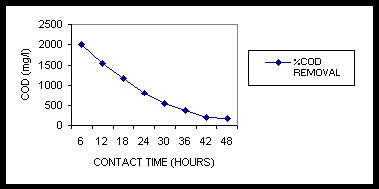
The start up of an anaerobic reactor depends on the nature of feed, nature of seed, organic loading rate, nutrient addition etc. in the present study, the anaerobic batch reactor was seeded with active anaerobic sludge collected from an existing plant. The reactor was initially operated with synthetic feed (Table 2) with an initial COD concentration of 2000 mg/l for 48 hours. This step was repeated till a constant COD reduction of 92% was observed with a gas production of 2340 ml. Steady state conditions of the reactor were confirmed when the COD reduction and gas production were consistent. After startup, the reactor was then taken for evaluating the treatability of pharmaceutical waste. Organic loading rates in the range of 1.95 kg/m 3 – 5.8 kg/m 3 as COD were studied. After startup the reactor, outlet was monitored for pH, ORP, COD, BOD, alkalinity, Sulfates and volatile acids at regular intervals to assess the nature of reactor operation. Fig. 2 represents the COD removal during the startup phase of the reactor with a COD loading of 2000 mg/l initially and gradually decrease to 800 mg/l in 24 hours and 160 mg/l in 48 hours and remained steady.
RESULTS AND DISCUSSION
% COD removal:
The efficiency of the anaerobic system can be best explained with reduction in COD concentration. The overall efficiency of anaerobic reactor is given in Table 3. Figure 3 represents percentage COD removal at different organic loading. From the Fig. 4 it can be visualized that a considerable COD reduction was observed at different organic loading rates. In case of 1.95 kg/m 3 as COD, a maximum COD removal of 83% was observed at the end of 72 h. COD reduction of 27% of the total concentration was observed at the end of 24 hours and reduction increased to 59% at the end of 48th hour. After attaining a maximum reduction of 83% at the end of 72 hours, No further degradation was observed till 96th hour. Gas production of 1560 ml was measured at 1.95 kg/m 3 (as COD) organic loading. In case of 2.45 kg/m 3 as COD loading, reduction of 80% was achieved at The end of 72 hours. Around 23% of the total COD were destroyed at the end of 24 hours and about 47% reduction in COD was observed after 48 hours. However, there was no increase in reduction after 72 hours of reactor operation. Gas production of 1820 ml was observed at this organic loading..906 S. Sridhar et al.
precipitate was frequently observed with Calcium hydroxide indicating CO 2 presence in the gas outlet.
pH and alkalinity:
In an anaerobic system, pH places an important role, which may affect the activity of the mixed consortia. The increase in the pH may be due to the accumulation of bicarbonate or decrease the pH due to the formation of volatile fatty acids. Thereby reducing the activity of the anaerobes. Optimum pH for anaerobic activity is in the range between 6.5 – 8.0.
In the present study, The pH was measured every day and maintained in the range of 6.8 - 7.6. pH values at different organic loading rates are represented in Fig. 5 .Alkalinity is very essential parameter as it provides the required buffering capacity to anaerobic system. Hence alkalinity was monitored everyday for all organic loading studied. Alkalinity ranged between 650-1270 mg/l through out the study, indicating the required buffering in the anaerobic consortia.
Oxidation and reduction potential (ORP):
ORP is useful in the evaluation of magnitude, characteristic, and process change of an anaerobic system. In the process of reduction and oxidation, electrons are exchanged, The electron exchange occurs, as a result of difference in potential between reactants and these potentials are measurable. The ORP is determined electrometrically with instrument resembling that of measuring pH and is expressed as mill volts. ORP can be used for diagnosis of problems in malfunction of treatment process. The anaerobic bacteria functions best between ORP values of +50 mv and –400 mv. (Reddy V. V, Swamy N. K 1995) Fig. 6 represent the ORP at different organic loading rates. Confirming the favorable conditions prevailing in the anaerobic reactor.
Volatile fatty acids:
Inhibition of methanogenic population by volatile acids is considered as the prime reason for digester failure. This is the main reason for which VFA were analyzed for every organic loading studied. Volatile fatty acids above 250 mg/l is considered to decrease the activity of the anaerobic At the organic loading of 4.0 kg/m 3 as COD, it was observed that 120 hours of time was consumed to attain a maximum COD reduction of 73%. The COD removal rate reached 27% after 48 hours, which increased further 54% after 96 hours, and gradually increased to 73% after 120 hours and remained stable. Gas production of 2600 ml was observed for this organic loading.
At 5 kg/m 3 as COD, reduction of 25% was observed at 48 hours and further increased to 49% at the end of 92 hours. The COD removal of 65% was observed at the end of 120 hours. No increase in COD reduction was observed after 120 hours. Gas production of 2880 ml was observed at the corresponding organic loading.
At 5.8 kg/m 3 as COD, in the initial stage, 19% of COD removal was seen in 48 hours. After 96 hours the % of COD reduction increased to 40%. COD reduction reached to 43% at the end of 120 hours and no further reduction in COD was observed after 5 days, this might be attributed to the inhibitory nature of the waste and this concentration. Gas production of 2200 ml was observed corresponding to this organic loading. Gas production: Anaerobic treatment owes much to the renewable energy resources. The augment of Gas collection through the displacement of water was made to notice indication of gas production. As the digester is batch feed, the exhaustive of digestible organic matter was assumed when gas production was stopped. However in order to analyze the contents of gas approximately simple methods were used.
The Gas outlet was sent into solutions of Lead acetate, Nessler’s reagent and Calcium hydroxide to know the presence of H 2 S (black precipitate of PbS) Ammonia (Brown precipitate) and CO 2 (White precipitate of Ca (OH)2 ). However methane was confirmed by its odor and flaming at the end of gas outlet. Black precipitate of PbS was observed after 6 to 7 hours of reaction with Lead Acetate confirming the low production of H 2 S, while absence of brown precipitate with nesslers reagent indicates absence of Ammonia. White.Batch studies to evaluate the treatability of pharmaceutical wastes by anaerobic digestion 907 process, but studies indicate that even at concentration of 1200 mg/l of Volatile fatty acids the anaerobic process is not hampered (Das S. B, 1998). Moreover the VFA: Alkalinity must be in the ratio of 1:2 in the efficient functioning of the anaerobic system (Soli. J. Arceivala, 1998). In the present study VFA was in range of 50-600 mg/l which is in good agreement with the above statement.
Sulphates
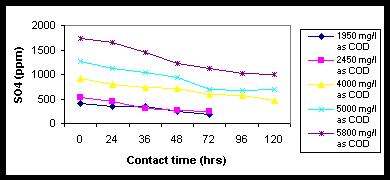
Many industrial wastewaters prone to contain high amount of sulfates. High sulfate concentration in wastewater is found to be inhibitory to the anaerobic process. The reduced sulfur products of sulfate reduction, particularly H 2 S are also inhibitory to methanogeneses (Hitler M. G, Archer D. B 1988). Studies indicate that by dilution of the waste, at elevated levels of pH in the reactor, presence of metal ions particularly iron promote methanogeneses (Omil .F, Lettinga .G et al 1996). In the present study sulfate reduction was observed in all the five organic loading rates studied Fig. 7. However the reduction of sulfate decreased with increased organic loading rates. Since sulfate concentration above 1250 PPM was found to decrease the anaerobic activity which can be justified by the high H 2 S production in the 5.8 kg/m 3 organic loading rate and blackening of the walls of the reactor and also decrease in the percentage COD removal to 43%.
CONCLUSION
The present study deals with evaluating the treatability of pharmaceutical waste with batch scale anaerobic digestion. Continuously stirred batch scale anaerobic digester was operated at lab conditions over an organic loading range of 1.95 kg/m 3 to 5.8 kg/m 3 .
It can be concluded from the results that the treatability efficiency was found to be optimum at an organic loading of 5 kg/m 3 as COD with a gas production of 2880 ml. At organic loading of 5.8 kg/m 3 and after 120 Hours operation, the COD reduction of 1520 mg/l i.e 43% is observed. This is due to production of H 2 S, which was further confirmed with a black precipitate when the gas is passed through lead acetate solution. Introducing a physico-chemical treatment before the anaerobic treatment for controlling sulphates may enhance the treatment process. Making the system continuous and recirculating the effluent for maximum COD removal efficiency may make the present study more efficient.
Table 5.1A: - %COD Reduction and Gas production VS Time at Different Organic Loading
Effluent Volume taken: - 3 Liters
Initial COD: - 1950 mg/l
Temperature: - 32 +/- 50c
|
Retention Time (hrs) |
COD reduction (mg/l) |
% COD Removal |
Gas production (ml) |
|
24 36 48 60 72
|
1430 1200 800 670 330 |
26% 38% 58% 65% 83% |
510 730 1120 1250 1560 |
Table 5.1B:
Effluent Volume taken: - 3 Liters
Initial COD: - 2450 mg/l
Temperature: - 32 +/- 50c
|
Retention Time (hrs) |
COD reduction (mg/l) |
% COD Removal |
Gas production (ml) |
|
24 36 48 60 72 |
1880 1560 1280 880 490 |
23% 36% 47% 64% 80% |
510 800 1030 1400 1760 |
Table 5.1C:
Effluent Volume taken: - 3 Liters
Initial COD: - 4000 mg/l
Temperature: - 32 +/- 50c
|
Retention Time (hrs) |
COD reduction (mg/l) |
% COD Removal |
Gas production (ml) |
|
24 48 72 96 120 |
3680 2910 2510 1840 1080 |
8% 27% 37% 54% 73% |
670 960 1320 1920
2600 |
Table 5.1D:
Effluent Volume taken: - 3 Liters
Initial COD: - 5000 mg/l
Temperature: - 32 +/- 50c
|
Retention Time (hrs) |
COD reduction (mg/l) |
% COD Removal |
Gas production (ml) |
|
24 48 72 96 120 |
4260 3750 2840 2540 1750 |
14% 25% 43% 49% 65% |
640 1100 1890 2170 2880 |
Table 5.1E:
Effluent Volume taken: - 3 Liters
Initial COD: - 5800 mg/l
Temperature: - 32 +/- 50c
|
Retention Time(hrs)
|
COD reduction (mg/l) |
% COD Removal |
Gas production (ml) |
|
24 48 72 96 120 |
5520 4700 3920 3480 3310 |
4% 18% 32% 40% 42% |
240 970 1650
2050 2200 |
Table 5.4: - SO42- Reduction VS Time at different Organic Loading
|
SO4 REDUCTON |
|||||
|
Retention time (hrs) |
1950mg/l |
2450 mg/l |
4000 mg/l |
5000 mg/l |
5800 mg/l |
|
0 24 36 48 72 96 120 |
404 351 346 235 192.5 |
523 449 309 261 250 |
911 792 725 710 587 569 478 |
1260 1130 1033 945 702 664 690 |
1729 1653 1448 1225 1120 1020 995 |
Table 5.2: - Variation of Alkalinity VS Time at different Organic Loading
|
ALKALINITY VARIATION |
|||||
|
Retention time (hrs) |
1950mg/l |
2450 mg/l |
4000 mg/l |
5000 mg/l |
5800 mg/l |
|
0 12 24 36 48 60 72 84 96 108 120 |
650 680 800 820 880 1020 1000 |
1170 1180 1260 1270 1140 1160 1210 |
1280 1260 1240 1140 1120 1170 1240 1270 1280 1310 1320 |
1140 1150 1140 1120 1120 1140 1020 1060 1120 1140 1160 |
1260 1260 1270 1160 1140 1120 1160 1200 1240 1260 1270 |
Table 5.3: - Variation of volatile Fatty Acids VS Time at different Organic Loading
|
VOLATILE FATTY ACIDS (VFA) VARIATION |
|||||
|
Retention time (hrs) |
1950mg/l |
2450 mg/l |
4000 mg/l |
5000 mg/l |
5800 mg/l |
|
12 24 36 48 60 72 84 96 108 120
|
85.7 120 188 120 85
51 |
120 160 360 234 188 88 |
85 120 160 360 514 428 188 120 88 71 |
80
120 160 223 428 360 188 110 85 51 |
188 210 360 428 605 514 234 200 120 _ |
Fig 5: - The COD removal at startup of the reactor
Fig 5.1: - Influence of time on percentage of COD removal with gas
Production of different COD concentrations in anaerobic Degradation
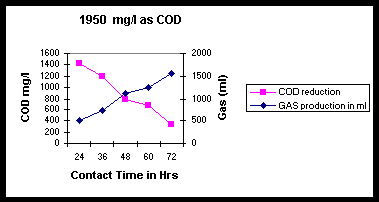
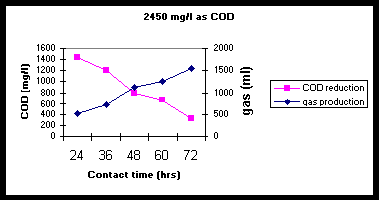
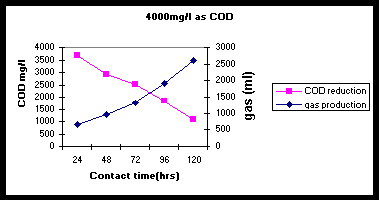
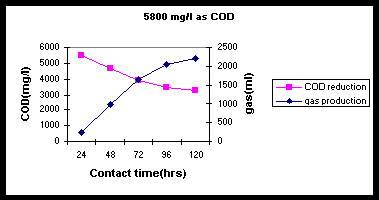
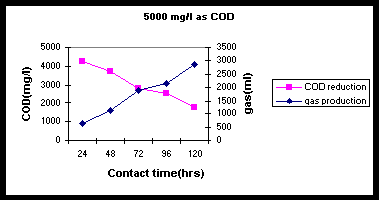
Fig 5.3: - Variation of Alkalinity during reactor operation with function of time
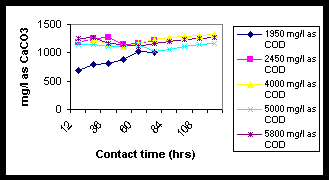
Fig 5.2: -Variation of outlet ORP during reactor operation with function of time
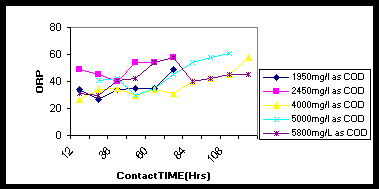
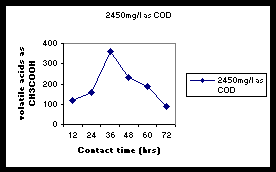
Fig 5.4: - Influence of time on Volatile Fatty Acids (VFA) of different COD concentrations in anaerobic digestion
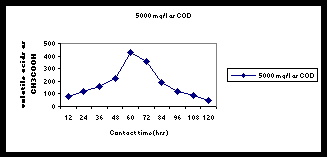
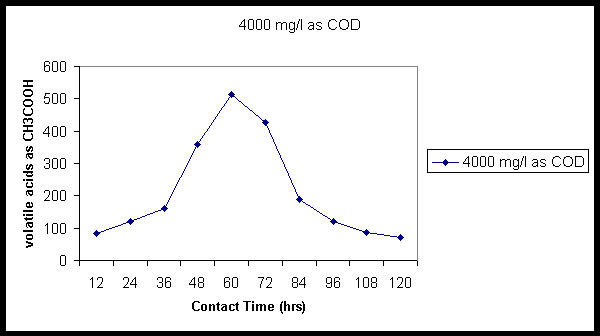
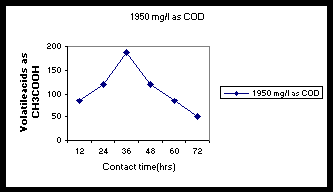
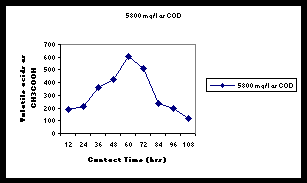
Fig 5.5: - Variation of outlet sulfates during reactor operation with function of time
REFERENCES
1. APHA, American Public Health Association (1996);
Standard Methods for the Examination of Water and
Wastewater.
2. Das S.B (1998). INDIAN JOURNAL.
ENVIRONMENTAL PROTECTION, Vol-18, P.650-
654.
3. S.GHOSH, M.L.PACKER, A.C.ROESS (1977).
Journal WPCF. P. 1019-1023.
4. Hilten M.G and D.B. Archer. (1988), Biotech and
Bioengg VOL-31 P- 885-888.
5. Isa.M.H, I.H.Farooqi and R.H.Siddiqui (1993).
INDIAN. J. ENVIRON. HEALTH. VOL-35 P.1-8.
6. Michael. P. Henry, Brain A. Donlon (1996). J. CHEM.
TECH. BIOTECH. 66.P.251-264.
7. Murugesasn.V, R.Elangovan (1995),
INDIAN.J.ENVIRONMENTAL PROTECTION, Vol-15,
P. 580-584.
8. Soli. J.Arceivala, Wastewater treatment for Pollution
control, second eldn, Tata McGraw Hill (1998), P. 150-
174.
9. Omil .F, P.Lens, L. Hulshoff pol, and G.Lettinga
(1996), Process Biochemistry, VOL-31(7) P. 699-710.
10. V.V. Reddy, N.K. Swamy, Dr. B. Kataiah, Dr.
Ramalingaiah (1995), 3rd International Conference,
Appropriate Waste Management Technologies for
Developing Countries, NEERI. P- 25-26..908 S. Sridhar et al.
©S Sridhar. email Sridhar
You are welcome to use the material here if you wish, provided acknowledgement is made.