|
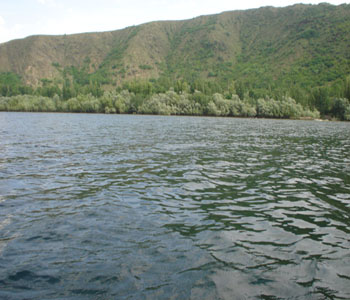
Wular lake is the largest fresh water lake of the India, having
an area of 189 square kilometers. The rampant silitation has devastating
effects on the lake. The human encroachments is the adding problem to this.
If the rate at which the silitation and encroachments are not stopped, it
won’t be far away to see the lake disappearing from the world map of Lakes.
Wular Lake plays an important role in hydrological regimes of the
Kashmir valley and acts as an absorption basin for floodwater. Wular Lake
along with its associated marshes is an important waterfowl habitat. The
wetland, however, is subjected to heavy siltation due to loss of vegetal
cover of the area.
The lake is the host to numerous migratory birds allover globe.
It is also host to many endangered migratory bird species like Marbled
Teal Marmaronetta angustirostris,
Pallas's Fish-eagle Haliaeetus
leucoryphus and many others. There is a serious risk of loosing the biological
diversity including loss of some important endemic and endangered species due
to human encroachment, increase in pollution level and heavy silitation.
The Local Government so
far has not been able to prepare a comprehensive management action plan with
a focus on catchment area treatment. Ministry of Environment and Forests has
provided substantial support for afforestation of native species and limited
engineering measures. Local communities have not been involved in the
afforestation, which is a major source of silt load in the lake.
The maximum depth of the lake at present is about 14 meters but
as the rampant pollution level is increasing, the depth too has got reduced
to about 2 meters at some places. According to the environmentalists depth
reduction has threatened a number of endemic species of the lake, thereby
making them figure in the endangered list of species.
It
is high time for the government to think of involving Local and International
NGOs in the conservation and wise use of Lakes. There by framing the action
plan on the sustainable use and development of the Wular lake and its
adjacent wetlands.
(Author can be contacted at bilal4u2@gmail.com)
"Copyright ©2000-2006 www.oocities.org\save_environ. All Rights
Reserved"
|