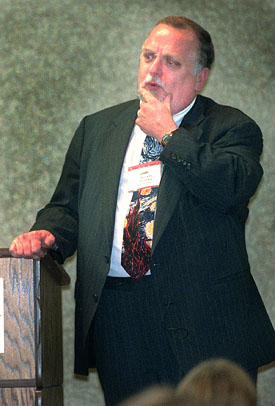
Man Who Killed
Mom Is Voice for Mentally Ill
Randy Starr fields questions at the Utah
Department of Mental Health conference Wednesday. (Paul Fraughton/The Salt Lake
Tribune)
BY ASHLEY ESTES
THE SALT LAKE TRIBUNE - May 3, 2001
PARK
CITY -- At first, Randy Starr did not understand why he was not
being rewarded for killing his mother. After all, he thought, she
was an evil entity -- surely everyone knew that.
"I thought I was doing the right
thing," he said.
His mother's murder culminated Starr's
years-long fight against mental illness, a battle accelerated by
his alcohol and drug abuse. He killed her as she approached him
with outstretched arms, telling him she loved him.
That was in 1979, the night before Starr's
29th birthday. Today, Starr works for the same mental health
system he once entered after being found not guilty by reason of
insanity. He brings a unique perspective to his work: that of a
former mental patient, one once classified as dangerous and
incurably insane.
"It took me over a year to realize the
magnitude of my crime," Starr, now 50, said Wednesday at the
Utah Department of Mental Health conference. "I thought it
was self-defense, but it wasn't."
Starr spent five years in four different
mental hospitals in Illinois.
"I could have been executed," he
said. "The society that I live in chose to give me a second
chance. People say, 'Randy, you couldn't have been that sick.'
Well, I was. And it didn't happen overnight."
Starr has refused to discuss the details of
his mother's death. But he described growing up in a home where
alcohol abuse, domestic violence and child abuse were so
commonplace, he began to think it was normal.
He doesn't blame his environment for his
crime, however. "My parents gave to me what had been given
to them," he said.
When he dropped out of high school at age 16,
"I was fighting about everything that moved," he said.
"I had become a real rattlesnake."
In his 20s, Starr's thoughts turned violent,
his drug use escalated and paranoia set in. Starr sought help
and, over five years, received "unsuccessful outpatient
treatment."
He began to view his mother in particular as a
threat to his well-being and possibly to all humanity.
Hospitalized later for his crime, the turning
point in Starr's recovery came during a "video therapy"
session, in which he was urged to re-enact the murder.
"I broke down in tears," he said.
"That was 20 years ago. In certain ways, on certain levels,
I've been crying ever since."
He decided to make the most of his therapy, to
work alongside those who were trying to help him. He made a
conscious choice, he said, to alter his violent behavior.
He left the hospital in 1984. His wife had
divorced him. His father and brothers had disowned him.
Now remarried and a father, Starr has earned
an associate's and a bachelor's degree, both with honors. He is
trying to give back to society; that, he said, helps him deal
with his guilt.
In a month, he will return to a Chester, Ill.,
maximum-security mental hospital, the one he entered as a
prisoner. There, he will work with patients in a
"nonadversarial" role, he said.
With a therapist, he leads a
"responsibility group," urging patients to accept their
actions, minimize shortcomings and focus on what they can -- and
can't -- do. He is also trying to work with police on ways to
better respond to people with mental illness.
A picture of Starr's mother, a woman bearing a
close resemblance to him, is used in the slide show accompanying
his talks. She would be proud of his progress, he said, and would
forgive him for his crime.
"I love my mother," he said.
aestes@sltrib.com