 |
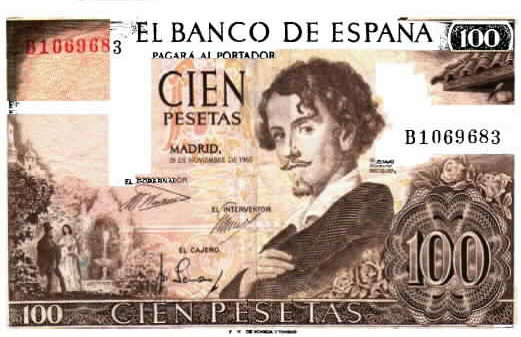
Gustavo Adolfo Becquer (1836-1870) was born in Seville. A great number of his relatives were painters. His father, Jose Dominguez Becquer, died when Gustavo was five. His mother, when he was eleven.
Before the age of fourteen he was close to his brother Valeriano and to a circle of friends that he would keep many years later, especially Narciso Campillo... They were interested in all kinds of art: painting, poetry, music...
In spite of his godmother's will, he traveled to Madrid in 1854. There he made several attempts at painting, such as the unfinished History of Spanish Temples. He wrote plays and zarzuela -minor opera-, by himself or with other friends. He undertook all kind of writings in order to survive in a poor and nocturnal Madrid. In 1858, he contracted a serious, although not well known illness.
He traveled to Soria and Veruela to get himself back to good health. There he found stillness, a doctor and a wife, Casta Esteban. The marriage was unhappy from the beginning in 1861. At this time, the poet wrote his best pieces: prose fiction and some poems in magazines such as El Contemporáneo. In 1868 he produced an edition of them, bought by the minister Gonzalez Bravo. The plundering of Bravo´s house during the Revolution, resulted in the loss of these manuscript poems.
From 1868, Gustavo settled in Toledo with his brother Valeriano. Both were divorced from their wives and kept some of their children. The poet became editor of La Illustration de Madrid and rewrote his own lost poems from memory. This new text was called Book of Sparrows and was not widely known until 1914. Valeriano's death in September 1870 accelerated Gustavo's own three months later.
On December, 23 -one day after his burial- his friends joined together in order to publish his work as a way for helping his widow and his three sons. These works got a foreword by his friend Ramon Rodriguez Correa and appeared in two volumes in 1871.
|
Spanish poet and romance-writer, Gustavo Adolfo Becquer was born on February 17, 1836, at Seville, one of the eight sons of Don Jose Dominguez Becquer, well-known genre painter of Seville, and Dona Joaquina Bostida de Vargas. The family was of distinguished Flemish ancestry. Before he was ten Gustavo Adolfo was orphaned; he was forced in his early years to depend on the generosity of a succession of relatives.
His education was a haphazard one, begun at the College of San Antonio Abad, continued at the College of San Telmo, a training school for navigators, set up by the government for orphans of noble extraction. At this school he first demonstrated literary precocity by beginning a novel and collaborating with a friend, Narcisco Campillo, on the writing and presentation of a play, Los Conjurados. After this school was suppressed by royal orders, the young writer was received into the home of his godmother, Dona Manuela Monahay. Gustavo Adolfo immersed himself in this wealthy lady’s private library—absorbing in particular the odes of Horace and the lyrics of the contemporary poet Jose Zorilla. Almost simul-taneously his sensibilities were sharpened by the art training he undertook at the age of fourteen under the painter Don Antonio Cabral Bejarano. Apparently Gustavo Adolfo could have inherited his godmother’s fortune had he been willing to take up a mercantile career. But the business life was repugnant to his artistic conscience, and so, at the age of seventeen and a half, he uprooted himself and set off for Madrid to devote himself to the precarious life of literature. He arrived in the metropolis in the autumn of 1854 “with empty pockets,” as his biographer Ramon Rodriguez Correa was to write, “but with a head full of treasures that were not, alas, to enrich him.” It was Correa, the most intimate friend of young Becquer from the time of his arrival in Madrid, who persuaded him to publish his story El Caudillo de las Manos Rojas in the journal La Cronica, and thus his career was launched. Next, also at the behest of his friend, Becquer entered the office of the Direccion de Bienes Nacionales as copyist, but was soon fired for drawing sketches of his fellow employees while on the job. Subsequently he earned a little money by assisting a painter. In 1857 Becquer was commissioned to edit a series on church buildings entitled Los Templos de Espana. Only one volume appeared, the only book by him that was published in his lifetime. Los Templos fuses his dual talents, since he both contributed to the text and helped illustrate it, and reveals that affinity for religious antiquities that was to manifest itself in his fiction. At about this time Becquer was drawn into a coterie of poets, artists, and musicians who gathered at the home of Don Joaquin Espin y Guillen, professor of music and organist of the Capilla Real. Here he read his first poems and fell deeply in love with Don Joaquin’s daughter Julia, generally believed to be the inspiration for the idealized lady of the Rimas. However, Becquer’s devotion to the lady was unrequited; apparently she was repelled by his unkempt appearance and his Bohemianism. About 1861 the poet married Casta Esteban y Navarro, daughter of a physician who attended him during one of his frequent sieges of illness. This union, like his romance, ended unhappily. However, Gustavo Adolfo was deeply devoted to the two sons born of the marriage and undertook their support after separation from his wife. For most of the rest of his life he lived with his brother Valeriano, an artist, who had also been through a brief and unsuccessful marriage. Also in 1861 Becquer secured, through the influence of Correa, a position on the newspaper El Contemporaneo, founded several years previously. This proved to be his principle literary outlet. Here were published most of his legends and tales as well as the beautiful series of letters that constitute his spiritual autobiography, Desde Mi Celda (From My Cell). Some years later, Becquer was fortunate to secure a Maecenas in the person of Luis Gonzalez Brabo, prime minister of Queen Isabel II, who became interested in his poetry. In order to provide him with leisure Brabo gave Becquer an official sinecure as censor of novels. |
Now the poet seemed on his way to realize his ambition of collecting his work into a volume. Luis Gonzalez agreed to underwrite the expense of publication and to write a prologue to the book. But in 1868 came the revolution that dethroned Queen Isabel. Luis Gonzalez was forced to flee to France, and somehow the manuscript was lost. Gustavo Adolfo was thus obliged to rewrite his entire Rimas from memory. Some were published in El Museo Universal. The whole series was eventually published in book form posthumously under the supervision of Correa.
With the loss of patronage, Becquer was reduced during the last years of his life to supporting himself by various hack jobs like translating popular French novels and writing articles (such as the series called Las Hojas Secas). The year before his death he was the director of the periodical La Ilustracion de Madrid, which his brother Valeriano illustrated. The death of Valeriano, to whom he had always been devoted, in September 1870, profoundly shocked Gustavo Adolfo. His health, always frail, broke under the strain, and three months later he died of pneumonia and hepatitis, not yet having reached his thirty-fifth birthday. Gustavo Adolfo Becquer is remembered equally for his haunting tales and his poignant lyrics. His tales derive for the most part from legendary materials. The best of them are characterized by medieval settings, an aura of the mysterious and the supernatural, and an apocalyptic style. Los Ojos Verdes (The Green Eyes), the tale of a romantic young man lured to his doom by the spell of a wood-nymph, reveals his genius for evoking an eerie, fascinating atmosphere. One of his most popular stories, Maese Perez El Organista (Master Perez, the Organist), in which an organist continues to spellbind his congregation even after death, is emblematic of its author’s own devotion to the spirit of art. Becquer’s poetry, less gorgeously colored than his prose, is characterized by a tone of quiet resignation. The subtly assonanced Rimas, a sequence of seventy-six introspective short lyrics, relates the successive disillusionments of the poet seeking after an unobtainable ideal—first in art, then in love, eventually, after despairing of happiness in this world, finding consolation in the surcease that death offers. Of all the Rimas (influenced by Heine’s Intermezzo), Poem X (“Los invisibles atomos del aire”) describing the ineffable presence of love, and Poem LIII (Volveran las oscuras golondrinas), contrasting the permanence of nature’s beauty with the transitoriness of human life and love, are the most famous. Although Becquer’s genius was recognized by contemporaries, his greatest fame has been posthumous, with the more extensive publication of his works. In England the novelist Mrs. Humphrey Ward, writing for Macmillan’s Magazine in 1883, went so far as to declare him the only Spanish poet of the period worth translating. Among Hispanic writers Becquer’s influence has been pronounced on Ruben Dario, Miguel de Unamuno, and particularly on the imagist poet Juan Ramon Jiminez, who did much to revive his reputation. He remains, according to Everett Ward Olmstead, “one of the most original and charming authors of the Spanish Romantic school.” A selection of Bequer’s tales is available in English in Romantic Legends and Tales of Spain, edited by Cornelia Frances Bates and Katherine Lee Bates (1908). Master Perez, the Organist is included in the anthology Great Modern Spanish Stories, ed. By Angel Flores (1956). The Rimas have been translated by Jules Renard (1908) and (as The Infinite Passion) by Young Allison (1924). The bilingual Ten Centuries of Spanish Poetry edited by Eleanor Turnbull (1955) includes a selection of Becquer’s poems. The best edition in Spanish is the Obras Completas (1942). English translations from Rimas appear in An Anthology of Spanish Poetry, edited by Angel Flores (Anchor Books, 1961). |
|
Back to Home Page
Back to Authors Page Contact Scott Vrooman, Sr. |