 A WEEKLY POW-WOW BY SIR ROBERT BADEN-POWELL, K.C.B. |
 |
|
A WEEKLY POW-WOW BY SIR ROBERT BADEN-POWELL, K.C.B. |
|
| January 03, 1920
THANKS FROM QUEEN ALEXANDRA As Chief Scout, I sent to Queen Alexandra a message of loyal greeting from the Boy Scouts and Girl Guides on the occasion of her birthday. The following reply was received from Her Majesty: "Please accept and convey to Boy Scouts and Girl Guides my best thanks for kind birthday congratulations, which I greatly appreciate. "(Signed) ALEXANDRA"
WAS THE OLD YEAR A DUD? What did you do during the past year that you can look back to and mark down in your record as a good step in your life? If you’ve nothing to put down, then that year, 1919, was a dud. If you let a few years pass in this way, your life will be a dud. Ever since I was a boy I kept a diary, and every year, on New Year’s Eve, I have run over it to find any steps of importance that I took during the twelve months, and I can tell you it gives some satisfaction when you can honestly feel that that year, at any rate, has not been wasted. Most of time that is wasted is time that we have not prepared for, for which we have made no plans. So look ahead—think what you want to do or ought to do and plan out how to do it. In this way you will Be Prepared.
BE PREPARED FOR 1920 What do you see coming in 1920? Well, for one thing, there’s the Jamboree. What are you doing about that? Are you not going to exhibit a bit of handiwork of your own? The exhibition will show every kind of work that Scouts like to send in—provided, of course, that it is well made. Is your troop going to give a show? Well, you mean to be in that, I suppose? It is probable that the King will open the Jamboree. King’s Scouts will, of course, form his Guard of Honour. If you are not yet a King’s Scout, now’s the time to set to work and earn your crown so that you will be one of the Guard that day. Yes—think out what you failed to do last year and what you hope to do this year, lay your plans, Be Prepared, and make 1920 a record year in your life. If you do this it will be what I wish for you-- A HAPPY NEW YEAR! CHIEF SCOUT |
| January 10, 1920
FIREMANSHIP During the War, when all the young men were away at the Front, the Boy Scouts enabled a lot more to go who were firemen and could not well be spared from their fire duties. But the Scouts were trained to the work, and agreed to take their places, so they went off to fight. Since then fire brigades have been formed in several places composed of Boy Scouts, because people had learnt that Scouts can do the work all right if it is left to them. In Scouting for Boys I have told you what to do in case of fire, but we have also a little book by the great fire officer, Capt. Wells, which tells Scouts all they want to know about dealing with fire, handling an engine, or using the fire escape, etc. but there are one or two additional tips to remember: When in a burning house, if the smoke gets very dense and choking, crawl along the floor; it is generally not so thick near the floor. If you find a door locked that you want to pass through, remember the weakest part is the panel, and you can generally kick through that. If your clothes catch light, don’t run for help-the draught will only make them flare; roll on the floor, wrap yourself round with a blanket, anything to keep air from helping the flame, or wrap your hands in bits of rag, towels, etc, and beat out the flames. Throw water at the lower part of the fire, not at the flames. Floors and roofs fall in during fires; if you stand in the doorway it is the safest cover from falling beams. By knowing how to drag an insensible person from a burning building many a lad has saved life. The thing is not merely to know how but to practise it every now and then. One is apt to forget the best knot to tie or how to slip it on quickly as described in Scouting for Boys. But when you practise it often it comes quite easily and naturally and you world have no difficulty in doing the right thing in all the excitement of a real fire. You are bound to be in a fire some day, so Be Prepared for it. Learn all you can about fire-fighting and life-saving while you have the chance as a Scout, and keep up your practice of it whenever you can get an opportunity. When I was a boy, I lived in London and kept a look-out for the glow of a fire every night-and whenever I saw it, or whenever I heard the fire-engines going, I made my way there. In this way I attended a great number of fires, and I got to be on such good terms with the firemen that I was allowed to lend a hand on several occasions. Didn’t I enjoy it! The Rovers in many parts of the country have taken up Firemanship as part of their training, and in many country towns and villages are looked upon as the local Fire Brigade. At the Jamboree there will be a lot of competitions in Fire Brigade work. Buck up! I want a really good display in your troop, and get up a really good show of fire-fighting and rescue work such as will give a real thrill to the onlookers and at the same time show what you are made of for that kind of job. ROBERT BADEN-POWELL CHIEF SCOUT |
| January 17, 1920
THE HUNS DEFEATED BY SCOUTS In Alsace and Lorraine-the part of France which the Germans had bagged from France in their former war, in 1871-the people had remained French, though under German rule. Their Boy Scouts were French at heart, and secretly belonged to the Boy Scouts of France. When the Great War broke out, their Chief Scoutmaster was at once imprisoned by the Germans, and was kept a prisoner through the war. His crime was that he was a Scoutmaster and had allowed his boys to wear the French Scout badge. The Germans were very pleased to think that by keeping the Scoutmaster in prison they had completely squashed the Scouts. The Germans are fools; they did not know what Scouts are made of. These boys carried on just as if their Scoutmaster were with them. They held their meetings at night in secret places. They brought out the French flag from its hiding-place and reverently saluted it at every meeting. And when they enrolled new Scouts they did so in the dead of night, at the foot of the monument of the brave French soldiers who had fallen in the war of 1870 in their effort to save Alsace and Lorraine for France. These boys are true Scouts and true patriots. They will be fine citizens of France now that Alsace and Lorraine are French once more. ROBERT BADEN-POWELL CHIEF SCOUT |
| January 24, 1920
THE BROTHERHOOD OF THE SCOUTS The story of Ali Baba and the Forty Thieves is really an old Arab tale, and was first written in Bagdad. The Boy Scouts of Bagdad recently got up the play of Ali Baba. As you know, we have Scouts of every form of religion under the sun, and at Bagdad there are Chaldeans, Moslems, Jews, and Christians. In that country the difference in a man’s religion makes a big difference in his dealings with other people, and it was considered a most wonderful thing by the onlookers when, in the performance of the play, Christian boys danced hand in hand with Moslems. The older men have been asking: "What sort of spirit is this that the British have brought to us? Those boys, instead of being continually at war with one another, according to the religion they followed, are now like a band of brothers together!" Such is the brotherhood of the Scouts. We can respect another fellow’s religion, and not think any the worse of him because he is not exactly the same as ourselves. ROBERT BADEN-POWELL CHIEF SCOUT |
| January 31, 1920
JAMBOREE COMPETITIONS A Scoutmaster has sent me this very practical article on what to do and what to avoid if you wish to make your competitions a success. In some troops or patroles where this spirit of sportsmanship is lacking, we often hear the old and feeble plea of "We don’t stand a chance against So-and-so troop." When you enter for any competition you must have confidence in your own abilities. A patrole which enters in doubt as to whether it stands a chance to come out on top, is the patrole that is going to lose. Don’t let the records of your competitors frighten you; make up your mind that you are going to be the winner, and, providing that you do your best, you stand an excellent chance of beating everyone else. Whatever the portion of the patrole’s work that may fall on you, do not be content on only learning that; make yourself familiar with every detail, so that at any time you are interchangeable and qualified to take over another fellow’s work. An accident or other catastrophe may prevent one of the members of the team from attending on the day of the competition. If no one can manage his job, your team’s hope of success is gone. Often it is extremely difficult for the examiner to choose between two teams, as both are equally well-versed in their work. It is then that such small details as the personal appearance of the patrole do a lot to bias the decision of the examiner. For instance, dirty shoes or unwashed hands may mean for you the loss of the competition. Be at the alert throughout the whole of the proceedings. Even if, at that moment, you are not actually doing any work, keep your eyes open in case your help is needed. Cary out your work in an intelligent manner, and keep your interest centered on what ever is in hand. Never discuss your chances of winning whilst the competition is still in progress. Then, again, if one of your team makes a slight mistake, don’t argue about it, because arguing is one of the worst signs of bad sportsmanship. Another important point to remember is that nothing tells against a team more when giving a competition in the public than showing off. If you are a signaller, for instance, do not flap your flags about before the contest commences. It is either a sign of nervousness or of conceit, and the audience will at once recognize it as such. Finally, remember that you are working for the good of your side, and not for yourself individually. CHIEF SCOUT |
| February 07, 1920
THE IMPERIAL CHALLENGE SHIELD In the first few years of the war, when we had the splendid lot of fellows - the Scout Defense Corps, the Scouts made a name for themselves by their good shooting, and showed up awfully well in the great Challenge Shield Competition, which was open to cadets and schools and brigades and Scouts all over the Empire. Lately we have not done so well, there have been so many other things for Scouts to do, and their war work prevented a large number from carrying on their rifle practice. But for those who like to in for it, the competition is coming on again. There are two challenge shields, one for seniors, between 14 and 18, the other for juniors, 11 to 15. Teams of eight boys. March to be fired on any miniature range, on any date between February 1st and June 30th. We can send you full particulars if you apply to Headquarters, 25, Buckingham Palace Road, London, S.W.1.
THE WAY TO PLAY FOOTBALL The secretary of a football club writes the following note about a football team against which his lot played the other day: "Although our opponents were inferior in weight, all our team say that they were the most sportsman like eleven that they had yet met. Their play was thoroughly clean, and although we beat them by a heavy margin (seven goals to nothing) they never once seemed to give up heart. "They were cheerful throughout, and their sportsmanlike behavior won the heart of many a spectator on the field." Who do you think those fellows were who stuck to it like that, with a smile on all the time? Why, of course, they were Scouts! And Scouts of the proper kind. I was awfully glad to get this report from one who was a total stranger to me, but who evidently felt that the Scout spirit was a jolly good thing. And so it is. I should like to congratulate the team who played so well in an uphill game, and who by their sportsmanlike play showed to others how Scouts can play the game without that snarling spirit, and without chucking it up in disgust, which is so common with ordinary boys who feel that they are not getting the best of it. If you cannot play your games in a real sporting spirit, you are best to leave them alone altogether. CHIEF SCOUT |
| February 14, 1920
SEE THE FUNNY SIDE Here is an amusing little story about a Christmas dinner. One boy, Jack, got a big helping of pudding while those on either side of him, Billy and Tom, got small ones. Billy cast envious eyes on Jack’s portion and grossed about his own unfair treatment, and finally tried to grab a bit of Jack’s. Of course, ther was a row then, Jack howling that it was his pudden’ and he ment to keep it, and Billy whining that it wasn’t fair and that he had as much right as Jack to a full amount. Both of them were as much in earnest about it as if their very lives depended on that pudding. Tom, on the other hand, had the smallest helping of the three, but he was grinning away to himself and tucking in heartily at what he got. When someone asked him: "Why aren’t you butting in, too, for a bit of Jack’s helping?" He replied: "I’ve got a fairly good lump of pudding; a bird in hand is worth two in the bush, and - well, I shall play football after dinner, while Jack and Billy will be so stuffed that they will scarcely be able to waddle." One of these boys was a Scout. Which do you think it was, Billy, Jack, or Tom? Yes! Tom, it was, of course. Scouts are out to enjoy life, and the best way to do that is to be content with what you have got and make the best of it. So many people think to seriously - they are always looking into the other fellows’ plates to see what they have got, and thinking themselves wronged because they are not as well off. They don’t see that life, like a dinner, is only a temporary affair after all. It will soon be over - and what does it matter if one fellow has had a little more to eat than another as long as you have enjoyed it. There’s lots of fun in life for even the poorest boy if he makes up his mind to be happy. If you can see the funny side every time you will get along all right; and there is generally a funny side to even the worst times. That is why "a Scout smiles and whistles when in difficulty, pain or trouble." A fellow who can’t see the funny side, who in other words has not a good sense of humor, makes himself miserable and grumpy, grouses at everything and will probably go on doing so all his life until he is dead - and then he will probably abuse the undertaker for making his coffin too long for him! No, give me the fellow with the sense of humor, because nine times out of ten he also has good humor, that is, he passes on his happiness to other people; good humor is as catching as the measles. I once made a man an officer in my force simply because he was full of jolly good humor. He knew nothing about soldiering; but that did not matter to me - he was valuable as a general cheer-up. And I never regretted that I had taken him on. You could hear him laugh all over the camp and when men heard it they all felt like laughing, too, so that we were a jolly cheery crew, seeing the fun of the thing even when there was precious little fun, from an ordinary soldier’s point of view, in the mud and slush, the danger and disease. But we managed to find it and to smile. There is a motto which says "Be good and you will be happy" - my version of it is "Be good humored and you will be happy." And I want every Scout to be happy. CHIEF SCOUT |
| February 21, 1920
BADGE-HUNTING AND BADGE-EARNING I had an officer with me once who went through a part of a campaign in which we were engaged jolly well. He did good work so I trusted him with a job which took him back to the coast for a time. But he did not return to me. He wrote instead to say that he heard of another campaign which was going on in another part of the Empire, and as he much wanted to see service over there he had got another officer to take on the job that I had given him and was off himself to the other country. Well, I soon afterwards heard that he had admitted to other people that he hoped to get a decoration for having served with me, and that by going to the other campaign he would come in for another medal there. As it happened, he fell between two stools, because the other campaign did not come off after all, and when he got there he found it all over and no medals going. And having left my force without my consent he got no decoration there either, as he certainly would have done had he carried out his work the way he had begun it. Now, I wonder what way you feel about him? Did he bring it on himself? Did it "serve him jolly well right" as somebody said about it? I think it did. You see, he was a medal hunter, only doing his work in order to get a reward. That is a poor way to do a thing - it is not the Scout way. And yet we must take care. Have you never come across a Scout doing much the same thing? I fear that sometimes we find a fellow going in for Proficiency Tests in order to get badges to wear. He likes to have a sleeve full of swank, but the fellow is not a true Scout - he is thinking of himself all the time. The true Scout is the chap who goes in for the training to make himself proficient and able to help other people. If the badge is awarded to him, he is glad to have it, and proud of it, but that was not his reason for taking up the work. A Scout does his work because it is his duty, not for any reward. I do hope that every Scout will remember this and carry it out when he is grown up. We have too many men - such as taxi drivers, railway porters, hotel waiters, and others who are not ashamed to expect tips and to take them - even from ladies. If they were self-respecting men they would be above this - it puts them on the same level as beggars and they have to fawn upon the richer people not because they admire them (probably they dislike them) but because they hope to gain a few coppers from them by acting a lie and appearing polite. It is a very sorry thing to see. I do hope that every Scout, having learnt what it is to do the Scout’s good turn without accepting any repayment, will do the same when he grows up and will scorn to accept bribes or tips of any kind. He will then be a true Scout - and a man. ROBERT BADEN-POWELL CHIEF SCOUT |
| February 28, 1920
BIRD WARDENS Spring is already coming on. For weeks I have heard robins singing. On January 21st the rooks which nest in my trees returned to them. After the nesting season they left the rookery, and although they would sit on the trees round about it they went away somewhere else to roost at night and came back in the early morning. Now they sleep in the rookery and make a fine cawing in the morning. I also heard a thrush singing the day. Then on January 25th I heard on a blackbird’s nest being found with one egg in it. Well - if the birds are beginning to nest it means that the Scouts in the country districts must be on the look-out to watch them and to protect them from being robbed and damaged by mischievous small boys, cats, rats, and all those kind of vermin. We badly need the birds, because they kill the insects, flies, and caterpillars and grubs that do so much harm to the crops and fruit. The more birds you raise, the more apples and plums and pears you will be able to enjoy. Besides, birds are jolly little beggars, and they can’t protect themselves, and so it is up to Scouts to protect them - to be Bird Wardens. THE GOATSUCKER Now, there’s one poor bird who has a very bad time of it, for no fault of it’s own, and that is the nightjar. He is no beauty, it is true - he has got such a big mouth. But I know one or two Scouts that suffer the same way; it doesn’t follow that because they’re ugly they haven’t some good in them. In fact, if anything, it’s rather the other way - I like a really ugly chap; he is generally a good ‘un. But about the nightjar; though ugly, he does a lot of good work with that big mouth of his by flying about in the dark catching flies by the dozens. Some old country folk will tell you that the nightjar, or goatsucker as they call him, uses his wide mouth to suck goats or cows, which of course is absolute rot. But there are loads of equally ignorant people who call the bird the "night hawk" and imagine that he kills rats and mice, and young partridges and rabbits. Well, now, here is what he really does do. A naturalist has made a very careful study of him, and in six months of summer he killed two birds each month as specimens and opened them up. He found that they ate nothing but flies and winged beetles, and that of the flies they caught eighty-eight percent were harmful to crops. In one bird, for instance, he found (and here’s an interesting collection for any Scout who is a "bug hunter") 15 June chafers. 67 Swift moths. 40 Turning Dart moths. 8 Great Yellow Underwing moths. Some meal that! How many? 130, isn’t it? Well, he shot another with 167 Crane flies in it’s stomach. So the birds not only eat the bad kind of flies but they eat plenty of them. They are hard at work all the time helping man - and man does his best to shoot them and to destroy their nests so that these useful birds are becoming rarer and rarer, and so is fruit! If all Scouts act as Bird Wardens we shall have lots of nightjars again. ROBERT BADEN-POWELL CHIEF SCOUT |
| March 06, 1920
WHAT SHALL I BE? That is the question that has puzzled a good many boys before leaving school, but it hasn’t puzzled all-because there are a certain number who are fools, and they don’t look forward to see what is going to become of them. But if you take my tip, you won’t think altogether of what you would like to be till you have thought a bit about yourself and what you are best fitted to be. In choosing your profession, don’t worry so much about the good pay that it will bring you at first, so much as how you with your particular hobbies are likely to get on with it. ROBERT BADEN-POWELL |
| March 13, 1920
THE CINEMA By the way, do you call it sinimar or kinema? This last is really the right way as it is a Greek word, spelt with a k. Wise people tell us to beware of the cinemas because although they are very amusing sometimes they are very bad for your eves; and also in times of influenza and colds and measles and other catching things like that you are very apt to get these in the crowded theaters; also you waste a good lot of money in going to them. This is all quite true. At the same time some fellows enjoy the pictures so much that they think it worth spending some pence to get a good laugh; and if they don’t go too often they don’t find their eyes ache; and if, like Scouts, they breathe through their nose and not through their mouth they are not likely to suck in the poisonous germs that float about in the air. That’s the way I take it and I enjoy going to see the pictures. Only not too often! Then, too, I find I don’t care for some kinds of pictures. I get very bored with those American stories - they’re so long winded and take hours to tell themselves - the fixes that the people get into are so impossible, and the American slang describing them is such rot that I keep wishing there were more good British films on show. I am hoping that before long we shall be able to have our own cinemas in Scouts’ clubs, with a weekly change of pictures. What do you think of that? ROBERT BADEN-POWELL |
| March 20, 1920
THE JAMBOREE PAGEANT At the Jamboree we are going to have a great pageant to show how Scouting has come to us from the customs and laws of various native tribes in different parts of the British Empire. A play will be acted showing Captain John Smith’s visit to America when he founded Virginia. This was a preparation to the colonising of New England in America by the Pilgrim Fathers from England in 1620, just three hundred years ago. That was the real beginning of civilised America, and in common with our American cousins we are celebrating that event this year. The play will show how John Smith landed in Virginia with his mixed crew of men from different parts of the British Empire, including some from Africa, Australia, New Zealand, and India. While they are pitching their camps in their various ways of doing so, and lighting their fires and cooking their grub, John Smith himself goes out to shoot game, and gets captured by the Red Indians; he is about to be executed by them when Pocahontas, the princess, impressed by his bravery, appeals for his life and he is spared. The Indian Chief, Powhatten, then makes friends with Smith, and finally becomes his guest and visits his camp, where he compares notes between the Red Indian methods and those of all the other countries. The various totems are brought together under the great totem of the British Flag, and all join hands in one great Imperial rally of races. That is the general story of the play, and each of the tribes will be represented by a Troop or more of Scouts dressed and equipped as the natives are. Now, we have been too much in the habit of thinking that the Red Indians with their totems and laws of the backwoods are the only people worth copying, but this is a great mistake. In every country under the sun the inhabitants have their interesting customs and their good points, so that they are all worth looking at; and in the British Empire we have more of these than any other country in the world. When I was in Australia I saw a little of the natives, and found them full of fun and of woodcraft. This is what they will do in the pageant at the Jamboree, and in the course of it they will show a number of points that will be of the greatest interest to Scouts.
(Next week I shall tell you some more about this great pageant which we are preparing for the Jamboree.) ROBERT BADEN-POWELL |
| March 27, 1920
A BIG JAMBOREE STUNT In my notes last week I told you that, for the grand Jamboree in August, we are arranging a pageant to show how Scouting has come to us from the customs and laws of various native tribes in the British Empire. I described some of the ideas we hoped to use, and here are others. COURT OF ELDERS The old men with grey hair and beards are the councillors of the nation, and they wear tassels of black feathers on their heads, while the younger men wear white feathers. For ceremonies, or "corroborees" as they are called, their hair and face are painted or powdered white with red or black streaks. Boys, before they are allowed to rank as men, have to appear before the elders, and are put through certain tests and ceremonies. BOY TRAINING One of the tests is that the Medicine Man armed with a stone chisel and hammer knocks out one of the boy’s teeth. It sometimes takes half-a-dozen blows before the job is done, but the boy is expected to show no sign of fear or pain. The attitude in which he carries out the initiation is a curious one; two men first lie down, side by side, on their stomachs on the ground and the boy to be operated upon lies on his back across them. The boy is afterwards daubed with white paint and sent off into the woods to remain unseen for some weeks. If he should let himself be seen by a woman, both he and the woman are killed. In fact, women are not allowed to be present at the ceremony of his initiation, and so, before it begins, heralds run around sounding the "Bidu Bidu" or "Bull Roarer" a flat piece of wood with a short string looped to it which they whirl round and round until it makes a deep, roaring sound. The boy also receives some words of paternal advice from the elders as to how he is to behave as a man, after which he is given the ornaments and arms that the men are allowed to wear. These consist of an ornimental belt, a piece of rope around the waist made of human hair; also a band round the head from which hang two bunches of white cockatoo feathers. Their arms are spears with bone or sharp stone heads; boomerangs, which are curved, sharpened sticks which can fly to an emmense distance at great speed, and in certain cases can be thrown so that they return to the thrower; and also woomera, a kind of flat handle with a little spike fitting to a notch in the but of the spear, by which they can hurl their spears to a great distance. Make one and try it for yourself. Throwing the boomerang is also good sport, and some fellows get awfully good at it, sending it seventy or eighty yards away and making it circle back to them. ROBERT BADEN-POWELL |
| April 03, 1920
OUR AMERICAN BROTHERS I expect that every Scout has heard of Dan Beard, one of the Chiefs of the Boy Scouts of America. He is a real backwoodsman, and though getting on in years is a real boy at heart. He writes ripping books of Campcraft, woodcraft, and pioneering. He is a real Boy Scout all through. And this is what he wrote to me on my last birthday:
"Our American pioneers would never have been the wonderful men they were but for the inheritance from their Mother country. Because the Boy Scouts of England live up to the best traditions of their native land, they can count on the love, friendship, and esteem of the Boy Scouts of America.
Yes, and we will show them that we can return that good feeling when they come over here for the jamboree. ROBERT BADEN-POWELL |
| April 10, 1920
SEA SCOUTING In my boyhood I did a lot of Sea Scouting and that is why I am so keen that my brother Scouts to-day should get their chance of enjoying it, too. I got a lot of hints from an old Sea Dog, Capt. John Smith, because he was a forebear of mine and I had his books to read. I will give you just a sample of the good advice he gave in his own quaint words. It was in a letter called "An Accidence for Young Sea-men"
A great number will say at home, before going to sea, "what I cannot doe I can quickly learne; it is not a great matter to sayle a ship or to go to sea." I confesse it is necessary for such to go, so that they may learne to be saylers, but not too manye in one ship; for if the labour of sixty lye upon thirty (as many times it doth), these will be so over charged with labour or bruises and overstrayning themselves, that they fall sick of one disease or other, and it endangers all - for there is no dallying nor excuses with storms and overgrowne seas. He doesn’t pretend that the sailor’s life is all calm and sunshine; he prepares his pupils for the worst. He warns them that
He goes on to say that a commander should especially take care before sailing that his ship is well provided with food for the men, and he gives an interesting list of what they carried on board ship in those days when tinned foods and ice chambers were not invented. Among other things they had
In other words, he says when you are going on a cruise or an outing "Be Prepared" for it. Very many fellows miss half the fun of the thing by starting without proper plans or equipment. ROBERT BADEN-POWELL |
| April 17, 1920
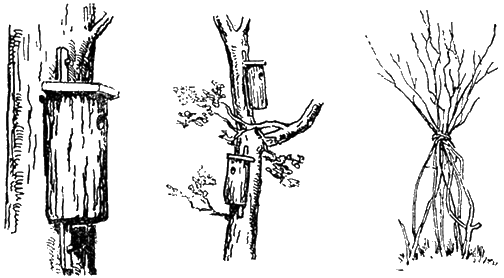
MAKE NESTING BOXES We will for the present take the birds that build in holes in trees. These include the various tits, such as the Great Tit, the Blue Tit, the Crested Tit, and the Willow Tit. Also the Nuthatch and Tree Creeper and the various kinds of Woodpeckers, as well as the Wry-Neck, Starling, Redstart, Pied Flycatcher, Swift, and among the larger birds Owls, Kestrels, Jackdaws, etc. Nesting-boxes, if properly made, attract these birds to such an extent that ninety out of a hundred of them will be found to be occupied by birds during the breeding season. I have said "if properly made" because on this depends success or failure. Most of the birds seem to like the same pattern of nesting-box, but of a size suited to the bird; thus a Tit will not go into a box that has a large enough opening to admit some bigger bird to come and drive him out, and the bigger birds like bigger boxes. I have drawn the section of a nesting-box which you will see is a block of wood (which I have here cut in half) with the inside hollowed out in a peculiar shape.
You may hollow it in many other shapes but you will not then get the birds to occupy it. You will notice that the entrance hole goes slightly uphill, at an angle of about four degrees. If you made it flat or sloping downwards the bird would not use it because the damp or rain would be allowed to run in. At the widest part, Z, the hollow must be 2 3/8 inches wide and 5 7/8 inches deep for small birds and 3 to 3 ¾ inches wide for bigger birds, and 9 to 11 ¾ inches deep. Then you must not make the sides of your nesting-box too thin. The birds prefer good thick walls such as will not admit the cold or damp. The like the bottom to be in cup-like form as I have drawn it, and slightly filled with a tablespoonful to half a cupful of sawdust and earth as a soft warm foundation on which they can lay their eggs and where the eggs will be held together by the shape of the nest. Then the box must be make to face in the right direction, that is, the South or South-East, so that the opening is not facing the cold North or East Wind or the wet South-West gales. The birds like to be where the sun can reach them and yet where they are hidden to some extent from marauders by foliage. For the small birds, the nests should be placed from six to thirteen feet from the ground, while for the large birds they should be from 12 to 16 feet, or higher when necessary. The box should be fixed firmly to the tree so that it does not wobble about, otherwise the birds will not use it. It is a fatal mistake to fix the box against the tree in such a way that it slants with the entrance hole upwards. It does not so much matter if it slants slightly the other way. An open nesting-box is used for birds that are inclined to nest in the bushes. If this is about four and a quarter inches deep it attracts Robins, Wagtails, Spotted Flycatchers, and Redstarts. Small stacks of brush-wood can also be used by which the bird will be attracted to build, or a number of branches of growing bushes, which do not otherwise offer a good harbour for a nest, can be bound together towards their top; bushes so prepared almost always attract birds to build.
I read of an experiment in which fifty bushes were thus tied together and forty seven of them were built in during the first year. More information will be given later, but fellows who are wanting to become Bird Wardens should if possible study the Bird Protection Act, of which I will give some extracts in another issue. Much of the fore-going information is from How to Attract Wild Birds, 1s. 6d., Witherby & Co. ROBERT BADEN-POWELL |
| APRIL 24, 1920
THE ELEVENTH SCOUT LAW How many laws are there in the Scout Law? Ten. Well, if there were an eleventh law it would be this: "A Scout is not a fool. He thinks a thing out for himself, sees both sides, and has the pluck to stick up for what he knows to be the right." A fellow who is a backwoodsman is never a fool, because he has to look out for himself on all occasions; while a chap who lives in a town gets everything done for him. If he wants water he goes to the tap instead of having to notice where a valley runs down between hills and brings you to a stream. "It is a disgrace to a Scout if anybody sees a thing before he does." That we know from our book, "Scouting for Boys." A SCOUT AND A CUP OF COFFEE Now I had a little instance of being able to trust a Scout not to be a fool when I was last in Canada. The train I was in stopped for a few minutes in the night at a station, and I badly wanted some food; so I asked a Scout who was on the platform to try to get me a cup of coffee. There was a big crowd, and no refreshment room was visible. Just as the train was moving out of the station my Scout came tearing along the platform after my carriage, which was in the front part of the train. He just caught me up to shout: Knowing it was a corridor train he had just time to put the food in there and then ran on to let me know. A fool, if he even succeeded in getting the coffee, would have run along with the train to give it me and would have spilt it all. ROBERT BADEN-POWELL |
| May 01, 1920
SCOUTS BOXING The boxing of the London Scouts at the Holborn Stadium was a fine show. Six hundred went in for it, so it took a lot of preliminary ties before we got to the champions. Then it became very interesting and some good fighting resulted. But what fellows would have done better if they had more careful teaching. Many of them knew nothing of the importance of good foot work, and this only comes of good teaching and careful attention. Then there was too much attacking and not enough defence; continually trying to get a knockout blow is not boxing, it is prize-fighting. Thank goodness we are not out to win money in our boxing - it is clean sport, where the points are awarded for skill and sportsmanlike conduct and the boxers are fighting for the honour of their district or troop and not for their own reward. I was particularly pleased to see at the London boxing that there was not much of the "show off", that many young boxers like to indulge in (before they have learnt sense); a sailor dancing a hornpipe isn’t in it with some of them. Also, all was done in most good-tempered and chivalrous style, which is what one wants to see. I am looking forward to seeing a really first-class display of boxing at the Jamboree. The main object in keeping quiet during a bout is that both combatants should have strict fair play. If a fellow gets a punch in the eye, and this is followed by a roar of laughter from the audience with applause for the hitter, it naturally helps to upset the one and to encourage the other. We don’t want this; we want each man to feel that he is getting a fair chance so far as the onlookers are concerned. In some countries they think it right to yell and cheer or hoot the players in the game so as to encourage or depress them. That is a very unsporting thing. I hope, therefore, that the Scouts will show an example of fair play by never letting a sound escape them while watching a boxing bout. Patrol-leaders and older Scouts remember this, and see that your Tenderfoots carry it out, too. Remember that we shall have the Scouts from foreign countries coming to see how we do things. Many of them will see British boxing for the first time, and they must carry away with them the feeling that it is a most manly form of sport and one which stands for, pluck, endurance, discipline, chivalry and good temper. ROBERT BADEN-POWELL |
| May 08, 1920
AFRICAN TRIBES Somehow or other the Red Indians of North America have been very much written up in books, and often half what is written of them is made up from imagination, or from secondhand information. The consequence is that fellows are apt to think that the Red Indians are the only wild people who are any good. But this is a great mistake, and our Pageant of Scouting at Olympia will show that in different parts of the British Empire we have other races just as fine and with equally good customs and ideas. I have described to you in The Scout something of the natives of whom I saw a little in Australia, and today I will give you something about the natives of Africa. I have had the good luck to live with several of these tribes, so that I do not have to get my information out of books, but there are so many different races in Africa that it is difficult to bring all of them and their ways into our show. Therefore I shall have to present mainly the Zulus, with perhaps a few Masai and Sudanese thrown in. The Zulus include several other big tribes who are their cousins, such as Swazis, Matabele, Basutos, Angonis, etc. Just to give you a rough idea of some of the main tribes and their whereabouts, here is a diagram of Africa, and though there are many more people inhabiting the continent, I only give the names of those I have visited. 1.—ON THE MARCH Well, as a matter of fact, I heard it before I saw it. For the moment I thought that a church-organ was playing, when the wonderful sound of their singing came to my ears from a neighbouring valley. Then three or four long lines of brown warriors appeared moving in single file behind their indunas The Ingonyama chorus played on the organ would give you a good idea of their music as it swelled out from four thousand lusty throats. At a given moment every man would bang his shield with his knobkerry (club) and it gave out a noise like a thunderclap. At times they would all prance like horses, or give a big bound in the air exactly together. It was a wonderful sight, and their drill was perfect. Behind the army came a second army of umfaans (boys) carrying on their heads the rolled-up grass sleeping-mats, wooden pillows, and water-gourds of the men. These boys, by going on the march and looking on at battles, giving first aid to the wounded, and cooking their men’s food, were all learning how to become good warriors later on. They were the Boy Scouts of their nation. 2.—CAMPING 3.—HUNTING Others would set traps with a noose made of twine attached to a sapling which was bent over to form the spring. Also, a usual method was for a number of men to go out on a wide circle and gradually close in, driving the game before them into the center and then spearing the buck as they tried to escape. 4.—FIRE-LIGHTING (Some more about these interesting people next week) ROBERT BADEN-POWELL |
| MAY 15, 1920
THE JAMBOREE PAGEANT Last week I began to tell you about some of the African tribes which I have visited, and whose picturesque customs we hope to introduce into our Pageant of Scouting at the Great Jamboree. 5. INITIATION OF BOYS "If we go forward we die, Then the Medicine Man of the tribe, in fantastic dress, painted the boys white, and they were given each an assegai and told to go off into the jungle and not to return until the white paint had worn off, and that if they were seen by anybody during that time they would be killed. 6. DISCIPLINE Thus, when two warriors quarrelled over their food and one of them stabbed the other slightly, the attacker was brought before the Induna for trial. The Induna pointed out that by injuring a fellow warrior he was acting as an enemy to the tribe and could not therefore be permitted to live. He would be taken away and handed over to the women, one of whom would take his chin and the back of his head between the two hands as she stood behind him and break his neck. 7. CHIVALRY In consequence of this, the Induna said that, in his case, since he had proved himself exceptionally brave in the face of danger, he would probably do so again in action against an enemy, and he would be of value to the tribe. His valour therefore outweighed his want of discipline, and he was pardoned. During the trial, the warriors all sat round in a ring on the ground grunting together in unison about once every two seconds as a sign that they were interested and agreed with what the Induna was saying. The moment he gave his verdict of acquittal, they all sprang to their feet and raised the right hand, shouting the word Inkos (chief), meaning approval. 8. SALUTATION OF FRIENDSHIP 9. TOTEM 10. SIGNALLING The Impi, on moving off, did so in a very peculiar way. The young, light-footed warriors ran off in a single file in a crouching position, all hissing through their teeth, to take up their position for the charge, while the older men, the Ring-kops, formed what was called the "chest" of the army, that was the central solid part of it which pressed forward to put the superior weight into the fight when necessary. 11. THE RALLY ROBERT BADEN-POWELL |
| May 22, 1920
ARTIST SCOUTS Now then, all you who have the Artists’ Badge, or who are aiming for it, here’s some good news for you! A Scout artist has had his picture accepted by the Royal Academy this year. ROBERT BADEN-POWELL |
| MAY 29, 1920
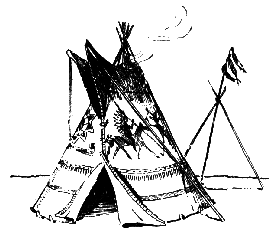
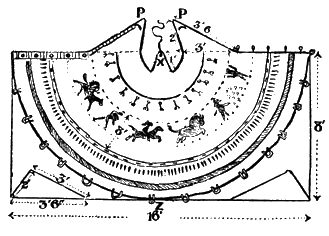
RED INDIANS Last week I described some of the interesting Red Indian customs which we hope to introduce into out Jamboree Pageant. Here is a continuation of the scene. TRIAL OF AN OFFENDER CHIVALRY PEACE SALUTATION John Smith now invites Powhattan and Pocahontas to visit his camp, which they do, attended by runners and totem bearers. TOTEMS SIGNALLING Meantime squaws and boys pack up their teepees ready for departure. General Rally to the Flag and "Rule Britannia." Followed by War Dance. Tribes march off. TO SET UP TEEPEE Lash four poles together at about 9 ft. above ground, set them up as tripod and add the other two. Lash the tongue X of teepee to one of these and lay the teepee round them, fastening it down the front with wooden pins through the loops of one side passed through the holes in the other. The lower ones are left open to form door (which generally faces east).
Rope loops are let into the bottom of the tent all round through which tent pegs are driven into the ground to hold it secure. The smoke flaps are held in position by two poles to be shifted according to the wind. (Next week I shall tell you how Powhattan is dressed, and give you a picture of him in full war paint.) To make a teepee.—Take a piece of sacking 8ft. by 16ft. From point X as centre, mark half circle of 8ft. diameter and cut out. Also mark smaller circles for ornamental painting. From pieces left over cut out two smoke flaps P and stitch them on. Cut out two V shaped apertures of 1ft. on either side of X and make pockets in corners P of smoke flaps for poles to fit into. Make model in paper first. ROBERT BADEN-POWELL |
| June 05, 1920
THE JAMBOREE PAGEANT THE BRITISH Captain John Smith complained in his diary that most of his band of British adventurers were men unaccustomed to the sea or to agriculture, being mainly townsmen, clerks, etc. As an instance, he describes how their hands got blistered with pulling ropes, rowing, using the axe, etc., and this made so much bad language among them that he instituted the punishment of pouring a cup of cold water down the sleeve when anyone offended in this way. "And verily enough cold water was used as might have filled a hogshead." Of course, there was a sprinkling of fine old salts among them, but for the lighter purpose of the play we can count a good number of the contingent as tenderfoots; two or three comic actors would take such parts. POWHATTAN Hear dress of white goose quills tipped black, stitched to a long embroidered band which fits round forehead and reaches below the knees. The big feathers have a row of smaller (brown and white) feathers along their base backed and topped with white fluffy feathers, and the tips are ornamented with tufts of red horse-hair. The Chief wears his hair in two pigtails plaited down each side of his head. A necklace of boars’ claws. (This can be made of wood). A buckskin shirt, embroidered and beaded (made of sacking with embroidery painted on and lower edge frayed deeply to form fringe). Sleeves ornamented with a band down the middle to which are attached tufts of long black hair. Buckskin (sacking) trousers ditto. Embroidered moccasins (brown canvas painted shoes). Buffalo robe cloak over shoulder (sacking with black lining and black fur edging). The outside of the robe should have drawings of the Chief’s exploits on it. Totem spear staff ornamented with scalps or feathers and "medicine bag" made from the skin of a deer or dog. Peace pipe in hand. ROBERT BADEN-POWELL |
| JUNE 12, 1920
THE MAORIS The Prince of Wales has been having a great time in New Zealand, seeing a good deal of the Maoris, who are the original natives of that fine country. In the old days they were a splendid race of brave and chivalrous warriors. They had many of the manners and customs of other wild tribes, even to a certain amount of eating of other people, but they had also a very kindly and sporting spirit even in War. Their leading orators spoke to the people with great eloquence and with high ideas, just as some of the Red Indian speakers had done, and as the leaders of the Zulus have done (I once heard old Mnymana, who was "Prime Minister" to Cetchwayo, the King of the Zulus, make a speech which was compared with one of Cicero’s orations by a good judge who was listening to it). I have met with great kindness at the hands of the Maoris, and among my treasures are a whale’s tooth charm which one tribe gave me since it had brought luck in war to their fighting chiefs for hundreds of years and now they no longer needed it, being at peace under British protection. I have also a little jade "Heitiki," or mascot, that was given me in New Zealand, which, if worn round the neck, will keep me from getting drowned! And I was also given a woven grass cloak ornamented with feathers which, though not a garment which I could wear in Piccadilly, is a very swagger article of dress in the backwoods of New Zealand. The Maoris proved themselves a brave enemy when our troops fought against them in 1867, and there are loads of good stories about their sporting characters. I can’t vouch for the truth of it, but I was told that, on one occasion, when the British had surrounded on of their fortified camps, and had secured the only spring of water in the neighbourhood, the Maoris sent a messenger under a white flag to say: "I don’t know if you are aware of it, but you are holding the only water supply in these parts, and if we can’t have water we can’t go on fighting," And another time, I’m told-but well, it is a bit to thick for me to swallow-in the middle of some heavy fighting the Maoris put up the white flag. When asked whether they meant that they surrendered, they replied: Oh no. But we have run out of ammunition. Could you lend us some to go on with!" I can’t quite believe that yarn-but at the same time it illustrates the spirit in which they fought. ON THE MARCH Their dress is scanty, generally a kilt of grass fibre and a small cloak of woven grass. Their bodies and faces are tattooed in patterns. Their weapons are chiefly spears (with horrible barbed points on them, made of sharp fish bones), also clubs and stone axes and slings for throwing stones. The tana (army) moves along under command of the rangatira (chief), who has with him his tohunga ("medicine man" priest). The baggage, chiefly mais, food, and a few cooking utensils, is carried by boys on their backs. No man carries loads after he has passed the ceremony of being admitted to manhood it would be wrong for his mana (personal dignity). (The Maoris have awfully strict rules about what a man may or may not do.) CAMPING The men set up little huts or sheds made of brushwood or palm leaves. Their fires are lighted with fire-sticks. Cooking is done in a pit dug out and lined with stones. A fire is burnt in this till the stones are hot. The ashes are swept out, then food is put in and covered over with leaves and left to cook itself. HUNTING The favorite food is parrot, pig, or dog. The pigs are wild boar, but are said to come originally from pigs which Captain Cook and other explorers put ashore for breeding purposes. Their way of getting parrots-the hunter had a tame parrot with him and, hiding himself near a tree, he put a long stick up into the branches, holding the other end himself with his parrot perched on it. The wild parrot, hearing the tame one calling, would fly to the tree and walk down the stick till within reach of the hunter. Quite a nice, simple way of catching your bird! Pigs or dogs are roasted whole on a wooden bar supported over a fire on two forked uprights. Dishes and plates, called para, are made from rushes, leaves, or long grass woven together. INITIATION The tana, (prince) of the hapu (clan), together with some of his rangatira (chiefs) and the tohunga (priest), sits to witness the initiation of boys into manhood. The priest puts boys in line and shows them horrible masked Demons, Tapu. He then teaches them what they ought to do as men, and shows them that when they do the wrong thing Tapu will punish them. 1. Thus "Fight bravely." The boys advance in line against enemy, stamping and threatening; panic seizes them, they turn to flee and then find themselves face to face with Tapu and his spear. Form up again for 2. 2. "Endure pain."-The boys march past in single file, the priest slightly stabs each boy with a knife. Tapu stands by him. If a boy opens his mouth to cry out, Tapu will drive his spear down his throat. 3. "Be courteous."-Boys file round again. If a boy passes a rangatira, or a sick man, without offering his services, Tapu will stand in his path and point with his spear to him to do his duty. Boys form in line for No 4. 4. "See what is beautiful in Nature."-If a boy looks round and does not sing and clap his hands with enjoyment of the mountains, forests, lakes, streams, Tapu will blind him by spearing his eyes out. Each by comes forward in turn to receive a spear as an emblem of manhood from the Chief. Tapu stands near his path with spear poised to stop him if he is a wrong ‘un. The boy advances smiling and Tapu lets him pass to be invested. COURT OF JUSTICE A man who has, even accidentally, injured another of his own iwi (tribe), has thereby committed a crime against a tribe because he deprives it of one of its fighting men. And a fighting man is tapu (sacred). So the delinquent has his arms taken from him, or can either be tapu’d-that is, "put in Coventry," or boycotted by the rest, or he can be killed, or he can be plundered by everybody under the law of murum. But he explains how the accident happened, which he does with a tremendous lot of pantomimic action, showing how, when he was cutting down a palm tree with his axe, the other silly ass went and stood in the wrong place and got knocked down. The rangatiras agree among them that he is a good man, and good men are scarce, so he can be forgiven by the priest. The ceremony of being released from tapu consists of the priest taking a branch of Korokio bush, spitting on it, and tapping the delinquent on both shoulders with it. Then he says a prayer over him, asking the evil spirit to depart. Then, picking up some leaves from the cooking oven, he throws them in the air and jumps twice after them. Then he puts them back on the hearth and the ceremony is over. The tribe salute the man by waving mats, and he rubs noses with them as we should shake hands. (Some more about the Maoris next week.) ROBERT BADEN-POWELL |
| June 19, 1920
SIGNALLING One of the displays at the Jamboree will, I hope, be a scene showing how the different native tribes in the British Overseas Dominions carry out signalling. It ought to be jolly interesting, because every tribe seems to have a different dodge for doing it. For instance, the Red Indians have smoke signals and sign language; the West Africans talk on drums or leave signs; Indians communicate by marks on walls or trees; Australians by marked sticks; Hillmen use whistles; Soudanese call from well to well, etc. The first signalling that I have read about as used by civilized people was done by that fine old adventurer, Captain John Smith, in 1601. He was then serving with the Austrians against the Turks. An Austrian town was being besieged by the enemy, and was in danger of being captured by them, when the force to which John Smith was attached came up to the relief of the place. The commander, Colonel Kisell, was in a difficulty as to how he would let his friends inside know that he was there and about to help them. Captain Smith said that some months earlier he had practiced a method of signalling with General Ebersbaught who was now commandant of the besieged town. So Colonel Kisell gave him some guides "who in darke nighte brought him to a mountaine, where he shewed three torches equidistant from other which plainely appearing to the towne the Governour presently apprehended (recognized) and answered againe with three other fires in like manner - each knowing the others being the intent." Smith, though seven miles distant, signified to him these words: On Thursday at night I will attack on the East - at the alarum - salley you! General Ebersbaught answered he would; and it was done. Smith’s dodge of signalling was this. For every letter of the alphabet from A to L he gave one flash of a torch corresponding with it’s number away from A. Thus A being one flash, B would be two, C three flashes, and so on up to eleven for L. All letters from L were shown by a double flash counting in the same way from M as one double flash, N two double flashes, etc. The end of the word was shown by three lights. A pause was made after each letter so that the observer could write it down. He acknowledged it with a single flash. It was a pretty slow method, but quite simple and effective. Try it yourself. ROBERT BADEN-POWELL |
| June 26, 1920
SWIMMING Lots of Scouts have asked me whether we could not alter the test of a First-Class Scout by leaving out swimming. Well, if I were to make the alteration, I should have the whole of the King’s Scouts and First-Class Scouts on to me with objections - and it is their opinion that I value. But there is no fear that I should ever want to call a fellow a First-Class Scout if he could not swim. I know that there are lots of difficulties in the way for many boys, but that is just one of the tests of whether he is a real manly Scout or not. A fellow who sits in a room and expects swimming to come to him is a bit of a - well, anyhow, he is not my idea of a Scout, and yet that is pretty nearly what a number of boys do. I have been in Norway and Sweden, and although they have colder climates than England there is hardly a boy or girl there who cannot swim. So it is rather a disgrace to us Britons that so many of our lads are only Second-Class in this respect. So, for the honour of the country and of the Scouts, I hope that every Scout and every Cub will do his best to learn. Before long I am going to call on the Cubs and Girl Guides to see if they can beat the Boy Scouts at swimming; not by having a race between a few selected members, but by comparing the proportion of swimmers to non-swimmers in the respective branches of our Movement. Swimming is such ripping good fun. It is a big thing to feel that you are master of the water, and instead of being afraid of it as an enemy who will drown you, you make it your friend who helps you to enjoy life. Think how awful it would be if you saw someone drowning, and though you were a big, healthy fellow you could only stand on the bank and jibber simply because you had never tried to learn to swim. You would feel almost guilty of murder. Thank god, a very large number of lives have been saved (somewhere about 600), by Boy Scouts who were able to swim. You ought to Be Prepared to do the same when the opportunity comes to you, as it is pretty sure to do one day. Those who are not swimmers generally excuse themselves by saying: "There is no place near where I can learn to swim." Remember this-there is some place where you can learn to swim, although it may not be next door. And somewhere there’s a way to that place if you only look out for it. Do you know where to look for that way? Why, in your own heart, of course. Where there is the will there is the way. There may be a swimming-bath in your nearest town, or you may make your camp or your hikes take you to the seaside or to places where you can bathe; in numbers of cases Scouts have made their own bathing-places by damming and digging little streams. There’s hardly a place in Great Britain where you cannot learn to swim if you only set your mind to it and determine to make yourself a First-Class Scout and therefore an A1 man. ROBERT BADEN-POWELL |
| July 03, 1920
ANSWER BACK One thing they don’t seem to teach a boy at school is to answer or to acknowledge letters when he gets them. At any rate, there are a very large number of young men nowadays who don’t answer letters. It is a bad fault, because very often, without knowing it, these young men are having their character tested, and if they don’t reply they are noted down as "unbusinesslike, won’t do." But really they are something worse than unbusinesslike, they are discourteous. And that is why I write this, as a word of warning to Scouts. The Scout Law requires a Scout to be courteous, and one sign of courtesy is to acknowledge letters when other people have taken the trouble to send them. ROBERT BADEN-POWELL |
| July 10, 1920
A MOTTO FROM THE PRINCE OF WALES The Prince of Wales is, as you know, making a great name for himself in each part of the Empire as he visits it, by his personal jollity and his Scout smile. In addition to that, he has a wonderfully happy knack of saying things that mean a lot and are useful to remember. Shortly before he went abroad he paid a visit to Eton College, where he inspected and addressed the Boy Scouts. There are no fewer than 250 Boy Scouts among the boys at Eton. And this is what he said to them: "Live not for yourselves but for your country, which is the same thing as playing not for yourselves but for your side." There is a motto for you, Scouts, wherever you may be, and I hope you will remember it and will carry it out in all that you do. It has been given to you by our Chief Scout for Wales and our future King. ROBERT BADEN-POWELL |
| July 17, 1920
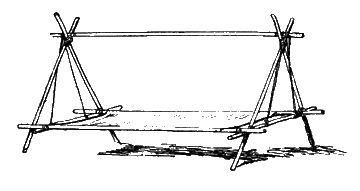
CAMPING And I dare say I’ve told you before, for the best part of eight years I lived in camp. I was generally my own cook and housemaid and butcher and baker. I’ve lived in tents of almost every size, and I’ve used cooking fires from a bonfire down to a few scraps of paper. For tent, that which I have found most suitable to my needs is one in which I still sleep now every night, summer and winter, although I have a comfortable house in which I might sleep, if I liked it better. But I don’t. Below you will see an illustration of my tent and bed. Any fellow can make his own and as cheaply as any tent that can be bought. One great value in mine is that, no matter how wet the ground may be, your bed and things are not on the ground, and are therefore dry; no matter how hard the gale may blow, your tent cannot blow down. Twice I have lived in comfort in tornadoed, flooded camps when my fellow campers have had a bad time of it. I don’t want to argue that my tent is better than anyone else’s; that would be silly, because anybody who has ever designed a tent knows perfectly well that his is the best. I only claim that this one suits me as well as any that I have tried. It is one that any Scout can make for himself; and if hiking in wooded country there is no need to carry poles, they can be got on the spot; so you only have to take the roofing cloth and the hammock cloth. Then a good camp cook does not want to be lumbered up with a whole crowd of pots and kettles and things. When my wife and I went trekking on the desert in Algeria we only had one stewpan to do all our cooking and one old preserved milk tin for all our drinking. That, I admit, was too small an allowance for comfort, and we had to boil our coffee in the same pot that cooked our fish, our vegetables, and our pudding! No, you want two boiling pots, i.e. a low, flat kettle and a saucepan and, as an extra, a frying pan. The fire is then fed with short, hard sticks to make a good red hot pile of glowing embers. A hole in the ground heated this way and made into an air-tight oven will cook your food for you if you want to go and do other things, just on the same principle as a "hay box", where you leave your pots of food half cooked to finish themselves packed tight among hay or newspapers and securely covered in form the outside air. ROBERT BADEN-POWELL |
| July 24, 1920
TRACKERS TO THE FORE ! Any Scout who wants to prove his mettle as a tracker will have his chance at the Jamboree. There will be some interesting competitions there; but the thing is to get your eye practiced at it by lots of tracking between this and then. Begin by raking over a piece of ground about 20 yards square and then making tracks of all kinds on it by walking, running, barefooted and with boots on, biking, horses, dogs, etc. Then do the same a few days later and compare their appearance so that you can tell whether they are old or fresh. Then get one or two fellows to enact some little simple scene over the ground while you look toe other way. When they have finished, you examine the tracks and say what you think has taken place. When all is said and done, "What is the use of being able to track?" you may be inclined to ask. Well, we know haw useful it is for finding the way, or for following up people when there is no one about to help us with information; in detecting crime it is a most valuable and necessary help; but most especially is it useful when you are out in the wilds after big game or on service among your enemies. "Big game! What chance have I," you will say, "of ever seeing big game in these days of civilization?" Well, some of the hunter’s life is still within reach of Scouts, as is shown by the report in the Calcutta Scout Sign, where the camp of the 1st Calcutta "King’s Troop" is described. These lucky fellows spent six days in camp in the jungle of Nepal and during that time they shot two cheetal deer, two Sambahar stags, a wild boar and a python, in addition to several alligators and crocodiles whose bodies were not recovered, as they sank in deep water. The python measured 15 feet 2 inches long and 19 inches round the body! I expect our Indian Scouts and those from other Overseas Dominions will be able to give us some pretty interesting yarns about hunting and trekking in their different countries. But in every one of these, wherever you choose to wander, it is certainly necessary for you to be able to track as well as to swim and cook your food. ROBERT BADEN-POWELL |
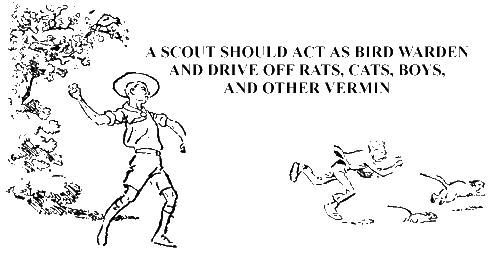
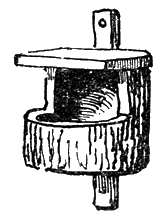 The Warden has to know which kind of birds nest in trees or bushes, and which prefer to live in holes in trees; then he can do a great deal towards encouraging them to build their nests and breed by providing clumped bushes for the one kind and nesting-boxes for the others.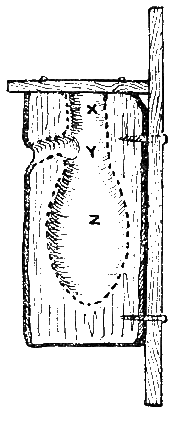
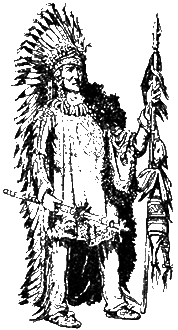 Here is the description of Powhattan’s "war paint" which I promised you last week.
  Two things are needed for camping-and, if you want to make a success of it, keep both those things as small as you can. One is your tent, the other is your kitchen and its fire.