Astronomical and Calendar Records on
Rongorongo Boards

Here I study a fragment of the Great Washington tablet (Sb 3 - Sb 5) presented in figures 1, 8, 9, 14 and 15 as well as the parallel texts written on this and other tablets. One must often observe the rules of gradual phonetic evolution that govern the Polynesian languages in order to translate words successfully.
Fragment 1, the Great Washington tablet, reads:
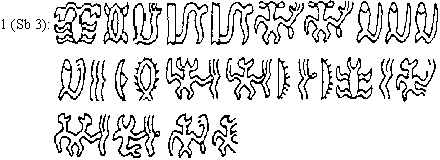
First of all, the moon goddess Black Crab is a symbol of solar eclipses (Rjabchikov 1997a: 37). The moon goddess is associated with rain (Barthel 1978: 261; see my article "Easter Island Place Names: The Sun, the Moon and Eclipses"). The final sentence of the decoded text corresponds to the Rapanui "Creation Chant" (Métraux 1940: 321). The names Breath, Breath/Underworld belong to the moon, the daughter of the god creator Tiki (Makemake, Tangaroa, Tana) and the elder moon. In fact, "Tiki-te-Hatu by copulating with Hina-Popoia produced Hina-Kauhara" (Métraux 1940: 321). It is well known that the moon goddess is a symbol of death (Barthel 1957: 64). On the other hand, in the Keiti inscription Hoe/Hae is the name of this goddess connected with the breath (see my article "Several Rongorongo Records (Symbolism of Archaic Beliefs)") (2). Furthermore, "Tinga Hae (cf. Rapanui tingai 'to kill') by copulating with Parararara-hiku-tea produced the shark"; "Hikue by copulating with Hina-oioi (3) produced the whale" (Métraux 1940: 321).
Interestingly, the term Nga 'Initial condition of the Universe' is presented in Tomenika's record on a sheet (Rjabchikov 1996: 36). It is inserted in the moon goddess' name Uraura Nga te Mahina (Métraux 1940: 372) 'The Crayfish - the Initial condition of the Universe - the Moon' (4).
The parallel text which tells of the full moon associated with rain is presented on the Mamari tablet (Cb 1/2), see fragment 2:
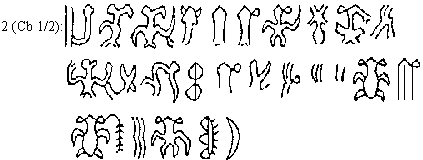
The Supreme Chief - the King (the god creator Tiki-Makemake) - is a personage of the Rapanui folklore text about the power of the king (Métraux 1937: 52-4). One can compare the Rapanui place name Rangi tekeo (Barthel 1962: 107), otherwise Rangi Teke o(h)o 'The SKY Chief (the sun) is coming up'. The word popo is preserved in the place name Apopo (Barthel 1962: 105), otherwise A Popo. According to the Tuamotuan and Easter Island beliefs (Lee 1992: 80; Rjabchikov 1993a: 23; 1993b: 5; 1997a: 46), the Turtle is a designation of the Pleiades. Besides, the latter are associated with sweet potatoes in the Maori beliefs (Best 1955: 53).
Fragment 3, the Tahua tablet, contains the text which tells of the creation of the Universe during a solar eclipse:
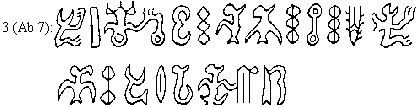
The last sentence correlates with a Rapanui song kai-kai (Campbell 1971: 419, Barthel 1978: 152; Rjabchikov 1997a: 44):
                            Kiakia, kiakia
                            tari rau kumara
                            i te ehuehu,
                            i te kapuapua.
'The bird god Tiki-Makemake (lit. 'the birds kiakia') is carrying a leaf of the sweet potato into the darkness, into the fog'. This is the description of a solar eclipse.
Fragment 4, the Tahua tablet, also contains the additional parallel with the folklore text about the power of the king:
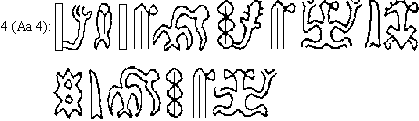
It should be remembered that the expression tana moko 'a man of the tribe hanau momoko' is associated with the yams and the sweet potatoes in the Rapanui "Creation-Chant" (Métraux 1940: 322).
The word hati of fragment 2 is also presented in fragment 5, the Great St.Petersburg tablet, fragment 6, the Great Santiago tablet, and fragment 7, the Tahua tablet.
Fragments 5 and 6 read respectively:


The words tete hatihati signify 'the heat - the stream', and the same idea is reflected in the place name Ahu Tangaroa Hiro (Barthel 1962: 104) 'The ceremonial platform 'The sun god Tangaroa - the rain god Hiro''. The words Kai Taha mean literally 'the Frigate Bird (the sun) being eaten', otherwise 'the sun in eclipse' (Métraux 1940: 52). The word ipu means 'gourd; calabash' (6); the gourd is a symbol of the Initial condition of the Universe in the Rapanui folklore and rock art (Rjabchikov 1998: 57). Actually, the text written down after the decoded fragment describes a solar eclipse (Rjabchikov 1997a: 32).
The word hati is registered in a Rapanui song (Métraux 1940: 352; Fedorova 1978: 340; see my article "Several Rongorongo Records (Symbolism of Archaic Beliefs)"):
                     Tama te ra'a - Hiro rangi pakupaku.
                     Rua - hi e.
                     Hati mai, a hati - Pu. (7)
'The Human Being (the god Tangaroa) of the sun - the (god) Hiro of torn rain clouds. The sunset/solar eclipse - the sun rays. It is the downpour, the downpour - the Trumpet-of-Hiro (Pu-o-Hiro)'. "A stone near ahu Mahatua on the northeast coast is named Pu-o-Hiro (the Trumpet-of-Hiro). It is pierced by a natural hole and it is said that when the northwest wind blows, a sound like that of a trumpet is produced" (Métraux 1940: 310).
Fragment 7 reads:

Fragment 8, the Great Washington tablet, reads:

The term iho/ihu is presented in the place name Ihu roroa o tama (Barthel 1962: 105) 'The great stone of Tama (Tangaroa)'.
Fragment 9, the Great Washington tablet, reads:
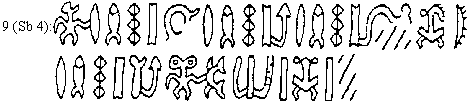
Here the sun god Makemake (Maki) has different epithets: Ana Ika (see below), Mauna 'the Mountain', Rau 'the Creator', Mata Matua 'the Face/Eyes-Father/Boat'. The chthonic/rain god Hiro has epithet 'the Paddle Rapa'. The sentence Tututu atua (Ariki) Mau atua ... means 'The light (burning) of the Supreme Chief (the sun) ...' So this text describes a solar eclipse. The words Rapa ... Matua correspond to the place name Rapanga rei (Barthel 1962: 107) 'The paddle rapa - the boat/the pendant rei-miro'.
The parallel text is presented in fragment 10, the Great St.Petersburg tablet:
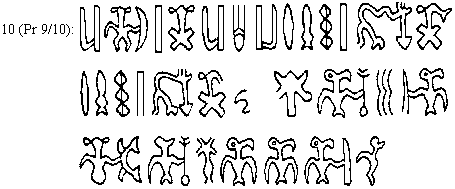
10 (Pr 9/10): 4-4 6-3 4 49 4-4 1 4-4 30-12 17-4 31 22 49 30-12 17-4 31 22 49 44-[101] 79 44-101 33 5-44 68 8 44-101 45 44-44-44 5-19 Tutu hahine atua (Ariki) Mau: Tutu-Tiki-Tutu. Ana Ika te atua Maki Rapa (Ariki) Mau. Ana Ika te atua Maki Rapa (Ariki) Mau. Tao Heke. Tao Ua titaa Honu Matua. Tao Pua Tatata Tuki. 'The light (burning) near the god 'the Supreme Chief' (the sun): the string figure Ko Akuru (12). (Then the same text as in fragment 10 is written, notice that the god Makemake also has the epithet (Ariki) Mau 'the Supreme Chief' (the sun) and 'the sun god Maui'.) The Octopus (the deity Heke-ma-kau) is carrying away. The Rain which is near the Water/Boat is carrying away. Pu Tatata Tuki (perhaps 'The Trumpet-Nearness-Copulation') is carrying away'.
The words Mata, Rau and Heke are included in the place name Hare mata rau heke (Barthel 1962: 105) 'The house of (the sun deity) 'The Face/Eyes-Creator-Octopus (Heke-ma-kau, cf. also the name of the second legendary king, Tuuma-Heke)''.
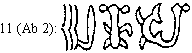
I have read the word 4-44 4-44 as titaatitaa 'near' in fragment 1, and the word 5-44 titaa 'near' in fragment 10, cf. Rapanui titaa, titaha 'border; to border on'. Interestingly, the segment 33 5-44 68 8 of fragment 10 is comparable with fragment 11, the Tahua tablet:
In fragment 12, the Great Santiago tablet, there is a text which correlates with fragments 9 and 10:
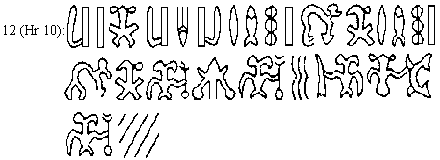
Notice that the preposition hahine 'near' is omitted in the first sentence. The god Makemake has the epithet Taha 'The Frigate Bird' as well.
Fragment 13, the Small Santiago tablet, is the key to the name 30-12 Ana Ika:
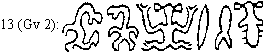
Therefore Ana Ika 'the Shine-Fish' is a name of the sun god Tiki (Tangaroa, Makemake, Tane), cf. also epithets Ana and Tuma of the sun deity (Rjabchikov 1997b).
Fragment 14, the Great Washington tablet, reads:
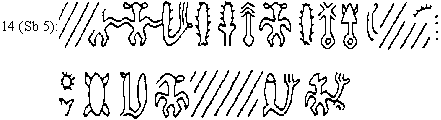
The name of the deity Keu (Ariki) Mau 'It looks like rain - the Supreme Chief (the sun)' compares with the name of the Rapanui deity Manu Keukeu Renga (Arredondo 1993: 220). The latter signifies 'The bird 'It looks like rain - the yellow colour (the sun)'' (13).
Fragment 15, the Great Washington tablet, reads:
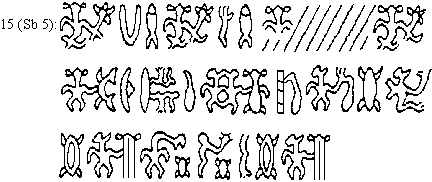
In this fragment the sun god Tiki and the moon goddess Hina are mentioned. In the second sentence the name Hina is replaced by the epithet Roa 'Grave'. I have found Old Rapanui roe 'grave' in the kai-kai song Ko Akuru (Rjabchikov 1997a: 34), cf. Samoan loa 'grave, esp. a kind of sepulchre like a small house'.
Interestingly, the god Tiki has not only the epithet Hatu, but also the epithet Matua 'Father/Boat'. On the other hand, one can read words 6-7 6 8 Hatu-a-Matua as Hotu-Matua, the name of the first legendary king. It is well known that he arrived on Easter Island on the south of the bay Anakena (Métraux 1940: 62), and the words Hatu-a-Matua and Anatahataha (Anakena) (15) are taken down together! The sentence 'The Underworld - the Turtle/Water' denotes the new (first) moon of the month Hora-iti (August-September).
The decoded name of the platform ahu correlates with the place name Hatonga manu ahuroa (Barthel 1962: 105), otherwise Ha tonga, manu - ahu roa 'The winter, the birds - the great ceremonial platform'. It should be noted that the ancient article ha of this place name corresponds to the modern article a. Glyph 6 denotes the article ha/a in rongorongo records. Moreover, the place name Hatonga manu ahuroa may be a variant of the place name Ahu te kitonga (Barthel 1962: 104), otherwise Ahu te ki(a), tonga 'The ceremonial platform 'The birds kiakia, the winter''. Besides, there is the place name Ahu te tonga (Barthel 1962: 104) 'The ceremonial platform 'The winter''.
These data are comparable with the schema: "... In July, probably until the end of the month, groups gathered at Mataveri and Orongo and performed the first ceremonies to procure the favor of the gods in the race. In August the hopu went to Motu-nui and stayed there awaiting the coming of the first manu-tara. In September the first eggs were found, the bird-man of the year selected, and great feasts held at Orongo" (Métraux 1940: 340).
Fragment 4, the Tahua tablet, is included in an astronomical report, see fragment 16:
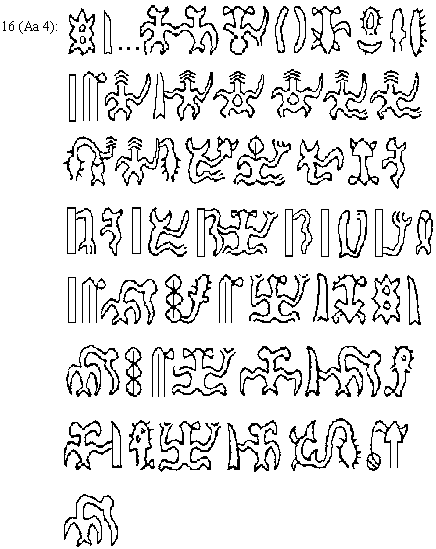
The Turtle is a designation of the Pleiades (the six or seven stars). As a woman is a symbol of a star in the Rapanui folklore (Rjabchikov 1997a: 35), the seven women (stars) are in my opinion another name of the Pleiades.
In accordance with the model on the basis of the RedShift 2 computer program, one can suppose that the date of this solar eclipse was September 16, A.D. 1773. It was the single full solar eclipse from 1722 (the date of the first visit of the Europeans) till 1800. Notice that the Tahua tablet or "Oar" is engraved on a European oar of ash (Fraxinus excelsior) and must date from the end of the 18th century or the first half of the 19th century (Métraux 1940: 393). So the initial text or its variant was written on this tablet in the postcontact time. In 1770 Felipe González' expedition visited Easter Island, and in 1774 James Cook's expedition did. I believe that after one of these visits the Tahua tablet was manufactured. The native name of this tablet is like Maori tahu 'to burn; to set on fire, light'. Perhaps the Europeans were interpreted by the locals as the sun men. Interestingly, the strange words coray [ko rai] 'head [the head of a Spaniard]' and geray [he rai] 'sea [the look at a Spanish ship]' are registered in a brief Rapanui vocabulary during González' expedition (Mellén 1986: 113). In both cases Rapanui rai 'the sun' is taken down indeed.
Using the RedShift 2 computer program, the following dates have been calculated. The date of the heliacal (morning) rising of the star Canopus was May 24, A.D. 1773; this report is associated with the first name 7-7-5 Tuutuu Atua 'the star Canopus'. The date of the heliacal rising of the Pleiades was June 7, A.D. 1773. The age of the moon illuminated 91% was 17th night, cf. the glyphs 3 14 Hina Haua 'the Full Moon'.
The characters Taha and Heke correspond to the characters Tafa-kula 'The burning edge' and Haele-feke 'The going octopus' of a Tongan myth (Polinskaya 1986: 183, 318). In this myth the deity Tafa-kula symbolizes the sun (cf. Rapanui Taha 'the sun' (lit. 'the frigate bird') in the rongorongo texts), and the deity Haele-feke symbolizes the darkness.
The parallel "text" of fragment 16 is represented on a rock drawing at the panel Pua Tivaka near La Pérouse Bay (Lee 1992: 88, fig. 4.72). The words Ti vaka may be translated as 'The star Canopus - the boat'. I have distinguished the figurre of the Octopus (Heke), the sign of a star (tuu), glyph 5 atua (so it is Tuu Atua 'the star Canopus'), glyph 82 Pipiri 'the star Canopus', glyph 49 (Ariki) Mau 'The Supreme Chief (the sun)', the sign of a boat, the sign of other boat together with glyphs 39 ra'a 'the sun' and 140 'the full moon' (the deities Makemake and Haua), the sign of the Shark together with glyph 50 hi 'the solar rays', the wavy sign (cf. Rapanui vai 'water', ua 'rain') on this drawing.
The text inscribed on the Mamari tablet before fragment 2 in presented in fragment 17:
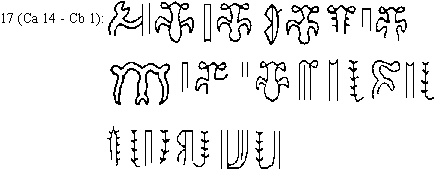
In this text there are six names of the Turtles (they are corresponding to the six stars), and I conclude that '6 Turtles' are an ancient Pleiades' name.
Thus one can concede that the side Ca is the recto (Cr) side, and the side Cb is the verso (Cv) side of the Mamari tablet.
The name of the Pleiades is mentioned in fragment 18, the Great Washington tablet:

The name of the star is reflected in the place name Ahu o pipiri (Barthel 1962: 103) 'The ceremonial platform of the star Canopus'.
The name of Pleiades is also registered in fragment 19, the Small Santiago tablet:

Fragment 20, the Santiago staff, reads:
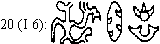
1. Cf. the name 2 6 Hina Ha corresponding to the name of the moon goddess Hina Kauhara 'The moon swimming along the road (ecliptic)' (Rjabchikov 1990: 5). Cf. Rapanui ha 'to breathe', anguangu 'breath; death'.
2. Cf. the place name Takitaki te Hoe of the Motu Nui islet near Easter Island (McCoy 1978). This name signifies 'The Womb (the sun god Tiki, cf. Rapanui tiko 'menstruation') - the paddle/to breathe rough (the moon goddess Hina)'.
3. The word oioi means 'to move away, to go away; to come up, to come nearer' (Rjabchikov 1997a: 39). Cf. also Japanese oya 'mother; ancestor'.
4. Certainly, nga may be the affix -nga, too.
5. Cf. Samoan tutu 'to light'; Tongan kita 'to bring on the death'; Maori, Tahitian hapu 'pregnant'.
6. See also Barthel 1978: 133.
7. Cf. Maori rua 'setting-place of the sun', hi 'dawn', hihi 'solar rays', Rapanui ahi 'fire'. The word Pu may be also interpreted as Hetuu Pu 'Aldebaran (Alpha Tauri)' (see my article "Guy's Reviews Examined").
8. Cf. place name Ahu tara kiu (Barthel 1962: 104), otherwise Ahu tara ki ua 'The ceremonial platform 'New moon - to rain''. Cf. also Rarotongan tara-marama 'the two points or horns of the new moon'.
9. See Rjabchikov 1997a: 37.
10. Cf. Maori honu 'turtle; water'.
11. The similar text is inscribed on the Great Santiago tablet (Hv 5): 65 12 12 12 12 6 8 65 12 12 12 12 RANGI tika, tika, tika, tika, a Matua, RANGI tika, tika, tika, tika 'Four levels of the Sky, the Father/Boat (i.e. the sun), four levels of the Sky'. Cf. Maori matua 'father; hull of a canoe'.
12. See Rjabchikov 1997a: 34.
13. See Rjabchikov 1999a: 19.
14. See Rjabchikov 1993c: 134.
15. Cf. the words 30-44 Anataha and 30-51-30 Anakena 'July-August' on the Aruku-Kurenga tablet (Bv 10) (Rjabchikov 1990: 9).
16. Cf. Maori whata 'to elevate', tara 'to shoot out rays, as the sun just rising', ika 'to lie in a heap; cluster; heap'. Glyphs 25 12 4 33 may be read as '(Ma)huika atua/ua 'the deity/place Mahuika' (Rjabchikov 1999b: 59), too. The Lizard is a symbol of the rain god Hiro in the Rapanui mythology (Barthel 1978: 251).
17. Cf. Maori ma 'to go; to come'.
18. Cf. Mangarevan gao 'sign; mark'
19. Cf. fragment 2.
Arredondo, A.M., 1993. Symbolism in Rapanui Art. In: S.R. Fischer (ed.) Easter Island Studies. Contributions to the History of Rapanui in Memory of William T. Mulloy. Oxbow Monograph 32. Oxford: Oxbow Books, pp. 214-21.
Barthel, T.S., 1957. Die Hauptgottheit der Osterinsulaner. Jahrbuchdes Museum für Völkerkunde zu Leipzig, 15: 60-82.
Barthel, T.S., 1962. Easter Island Place-Names. Journal de la Société des Océanistes, 18: 100-7.
Barthel, T.S., 1978. The Eighth Land. The Polynesian Discovery and Settlement of Easter Island. Honolulu: University of Hawaii Press.
Best, E., 1955. The Astronomical Knowledge of the Maori. Dominion Museum Monograph No 3. Wellington: R.E. Owen, Government Printer.
Campbell, R., 1971. La herencia musical de Rapanui. Santiago: Editorial Andres Bello.
Fedorova, I.K., 1978. Mify, predaniya i legendy ostrova Paskhi. Moscow: Nauka.
Lee, G., 1992. The Rock Art of Easter Island. Symbols of Power, Prayers to the Gods. Los Angeles: The Institute of Archaeology Publications (UCLA).
McCoy, P.C., 1978. The Place of Near-Shore Islets in Easter Island Prehistory. Journal of the Polynesian Society, 87: 193-214.
Mellén Blanco, F., 1986. Manuscritos y documentos españoles para la historia de la isla de Pascua. Madrid: CEHOPU.
Métraux, A., 1937. The Kings of Easter Island. Journal of the Polynesian Society, 46: 41-62.
Métraux, A., 1940. Ethnology of Easter Island. Bishop Museum Bulletin 160. Honolulu: Bernice P. Bishop Museum.
Polinskaya, M.S., 1986. Mify, predaniya i skazki Zapadnoy Polinezii (ostrova Samoa, Tonga, Niue i Rotuma). Moscow: Nauka.
Rjabchikov, S.V., 1990. Tayny ostrova Paskhi. Vol. 1. Krasnodar: RIO.
Rjabchikov, S.V., 1993a. Notes on the Easter Island Script. L'Écho de Rapa Nui, 6(24): 22-3.
Rjabchikov, S.V., 1993b. Tayny ostrova Paskhi. Vol. 2. Krasnodar: Severny Kavkaz.
Rjabchikov, S.V., 1993c. Rapanuyskie texty (k probleme rasshifrovki). Etnograficheskoe obozrenie, 4: 124-41.
Rjabchikov, S.V., 1996. Tayny ostrova Paskhi. Vol. 5. Krasnodar: Ecoinvest.
Rjabchikov, S.V., 1997a. Rongorongo versus Kai-kai: A Second Look at Themes Linking Easter Island's Mysterious Script with Its String Figure Repertoire. Bulletin of the International String Figure Association, 4: 30-55.
Rjabchikov, S.V., 1997b. A Key to the Easter Island (Rapa Nui) Petroglyphs. Journal de la Société des Océanistes, 104(1): 111.
Rjabchikov, S.V., 1998. K voprosu ob interpretatsii rapanuyskoy religii. In: A.S. Petrikovskaya and V.P. Nikolaev (eds.) Kul'turno-istoricheskoe nasledie i sovremennost' stran Yuzhnykh morey. Materialy XXIV nauchnoy konferentsii po izucheniyu Avstralii i Okeanii. Moscow: Institut Vostokovedeniya RAN, pp. 55-9.
Rjabchikov, S.V., 1999a. Astronomy and Rongorongo. Rapa Nui Journal, 13: 18-9.
Rjabchikov, S.V., 1999b. Polynesian String Figures and Rongorongo: More Parallels. Bulletin of the International String Figure Association, 6: 56-61.
Thomson, W.J., 1891. Te Pito te Henua, or Easter Island. Report of the United States National Museum for the Year Ending June 30, 1889. Annual Reports of the Smithsonian Institution for 1889. Washington: Smithsonian Institution, pp. 447-552.
Copyright © 2000 by Sergei V. Rjabchikov. All Rights Reserved.