ON THE RAPANUI DEITY KUHU OR
KUHIKIA
Four fragments of rongorongo records are presented in figure 1.
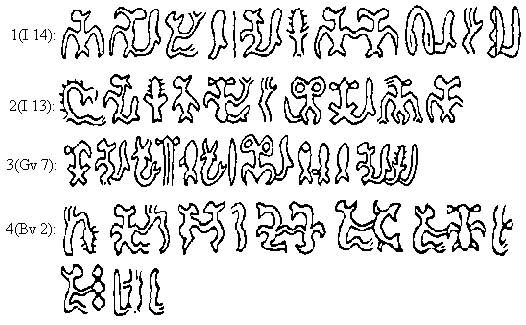
Fragment 1 (I 14) is written down on the Santiago staff. It reads as follows: ... 44-44 6 19-25 44-44 10-15 18-4 ... ... tata a Kuhu, tata Hiro-te-atua... Glyphs 102 associated with fertility are late insertions (a magic action) in the initial inscription. Therefore these signs are eliminated from consideration. In fragments 2 and 3 they are inserted, too. A vertical line separates the article a from the name Kuhu. I translate the text as '... (the god) Kuhu is washing, the god Hiro is washing...' Hiro is the rain deity (Métraux 1940: 310, 330). But what do we know about the deity Kuhu?
Let us examine three sentences of the Creation Chant of the Easter Islanders (Métraux 1940: 322):
A: Uku ki ai ki roto kia Rori, ka pu te ngaata.
B: Kuhikia ki ai ki roto Taurari, ka pu te ngaata.
C: Kuhikia ki ai ki roto Rupe-roa, ka pu te turi.
Rapanui expressions mean: ki ai ki roto (kia) 'by copulating', ka pu 'produced'.
T.S. Barthel (1978: 153) distinguishes the morpheme kia (cf. Rapanui kiakia 'white tern') in the name Kuhikia. Hence one can distinguish the morpheme kuhi as well. I suppose that sentences A and B contain not only the same "child" (the bulrush), but also the same "parents". So Rori corresponds to Taurari. The words rori and rari are variants in connection with the alternation of the sounds o/a, cf. Rapanui rari 'wet'. Rapanui tau signifies 'time; period'. The name Uku is comparable with Rapanui ukauka 'firewood' in connection with the alternation of the sounds u/a. The name Kuhi is comparable with Rapanui kui 'to see', kuikui 'to gather', Maori kuhi, kuhu 'to join a company' (the alternations of the sounds h/-, i/u are quite possible). I restore the name of the bird god as Kuhu or Kuhi 'The look'. Apparently, this deity is the personification of the sun (cf. also the ideas "firewood, fire", "white tern, bird"), his other names are Mata 'The eye, face', Tare 'The look' and Kava Aro 'The rib -- the face, day, light' (Rjabchikov 2001: 216, 218). The deity Kuhu/Kuhi has a direct relationship to the bird cult of the deities Makemake and Haua on the island. In sentence C Rupe-roa is 'the Great Pigeon', and turi is 'the sea-gull'. According to the Marquesan mythology (Buck 1938), the god Maui (Maui-tikitiki) turns into a pigeon to get back his wife. In addition, Maui is the sun deity indeed (Best 1955: 22). I believe that Kuhu/Kuhi may be intimately related to Maui (< Maui *Tiki), and these personages may go back to the common prototype (the solar god-creator).
But the god Kuhikia (Kuhu) can be compared not only with Maui, but also with Tinirau. K. Luomala (1955) points out that the inhabitants of different islands of the Polynesia knew myths or their fragments about the deities Tinirau and Hina. I suggest that the first character is the sun god (Rjabchikov 1994: 18-9; 1998: 72). His name means literally 'The sun in the zenith -- the fruit', cf. Rapanui ki te tini te ra'a 'zenith', ra'a tini 'noon', tunu 'to heat', Marquesan, Mangarevan tunu 'to put to the fire to cook', Maori whakarau 'to multiply', Samoan malaulau 'to grow vigorously', Rapanui rau 'leaf', raua 'to form', and Tahitian rahu 'to create'. I suppose that hints of Tinirau and Hina are preserved in the Tongan legend of Lupe-ovalu (Polinsky 1986: 188-90). A man, Mata-ika-moana, was connected with the ocean and protected from winds. He loved a girl, Lupe-ovalu. She, this man and her sister, Mapui-kaufanga, swam in a canoe to a place where this hero lived. He stayed together with Lupe-ovalu during one night. Then he began to meet with her sister only. Soon spirits killed both of them. I tried to realise this legend. In this story Mata-ika-moana 'The eye, face -- the fish of the ocean' plays a role of Tinirau. Lupe-ovalu 'The eighth pigeon' plays a role of Hina. Her sister, Mapui-kaufanga, is the personified form of the east wind which brings rains. The morpheme ma in her name means 'the sun; east; east wind', cf. Maori ma 'white, clean', whakama 'to make white'. Two Rapanui names of the east wind, Marengorengo and Mareioreio (2), contain this morpheme. The morpheme pui in her name compares favourably with Rarotongan pupui, Tuamotuan puhipuhi, Mangarevan, Rapanui puhi 'to blow', Maori puhi 'wind'. Hence the death of Mata-ika-moana (Tinirau) describes the disappearance of the sun in dark clouds. Interestingly, in Tongan myths Tinirau often turns into a pigeon (Collocott 1928: 20-38).
In the light of the obtained data one can interpret sentences A - C. In sentences A and B Tinirau and the goddess of the winter, spring and rains are mentioned. In sentence C Tinirau and Hina looking like a pigeon are mentioned. She corresponds to the spring and summer. I think that one can say about the Proto-Polynesian myth about the sun god and two (moon) goddesses associated with seasons. According to Maori beliefs (Best 1955: 18), the Sun (ra) spends part of the year with the Winter Maid (Hine-takurua) afar out on the ocean. Then he returns to his other wife, to Summer Maid (Hine-raumati) who dwells on land. In the name of the first moon goddess I pick up the morpheme rua, cf. Maori rua 'setting-place of the sun'. This character corresponds to the time of the darkness and rains. In the name of the second moon goddess I pick up the morpheme rau, cf. Maori whakarau 'to multiply'. This character corresponds to the harvest time. In the Rapanui folklore text Apai there is a myth about the sun god Tiki with different epithets and his two wives, the images of two seasons (Rjabchikov 1993a: 134-5). On the whole, all the solar personages -- Kuhu/Kuhi, Maui (< Maui *Tiki), Tinirau, Tiki and so on -- are derivable from the initial sun god-creator. Perhaps, the Tuamotuan supreme god Kiho is relevant to the Rapanui god Kuhu/Kuhi (3).
As has been shown by the author earlier (Rjabchikov 2001: 218), Tare is the personification of the east wind which together with the north-west wind brings rains. Besides, it is known the place name Vai a Tare 'The water of Tare' (Barthel 1978: 224). I arrive at conclusion that fragment 1 reports about the east wind associated with the rain as well as about the god of rains.
Let us consider fragment 2 (I 13) written down on the Santiago staff. It reads as follows: ... 156 19-25 44-68 15-4 60 49 6-44 ... ... Too Kuhu, tahonga rotu, Mata Mau (Ariki) hata... '... (The god) Kuhu is taking, a priest is bringing (gifts), the Pleiades are rising'. The formula ka too ma Haua, ma Makemake... 'take for Haua and Makemake...' (1) correlates with the first part of the fragment. It should be borne in mind that Haua is the all-Polynesian moon goddess Hina, and Makemake is the all-Polynesian sun god Tiki (Tane, Tangaroa) (Rjabchikov 1987: 365). Old Rapanui tahonga means 'priest'. Old Rapanui hata 'to rise; to elevate' is comparable with Maori whata 'to elevate'. Using the RedShift 2 computer program, one can see on the screen of a computer, for instance, that the Pleiades rose after the sunset on the east from September till November, A.D. 1722. On the other hand, it is common knowledge that the sun rises on the east. So in Easter Island beliefs the Pleiades were connected with the sun during the harvest time. The obtained text can be read as follows: ... 156 19-25 44-68 15-4 60 49 6-44 ... ... Too Kuhu -- Taha, Honu rotu, Mata Mau (Ariki) hata... '... (The god) Kuhu (the Frigate Bird) is taking, the Turtle (the Pleiades) is bringing, the Pleiades are rising'. The Turtle is a symbol of the Pleiades in Tuamotuan and Easter Island belief systems (Lee 1992: 80; Rjabchikov 1993b: 23; 1993c: 5; 1997: 46).
Let us consider fragment 3 (Gv 7) written down on the Small Santiago tablet. It reads as follows: ... 49 19 11 26-12 11 30 60-23 12 12 12 19-25 4 ... ... mauku paka, maika paka; ana Mata ura; Ika, Ika, Ika; Kuhu-atua... '... the dry grass, dry banana; Mars is shining; the Milky Way; the god Kuhu...' In this text the hot season is described. The Old Rapanui name Mata ura 'The red eye' is the designation of Mars (Rjabchikov 1987: 361). Three words 'Fish' can be read as 'the Great Fish' or 'the Milky Way' (cf. Maori Ikaroa 'the Milky Way'). According to this inscription, in the morning Mars is appearing, the Milky Way is seen, then the sun (the deity Kuhu) is rising. The date of the heliacal (morning) rising of Mars was, for instance, December 29, A.D. 1722. I used the RedShift 2 again.
Let us consider fragment 4 (Bv 2) written down on the Aruku-Kurenga tablet. It reads as follows: 15-25 6-50 19-19 50 158-158 6 8 6 68 43 6 17 4-15 43... Rohu ai Kiakia i Ruperupe, a matua a Honu maa a te Turi maa... 'The White tern by copulating with the Pigeon produced the bright Turtle (the Pleiades) of the bright Sea-gull (the sun, the birds)...' This text correlates with sentence C. According to the Rapanui folklore text Apai, the Old Rapanui name Tuu ama tavake is the designation of the Pleiades (Rjabchikov 1996: 8). On the other hand, Rapanui tavake signifies 'tropic bird'.
NOTES
1. See Métrax 1940: 335.
2. See Métrax 1940: 54.
3. See Rjabchikov 1996: 5.
REFERENCES
Barthel, T.S., 1978. The Eighth Land. The Polynesian Discovery and Settlement of Easter Island. Honolulu: University of Hawaii Press.
Best, E., 1955. The Astronomical Knowledge of the Maori. Dominion Museum Monograph No 3. Wellington: R.E. Owen, Government Printer.
Buck, P.H. (Te Rangi Hiroa), 1938. Vikings of the Sunrise. Philadelphia - New York: J.B. Lippincott Company.
Collocott, E.E.V., 1928. Tales and Poems of Tonga. Bishop Museum Bulletin 46. Honolulu: Bernice P. Bishop Museum.
Lee, G., 1992. The Rock Art of Easter Island. Symbols of Power, Prayers to the Gods. Los Angeles: The Institute of Archaeology Publications (UCLA).
Luomala, K., 1955. Voices of the Wind. Polynesian Myths and Chants. Honolulu: Bernice P. Bishop Museum.
Métraux, A., 1940. Ethnology of Easter Island. Bishop Museum Bulletin 160. Honolulu: Bernice P. Bishop Museum.
Polinsky, M.S., 1986. Mify, predaniya i skazki Zapadnoy Polinezii (ostrova Samoa, Tonga, Niue i Rotuma). Moscow: Nauka.
Rjabchikov, S.V., 1987. Progress Report on the Decipherment of the Easter Island Writing System. Journal of the Polynesian Society, 96: 361-7.
Rjabchikov, S.V., 1993a. Rapanuyskie texty (k probleme rasshifrovki). Etnograficheskoe obozrenie, 4: 124-41.
Rjabchikov, S.V., 1993b. Notes on the Easter Island Script. L'Écho de Rapa Nui, 6(24): 22-3.
Rjabchikov, S.V., 1993c. Tayny ostrova Paskhi. Vol. 2. Krasnodar: Severny Kavkaz.
Rjabchikov, S.V., 1994. Tayny ostrova Paskhi. Vol. 3. Krasnodar: Ecoinvest.
Rjabchikov, S.V., 1996. Tayny ostrova Paskhi. Vol. 5. Krasnodar: Torgovo-promyshlennaya palata Krasnodarskogo kraya.
Rjabchikov, S.V., 1997. Rongorongo versus Kai-kai: A Second Look at Themes Linking Easter Island's Mysterious Script with Its String Figure Repertoire. Bulletin of the International String Figure Association, 4: 30-55.
Rjabchikov, S.V., 1998. Polynesian String Figures and Rongorongo: Additional Remarks. Bulletin of the International String Figure Association, 5: 63-76.
Rjabchikov, S.V., 2001. Rongorongo Glyphs Clarify Easter Island Rock Drawings. Journal de la Société des Océanistes, 113(2): 215-20.
Copyright © 2004 by Sergei V. Rjabchikov. All Rights Reserved.