ABSTRACT. This report deals with reading of several fragments of the rongorongo records which include the anthropomorphic glyphs 6.
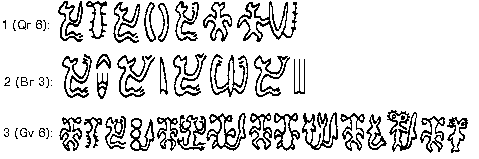
First of all, having compared parallel records, I found variants of glyph 6 ha (a, ho) (Rjabchikov 1988a: 317-8). Article 6 a introduces the homogenous parts of a sentence. Figure 1 contains the following examples:
The first fragment, Small St. Petersburg tablet, reads 6 56 6 57 6 6-6 61 24 a Po, a tara, a Haha -- Hina -- ai 'the Night, the two horns of the new moon, the place of the dead -- the moon Hina -- the place'. It is a description of a solar eclipse. The words tara and Haha are presented in the Polynesian vocabulary: Rarotongan tara-marama means 'the two points or horns of the new moon', and Samoan Fafa -- 'the place of the dead'. The second fragment, Aruku-Kurenga tablet, reads 6 1 (inverted sign) 3 6 5 6 15-30-15 6 34 a Tiki, Hina, a ata, a Ronaro [Rongo], a ra'a '(the deities) Tiki (and) Hina, the sunset, (the god) Rongo (the name of a star or a constellation), the sun'. It is a story about a solar eclipse as well. I should like to stress that relationship between the names of the deity Rongo and a star requires special study. Indeed, the Rapanui place name Tu Rongo titiero (Barthel 1962: 107) means 'The star Rongo -- the bright sun [lit. 'full and bright/red']'. On the other hand, Maori Matiti signifies 'a star indicating the summer' ['summer; to bask', lit. 'white and full'] and even 'a son of the god Rongo-ma-Tane'. The decoded name of the star can be connected with the name of the Hawaiian god Lono [Rongo] and Makahiki (lit. 'The Face [the sun] is appearing'), the name of a Hawaiian festival (Beckwith 1970: 33-4). The third fragment, Small Santiago tablet, is a genealogy discovered by N.A. Butinov and Y.V. Knorozov (1957: 15; table 7). The five names of the ancestors -- 6 56-6-17 102 6 23 68 102 6 68 11 102 6 11 60 102 6 60 -- are introduced by article 6 a, too (Rjabchikov 1988b; 1994: 3).
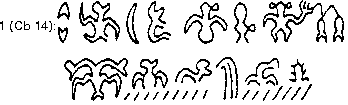
Figure 2 contains three fragments with word 4-6 tuha 'to distribute; to share; to divide; part'.

The first fragment, Aruku-Kurenga tablet, reads 74-74 38 4-6 3 53 tinitini ra'a -- tuha -- hina Maro 'the sun is at the zenith -- the part -- the month Maro'. This text denotes June, the time of the winter solstice. The second fragment, Aruku-Kurenga tablet, reads 21-15 26-15 4-6 Koro, Maro -- tuha '(the months) Koro and Maro -- the part'. Interestingly, Koro and Maro mark the summer and winter solstices respectively. The third fragment, Tahua tablet, reads 4-6 28 14 51 73 4-6 57 51 Tuha nga auke. He tuha tarake. '(Someone) is distributing seaweeds. (He) is distributing fish'. It is necessary to mention about two features of the text. The rare article 73 he introduces the second verb tuha, but it is omitted in the first case. The word tarake 'shoal exposed at low water' is preserved in Maori. Besides, the Rapanui place name, Ana tarake (Barthel 1962: 105), means 'The cave of fish'.
The text of figure 3, Mamari tablet, reads 29 6 3 6 68 73 6 12-12 44-68 62 32 62 25 Rua -- a Hina, a HONU ea. Ikaika tahonga. Too ua, too hua. 'The place of the sunset -- the moon goddess Hina, the downpour/torrent. The expert craftsman/priest is sacrificing. (He) is taking the rain, (he) is taking a fruit'. (HONU is capitalised in this transcription to indicate its function as a generic determinative.) There are two words in the Maori vocabulary: rua 'setting-place of the sun' and honu 'water'. This text resembles the legend "Hiva Kara Rere, the god of rain" (Felbermayer 1963) which tells of a priest prayed for the rain. I think that Hina's name is presented hereabove because this goddess provided the rain (Barthel 1978: 261).
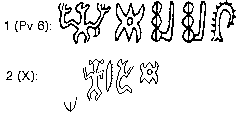
Figure 4 offers word 6-7 Hatu which is an epithet of the sun god Tiki (Makemake/Tangaroa/Tane) (Métraux 1940: 321, 323). The first fragment, Great St. Petersburg tablet, reads 6-7 17-4-17-4 14 Hatu tetutetu, Haua 'the great Hatu (and) Haua'. It is a version of a story about the permanent companions Makemake and Haua (Métraux 1940: 313-4). The second fragment is written down on the New York birdman figure. The record reads 1 6-46 6-7 Tiki -- Hana -- Hatu 'Tiki -- the sun -- Hatu' and is apparently associated with the birdman/Makemake cult (Métraux 1940: 314, 341). The word hana signifies 'heat' in Rapanui, 'warm' in Hawaiian, 'shining' in Mangarevan, and 'the sun' in Tuamotuan.
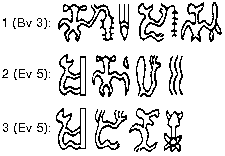
Figure 5 contains three fragments concerned with place names. The first fragment, Aruku-Kurenga tablet, reads 6-25 1 6-24 44-51 Ahu Tiki hari -- take 'The ceremonial platform 'Tiki [the sun] brings -- initiation rites''. It can correspond to several place names registered by T.S. Barthel (1962: 103, 104): Ahu Manu Mea 'The ceremonial platform 'The Red Bird'', Ahu Mataveri 'The ceremonial platform 'The Face -- Menstruation'', and Ahu Puna rere Takatea 'The ceremonial platform 'Puna (Tiki's epithet) flies -- the white sphere''. The second fragment, Keiti tablet, reads 6-4 6 3 48-15 33 a atua a Hina -- uri -- vai 'the goddess Hina -- the black colour -- water [rain]', and is comparable with the Rapanui place name Ahu huri avai (Barthel 1962: 103). The third fragment, Keiti tablet, reads 6-4 6-19 7 21 a atua Hoki tuu oko 'the deity 'The ripe star is returning''. I believe that it correlates with the Rapanui place name Ahu hanga Paukura (Barthel 1962: 102) 'The ceremonial platform of the bay of Halley's Comet' (Rjabchikov 1994: 3-4). Interestingly, the Rapanui place name Hanga Pau Kura is also known as Hanga Pua Kura (Barthel 1978: 365, 37, 87, 219). The terms Pau and Pua are presented in the Rapanui place name Ahu Pua Pau (Barthel 1962: 104). On the other hand, whetu means 'star; comet', and Puaroa is a comet's name in Maori (Best 1955: 67). The Easter Islanders informed that the star Pau appeared in October or November (Métraux 1940: 53), and Halley's Comet was visible in October (A.D. 1835), in September (A.D. 1682), in October (A.D. 1607) and in September (A.D. 1531) (Belyaev, Churyumov 1985 & the models on the basis of the RedShift 2 computer program).
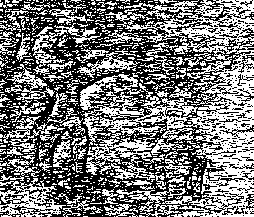
Word 6-6 Haha 'the underworld' is taken down on a fetish board (Rjabchikov 1997: 6), see figure 6. This paddle houses in the Smithsonian Institution, Washington, D.C., USA (F.G. Pickering, personal communication, September 8, 1997). In W.J. Thomson's (1891: plate LIII, fig. 3) work the other side of this artifact is represented; its name is timo ika (Thomson 1891: 536) which signifies 'exorcist during burial' (timo means 'sorrow', and ika -- 'dead'). The pattern is described as follows: "This wand is used in working a charm against an enemy. The injured individual while performing a sort of convulsive dance, makes mystic movements with the paddle, meanwhile muttering incantations in a monotonous tone. The result is believed to be the speedy death of the person against whom the fetish is invoked".
Barthel, T.S., 1962. Easter Island Place-Names. Journal de la Société des Océanistes, 18: 100-7.
Barthel, T.S., 1978. The Eighth Land. The Polynesian Discovery and Settlement of Easter Island. Honolulu: University of Hawaii Press.
Beckwith, M., 1970. Hawaiian Mythology. Honolulu: University of Hawaii Press.
Belyaev, N.A. and K.I. Churyumov, 1985. Kometa Galleya i ee nablyudenie. Moscow: Nauka.
Best, E., 1955. The Astronomical Knowledge of the Maori. Dominion Museum Monograph No 3. Wellington: R.E. Owen, Government Printer.
Butinov, N.A. and Y.V. Knorozov, 1957. Preliminary Report on the Study of the Written Language of Easter Island. Journal of the Polynesian Society, 66: 5-17.
Felbermayer, F., 1963. Hiva Kara Rere, der Gott des Regens. Tribus, 12: 215-8.
Métraux, A., 1940. Ethnology of Easter Island. Bishop Museum Bulletin 160. Honolulu: Bernice P. Bishop Museum.
Rjabchikov, S.V., 1988a. Allographic Variations of Easter Island Glyphs. Journal of the Polynesian Society, 97: 313-20.
Rjabchikov, S.V., 1988b. Note on Butinov and Knorozov's Investigation. Rapa Nui Journal, 2(2): 6.
Rjabchikov, S.V., 1994. Khronologiya rapanuyskoy istorii. Krasnodar: DENOS.
Rjabchikov, S.V., 1997. Rapanui Studies. Krasnodar: Torgovo-promyshlennaya palata Krasnodarskogo kraya.
Thomson, W.J., 1891. Te Pito te Henua, or Easter Island. Report of the United States National Museum for the Year Ending June 30, 1889. Annual Reports of the Smithsonian Institution for 1889. Washington: Smithsonian Institution, pp. 447-552.
Copyright © 1998 by Sergei V. Rjabchikov. All Rights Reserved.