On the Designation of Deities in the Polynesia
Let us examine a photo of a Maori sacred place (tuahu, or wahi tapu). Here four stones are seen, and they are images of the four Maori principal gods: Maru-te-whare-aitu, Rongomai, Ihungaru, and Itupawa (Best 1954: 43, figure). Besides, investiture pillars (stones) decorate the Romapohia temple at Fagatau atoll (Buck 1938: 178-9, figure [3]). At the island of Tahiti, the Society Islands, a stone upright decorates the platform of the Taputapu-atea temple devoted to the god 'Oro, the son of Ta'aroa (Buck 1938: 78ff). Besides, several stones were set up on a temple platform (Marae Mahina-i-te-ata) of Takaroa island, the Tuamotu Archipelago (Bellwood 1979: 343, figure 12.13). It is amply clear that this temple was dedicated to the moon goddess. Thus, the sacred stones in different parts of the Polynesia were associated with deities. A key to these religious ideas lies with the term tapu, cf. Maori tapu 'holy, sacred; prohibited', Tahitian tapu 'sacred; restriction', Tuamotuan tapu 'sacred; prohibited', Hawaiian kapu 'holy, sacred; taboo, prohibition', Samoan tapu 'sacred', Rapanui tapu 'sacred; to prohibit', tapua 'sacred'.
I conclude that the Rapanui rongorongo glyphs 4a and 5 atua 'deity' resemble these holy stone objects. Let us consider two illustrations in the rongorongo texts.
Fragment 1, the Small Vienna tablet, reads:

1 (Na 2): ... 6-4-32 44 45 44-44 5 44 6-4-32 69 ... ... (h)a atua/ua tapu Ta(h)a-ta(h)a-atua-Ta(h)a, (h)a atua/ua Moko... '... The deity/sacred dwelling (called) 'The Great Frigate Bird-the god-the Frigate Bird', the deity/dwelling (called) 'The Lizard'...'. The Frigate Bird is the symbol of the sun god Makemake (Tiki, Tane, Tangaroa) (1). According to T.S. Barthel (1978: 251), the Lizard is an epithet of the chthonic god Hiro. One can suppose that both personages denote the place name Ahu Tangaroa Hiro 'The platform of (the deities) Tangaroa (and) Hiro'. This name can describe a solar eclipse. On the other hand, it is felt that in this record a sacred place of the bay of Anakena is described. The latter means either 'The cave of the kena bird' or 'The shine of the kena bird' (< *Ana kena). A platform, Ahu Runga, was associated with the astronomical observations and burial rites, cf. Rapanui runga 'above'. A platform, Ahu Naunau, was an important ceremonial place of the ancient cults. Conceivably on this platform priests celebrated rites and appealed to the rain god (2). Interestingly, a big lying lizard is depicted on a slab of this ahu (3). I believe that it is the symbol of Hiro, the god of the rain and the darkness. In any event it follows from the inscription that some Rapanui statues and even platforms can be connected with certain deities.
Fragment 2, the Mamari tablet, reads:
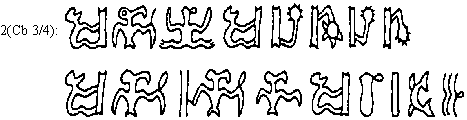
2 (Cb 3/4): ... 6-4 44 69 6-4 4-25 4 7 4-25-4-25 6-4 44-30 4 44-30 44 6-4 56-4 8 33 ... ... (h)a atua Ta(h)a Moko, (h)a atua Tuhu-atua-Tuu-tuhutuhu, (h)a atua Tana atua Tana Ta(h)a, (h)a atua Poti Matua VAI ... '... The deity (called) 'The Frigate Bird - the Lizard', the deity (called) 'The priest of the god Tuu-the priest', the deity (called) 'Tana (Tangaroa)-the deity, Tana (Tangaroa)-the Frigate Bird', the deity (called) 'The boat (with the determinative WATER)'...'. The first name in this list designates either Ahu Tangaroa Hiro or Ahu Naunau. Besides, this pair of the gods can be associated with some other stone objects (cf., e.g., the names of the tower of Tupa Hiramoko and of the bay of Hanga-o-Hiro both situated not far from the bay of Anakena). The second name in the list can be connected with a Rapanui cultural hero, Tuu-ko-Ihu. To the west of Anakena a place called Tuu-ko-Ihu is located. Interestingly, this character is compared with the Polynesian god Tu (Buck 1938: 225). The third name in the list is associated with the god Tangaroa. It is the designation of the platform called Ahu a Tanga which is located near the north tip of the island. It is possible that A Tanga is the name of a statue. S. Englert (1974: 260) calls this platform ahu poepoe 'platform (looking like) a boat'. W. Liller (1993: 125) calls this 'boatlike' ahu "a particularly impressive astronomical candidate" to his inventory of the various ahu associated with the solar orientation. The fourth name in the list describes the shape of the platform Ahu a Tanga. It should be pointed out that the Atan manuscript (Heyerdahl and Ferdon 1965: fig. 116) includes the following expression: Kua vari te gao o te makohe 'Vari ('The Motion around', an epithet of the sun god Tiki/Tane/Tangaroa) [with his companions] - the sign of the Frigate Bird' together with the glyphs which read 56-4 Poti 'Boat' indeed. This word is written down here instead of Matua (literally 'Hull of Canoe; Father'), an epithet of Tiki/Tane/Tangaroa (Rjabchikov 1997: 41). The Maori expression ara matua 'the main road; ecliptic' is known (Best 1955). It means 'the road of the canoe' literally. So the 'boatlike' platform may be a symbol of the sun.
NOTES
1. See Rjabchikov 1987: 364-5.
2. See Rjabchikov 1998: 56. It is common knowledge that the Rapanui king Ngaara who lived at Anakena sent priests ariki-paka to pray concerning rain (Routledge 1998: 242).
3. See Heyerdahl 1976: plate 8e.
REFERENCES
Barthel, T.S., 1978. The Eighth Land. The Polynesian Discovery and Settlement of Easter Island. Honolulu: University of Hawaii Press.
Bellwood, P., 1979. Man's Conquest of the Pacific. New York: OUP.
Best, E., 1954. Some Aspects of Maori Myth and Religion. Dominion Museum Monograph No 1. Wellington: R.E. Owen, Government Printer.
Best, E., 1955. The Astronomical Knowledge of the Maori. Dominion Museum Monograph No 3. Wellington: R.E. Owen, Government Printer.
Buck, P.H. (Te Rangi Hiroa), 1938. Vikings of the Sunrise. Philadelphia - New York: J.B. Lippincott Company.
Englert, S., 1974. La Tierra de Hotu Matu'a. Historia y etnologia de la Isla de Pascua. Santiago de Chile: Ediciones de la Universidad de Chile.
Heyerdahl, T., 1976. The Art of Easter Island. London: George Allen & Unwin.
Heyerdahl, T. and E.N. Ferdon, Jr (eds.), 1965. Miscellaneous Papers: Reports of the Norwegian Archaeological Expedition to Easter Island and East Pacific. Vol. 2. Chicago - New York - San Francisco: Rand McNally & Company.
Liller, W., 1993. The Monuments in the Archaeoastronomy of Rapanui. In: S.R. Fischer (ed.) Easter Island Studies. Contributions to the History of Rapanui in Memory of William T. Mulloy. Oxbow Monograph 32. Oxford: Oxbow Books, pp. 122-7.
Rjabchikov, S.V., 1987. Progress Report on the Decipherment of the Easter Island Writing System. Journal of the Polynesian Society, 96: 361-7.
Rjabchikov, S.V., 1997. Rongorongo versus Kai-kai: A Second Look at Themes Linking Easter Island's Mysterious Script with Its String Figure Repertoire. Bulletin of the International String Figure Association, 4: 30-55.
Rjabchikov, S.V., 1998. K voprosu ob interpretatsii rapanuyskoy religii. In: A.S. Petrikovskaya and V.P. Nikolaev (eds.) Kul'turno-istoricheskoe nasledie i sovremennost' stran Yuzhnykh morey. Materialy XXIV nauchnoy konferentsii po izucheniyu Avstralii i Okeanii. Moscow: Institut Vostokovedeniya RAN, pp. 55-9.
Routledge, K., 1998. The Mystery of Easter Island. Kempton: Adventures Unlimited Press.
Copyright © 2006 by Sergei V. Rjabchikov. All Rights Reserved.