| A visit to the Filmoteca Española
Those who received training or were granted study tours in film archiving during the 70s and early 80s will agree that the Filmoteca Española or the Spanish Film Archives in Madrid is the “classic” institutional model of preserving film as film. This observation was confirmed during a visit made by Annella Mendoza, a member of the SEAPAVAA executive council on 29 September 2000, shortly after the International Council on Archives Congress in Seville.
Founded in 1953, the Filmoteca is now part of the Institute for Film and Audiovisual Arts under the auspices of the Ministry of Education and Culture. Its preservation facilities are situated in the Ciudad Universitaria in the outskirts of Madrid. Inspite of its claims that much of its early nitrate productions had been lost, a good percentage has still been preserved. Its collection includes some 22,000 titles, 60 percent of which represent the Spanish film industry. Feature-length, short films, and newsreels comprise the greater bulk of the collection. Recent acquisitions of video materials number over 5,000 items. The archives also accepts deposits of foreign productions.
The Filmoteca maintains storage vaults and a very effective restoration facility which can handle up to 10 percent shrinkage. Computerized cataloguing is well-established. Its documentation collection contains more than 300,000 images from stills, pressbooks, slides, lobby cards, and negatives. Facilities to house its more than 20,000 film museum artifacts and sound collection are currently being developed. A special library of cinema publications
 (Continued on p. 12) (Continued on p. 12)
|
 |
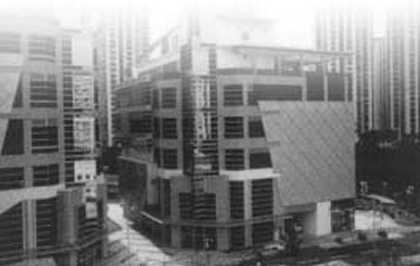
Hong Kong Film Archive building
The Hong Kong Film Archive building officially opens
|
|
|
In 3 January 2001, the Hong Kong Film Archive (HKFA) building was formally inaugurated. The auspicious occasion was graced by Hong Kong’s finance secretary Donald Chang and superstar Chow Yun-Fat. During the opening ceremonies, the film Hong Kong on the Silver Screen was screened followed by a tour of the archive building’s resource center and film stores.
It was in 1993 that the HKFA was established by the Hong Kong government to serve as the country’s repository of film collections and as a film resource center to scholars and researchers. Three years after its establishment, it was accepted as a full member of the International Federation of Film Archives (FIAF) which opened avenues for the exchange of audio-visual technological operations between archiving institutions from around the world. It also serves as a channel for timely and relevant issues on film archiving.
The Archive is a three-storey building consisting of an exhibition hall and a resource center, among others. Rooms are equipped with the latest technology to enhance and recapture the magic of a bygone era.
|
|
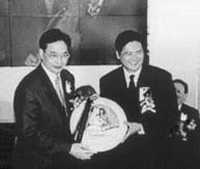
Superstar Chow Yun-Fat takes the opportunity to donate a print of Crouching Tiger, Hidden Dragon (2000) to the Archive on behalf of the United China Vision Inc. and Edko Columbia Tristar Film.
Four individual booths and a group viewing room are available for video watching of their large collections of books, magazines, and audio-visual materials at nominal fees. The Archive provides linkages with schools and film societies to further enrich their programs aside from the holding of regular retrospectives, exhibitions, seminars, and tours.
Foremost of the HKFA’s mission is to promote Hong Kong’s cinematic heritage as well as to
(Continued on p. 12)
|
|