 Badlis sa Kinabuhi
|
|
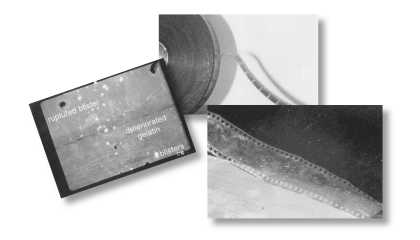
The negatives of the Filipino feature Badlis Sa Kinabuhi were sent to ScreenSound Australia to be evaluated for preservation. The black and white negatives are on a cellulose triacetate (CTA) film base and had been stored under consistently high relative humidity for an extended period of time. This had inevitably resulted in its severe decomposition, commonly known as “vinegar syndrome”. The degree of decomposition varies from reel to reel but the most affected are the sound negatives. This is consistent with the anecdotal evidence that sound negatives are more susceptible to decomposition than image materials. On examination, it became obvious |
|
that there are numerous problems to deal with.
Most of the reels, especially the sound films, are very badly “blocked”. Films that are blocked are stuck solidly together within the reel and can not be unwound without severely damaging the film. For decomposed CTA films, blocking is usually caused by plasticisers that migrate from the increasingly acidic base material to form a glue-like bond between the gelatin and the back of the next layer of film. In extreme cases, such as Badlis Sa Kinabuhi, the gelatin emulsion becomes very soft and also forms links between the layers. This makes separation more difficult than usual.
|
SEAPAVAA Book
 Film in South East Asia: Film in South East Asia:
Views from the Region
The book, Film in South East Asia: Views from the Region, launched at the SEAPAVAA conference in Singapore is being republished in English for distribution outside Vietnam.
Funding for its republication is being sourced from the National Screen and Sound Archive of Australia, and the publishers are SEAPAVAA in association with the Vietnam Film Institute and the National Screen and Sound Archive of Australia.
The book’s editor, David Hanan from Monash University in Australia, was in Hanoi in January for two weeks, working together with the book’s designer and staff from the Vietnam Film Institute.
This edition has a redesigned cover, with a South East Asian motif on it, and the title of the book in six South East Asian languages (Vietnamese, Cambodian, Indonesian/Malay, Lao, Filipino, and Thai).
Originally published in both Vietnamese and English, this edition has 60 illustrations, 320 pages with reader friendly fonts. With more time on their hands, the production crew had the opportunity to finetune the cover and illustrations.
|
|
 |
The way decomposition had progressed give some valuable clues as to the behavior of gelatin in decomposing films. This unique condition of old films is the basic theme of a research project that the engineering and research group (ERG) at ScreenSound had been working on for some time. In many places, a small blister of plasticiser had formed under the emulsion. Other researches had suggested that the plasticisers will hydrolyse to form a strong acid. Gelatin is very sensitive to changes in the concentration of acids. Gelatin reacts to a rise in the concentration of acids by swelling and softening greatly. The areas surrounding the blisters give a strong visual clue as to what was happening in the emulsion, especially to the silver image.
Research has led to a hypothesis that at a certain point, the gelatin will swell so much that the pressure inside the emulsion will move the silver to areas where the pressure stress has been reduced by a slight folding of the emulsion. This is very similar to “reticulation”, an effect that can occur during film processing where normal swelling, due to processing and a sudden change in tempe-rature, can cause the silver image to form a very grainy looking image. The areas surrounding the blisters in Badlis Sa Kinabuhi show this effect whereas the rest of the image are relatively unaffected.
After unblocking, the emulsion will be very soft. Testing the film on a printer to evaluate whether the degree of shrinkage and especially the resultant buckle, can be accommodated was considered too risky. A method of hardening the gelatin was needed. Normal hardening techniques use either metal salts or organic hardeners in an aqueous solution. Due to the highly fragile state of the gelatin emulsion, aqueous solutions could not be used. In this state, the gelatin emulsion will simply dissolve in the aqueous solution. Another approach is being researched using a vacuum chamber to remove the acid and water from
(Continued on p. 10)
|
