 Country Update |
|
| NEW ZEALAND | ||
Produced in New Zealand for the World |
||||
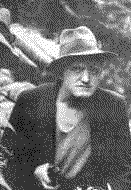
 Beginning in 1909 as a nine-year-old assistant to the projectionist at Hayward’s Theater in Waihi, New Zealand, Rudall Hayward spent a lifetime in film. He died in 1974 in Dunedin while on the road promoting his last feature To Love a Maori and is remembered as New Zealand’s most influential pioneer filmmaker.
Hayward set out to tell local stories and to put New Zealand history on the screen. Assisted by his first wife, Hilda, he made seven features, numerous two-reel comedies, newsreels, and competition films. With his second wife, Ramai, Hayward traveled extensively making educational and travel documentaries -- they filmed from Albania to Red China, and their subjects ranged from village life in Samoa to the life cycle of the New Zealand eel. Living in England during the 1940s, Hayward also made several feature films including the Goodwin Sands, a 1948 feature for Dixey Productions. Like his contemporaries, Rudall Hayward was an inventor and a pioneer. Frequently he did not have the necessary equipment or it broke down. |  |
Howard’s catchphrase was, “it’ll go, I’ll cook it up, it’ll get by”, and usually it did. Earlier this year, Ramai Hayward deposited a substantial collection of Hayward material at the New Zealand Film Archive. Original posters for many of Hayward’s early films including The Bloke from Freeman’s Bay (1921), The Te Kooti Trail (1927), and Rewi’s Last Stand (1940) are special jewels in the collection. The posters formed the centerpiece of an exhibition at the Film Center celebrating Rudall Hayward’s centenary and career. During the exhibition, a selection of Hayward documentaries were screened in the TV lounge. The exhibition was accompanied by a cinema screening program including Hayward’s first feature My Lady of the Cave (1922), the early talkie On the Friendly Road (1936), and the sound remake of his 1925 film Rewi’s Last Stand (1940). (From Newsreel, the New Zealand Film Archive Newsletter) | ||
| ||||
| PHILIPPINES | ||||
Celebrating Philippine cinema: |
||
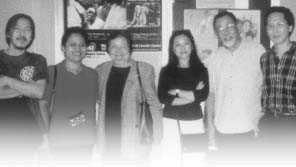
Taken at the lobby of the Lincoln Center in New York during the Second Filipino Film Festival in New York. (From left to right) Lav Diaz, Vicky Belarmino, Marina Feleo-Gonzales, Marlina Gonzalez, Alberto Florentino, and Gil Quito. |
As a result of the overwhelming response to the centennial film festival in 1998, Filipino films were featured for the second time at the prestigious Lincoln Center in New York from 28 July - 8 August 2000. This event was organized through the efforts of the Film Society of Lincoln Center and the Cultural Center of the Philippines.
The selection/organizing committee was composed of the original group who implemented the first festival in 1998. They are Richard Peña and Domingo Hornilla Jr. of the Lincoln Center as program directors, Vincent Nebrida and the late Agustin Sotto (former SEAPAVAA board member) as curators, and Victoria D. Belarmino of the Cultural Center of the Philippines (CCP) as executive curator. Eleven (11) contemporary films directed by the Philippines new breed of directors were selected  (Continued on p. 9) (Continued on p. 9)
| |
| 8 AV Archives Bulletin |