chapter. A plan was drawn to create an independent organization (SOFIA New York or Philippine Cinema Heritage Trust) that will assist SOFIA specifically in fundraising activities for the establishment of an archival facility in the Philippines, hopefully in the next five years.
On the initiative of this same group, a visit was arranged to the George Eastman House in Rochester to meet its director, Tony Bannon, and explore the possibility of having a space
|
|
for Filipino films in their archive. The fruitful visit consisted of a tour of the archives facilities, school, and museum. An added bonus was the unexpected meeting with Paolo Cherchi Usai, senior curator of the Motion Picture Department.
Based on the warm reception of people to the festival, a third festival is maybe in the offing once new films have been restored, reprinted, and subtitled.
|
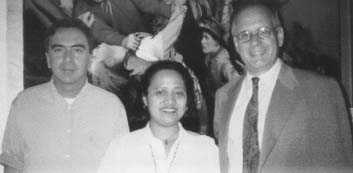
At the George Eastman House in Rochester, New York with (from left to right) its director, Tony Bannon, Vicky Belarmino, CCP’s executive curator, and Paolo Cherchi-Usai, senior curator of the GEH Motion Picture Department.
|
|

|
VFI develops... from p. 9
Initial treatment of infected film is through the “dry method” and completed with the ‘wet method”. During the dry method treatment, the acetic acid produced is eliminated by exposing the affected films to air ventilators inside fume rooms of four meters long, 3.5 meter wide and three meters high and can accommodate 18 reels at a time. Films in level 1 infection are cleaned within 48 hours while those in levels 2 or 3, within 72 hours.
The wet cleaning method is applied using the rewashing machine which brings the added benefit of making film less susceptible to the recurrence of vinegar syndrome.
This technology developed by VFI, however, was found to be most effective on films with vinegar syndrome within levels 1 or 2, wherein the film exhibits only 1-3 percent shrinkage. For films in level 3 and above, a chemical or physical method must be developed to counter the 4-5 percent shrinkage which prevents the film from being treated because of the great risk involved.
|
