On Cryptanalysis
Cryptanalysis is essentially code breaking. It is the study of cipher text for vulnerabilities which can be exploited to decipher its contents. If cryptography is big, then cryptanalysis is huge and probably where the greatest gains can be made. Consequently, advances in cryptanalysis tend to be far more clandestine.
While cryptanalysts can be viewed as the adversaries of cryptographers, it is perhaps more accurate to say that one cannot be a good cryptographer without being a proficient cryptanalyst. Similarly, a good cryptanalyst is likely to be an excellent cryptographer too. Cryptography and cryptanalysis together form the two branches of cryptology.
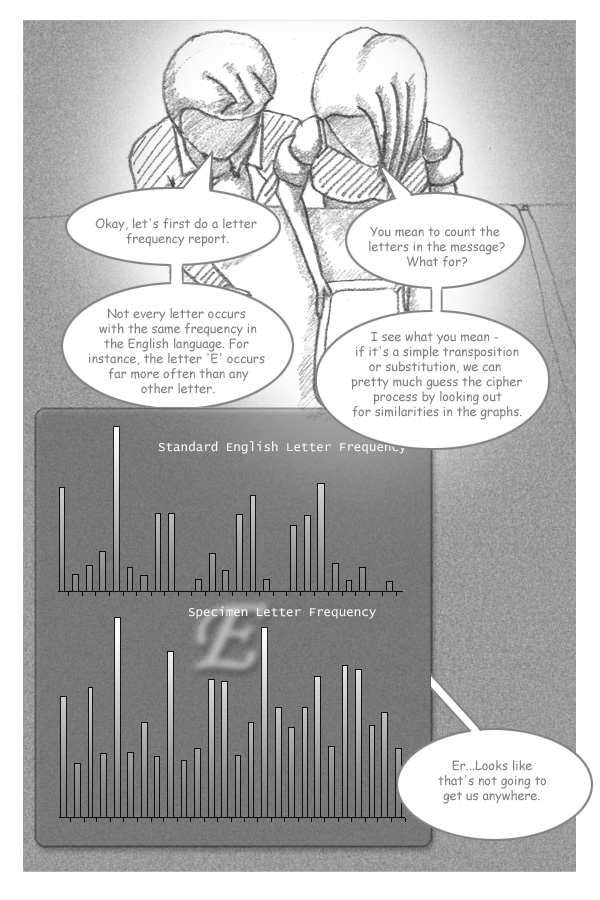
Frequency analysis is a very old cryptanalytic technique. It is based on the recognition that language exhibits structure and characteristics that can be inherited by the cipher text under certain cipher methods. It exploits the differential in the usage of each English letter. Vowels occur more frequently than consonants while particles appear more often than adjectives. All these result in a letter frequencies signature that can be used to identify English text.
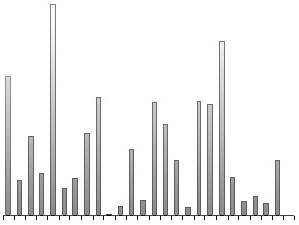
In addition, this signature can be used to break simple substitution ciphers. By plotting and comparing the letter frequencies signature of the cipher text with that of an average English text, correlation between the peaks and troughs can be drawn. For instance, the highest peak would most likely be "E" while "A" would most likely be the second highest one.
Frequency analysis was a powerful tool that broke many ciphers and proved to be a frustration to cryptographers back then. Cryptographers have since created ciphers that are invulnerable to frequency analysis and as the example above shows, even this sixteenth century cipher is resistant to it.
Next