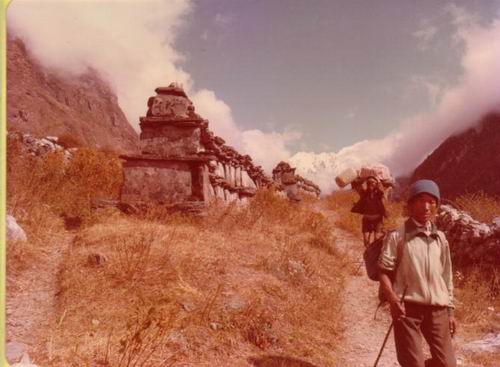
Wayfarers on the high road to Langtang.
Text by daffydil, Pictures by heng
Home / Album/ Blog / Collections / Flickr/ Haiku / Heritage / Jade / Reflections/ Sale/ Travel
|
"....... the rain was coming down in sleets making the treacherous steps cut into the cliffside look like a nightmare of loose rubble, soggy mud and shifting sand on which we had to test the agility and tenacity of our feet and muscles. My guaranteed non-slip Clarks soles were certainly taking a beating as I stumbled and slithered on the tricky slope. The sound of waterfall crashing off the 800 foot cliff which we were ascending, would under normal circumstances been beautiful but was in this instance more of a threat and did nothing to soothe my jagged nerves. I was fighting a head cold, a bad throat and a raging fever equivalent to the raging heavens and torrents. Some fool traveler had described this part of the trek as 'a walk through a pleasant gully' The brochure's description of 'an almost vertical cliff, 800 feet in height' was more accurate but still wide off the mark in this foul weather. Guilty pangs mulled with fearful ones as I thought of my 5 year old somewhere ahead perched perilously on the shoulders of Klipa our cook......." from an excerpt in my diary describing the misadventures on the fourth day of our trek to Langtang in the northern corner of Nepal. Why I wanted to trek in Nepal, especially with a five year old in tow was one of those difficult to answer questions. Nepal can sometimes be viewed as an unsafe destination full of dreaded diseases, perils and unknown dangers to which you certainly didn't drag your 5 year old. But if the truth be told I was really inspired by this gusty Irish woman D. Murphy who had taken her 6 year old on a three month winter odyssey in the mountains of remote Baltistan. Her book Where the Indus is young was what really started me off. In trying to emulate this adventurous stalwart, though on a very small scale (my trek was only of 12 days) I had gravely overrated myself. A citified Singaporean like me cannot quite measure up to the likes of Ms Murphy. I also did not bargain for falling ill, the incredibly punishing terrain, or the vast and daunting distances to be covered. My little boy however had less problems. He was certainly well entertained chasing all the chickens, goats and kittens that we came across in the villages. He had a fun time too, playing peek a-boo with the Nepalese crew though usually by mid afternoon black moods and tantrums were not uncommon. Our family of three and crew of nine included a guide, a sherpa, a chief cook, a sub cook a kitchen boy and 4 porters to carry our loads. Compared to Ms Murphy team of 2 we were indeed a pampered lot ! We had opted for the Langtang route because of it's nearness to Kathmandu, the acceptable number of days and because the Upper Langtang Valley had been billed as offering one of Nepal's most spectacular scenery. Langtang is a narrow valley which lies south of the Tibetan border sandwiched between the main Himalayan range to the North and slightly lower range of snowy peaks to the south. Langtang Village at 11,500 feet is just below the foot of the Langtang Himal at 23,776 feet. This high and isolated valley is inhabited by people of Tibetan origin. Our Langtang trek was of 12 days duration. We took 6 days to walk to Langtang, including 4 hours of jeep ride to the trail head at Betrawati (this was before the days of the motorised road which now connects Kathmandu with Syabru) had a free day in Langtang and took 5 days to do the return journey. |
| DAY 1: BETRAWATI-MANIGOAN |
| A 4hr jeep ride from Kathmandu took us to our trailhead, Betrawati at 2,200ft. We stopped briefly at this hamlet for lunch. Here, my little boy is surveying his vast, new playground | 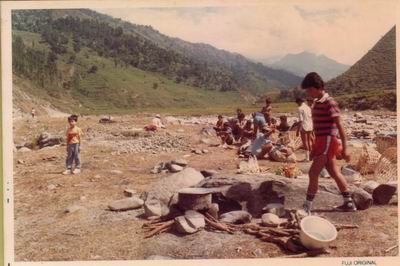 |
| From Betrawati we set off on our trek, overburdened with our baggages, tents, food and members. Here, our motley crew on one of our numerous Stop-Breaks. The key ditty on a Nepali trek is, Break, Break, Break, otherwise your limbs would Ache, Ache, Ache ! | 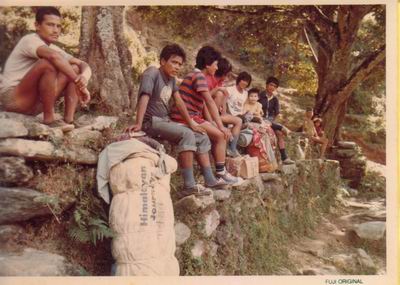 |
| Trailing the Trisili Khola, we finally made it to the alpine valley of Manigoan, our first overnight campsite at 4,000ft. | 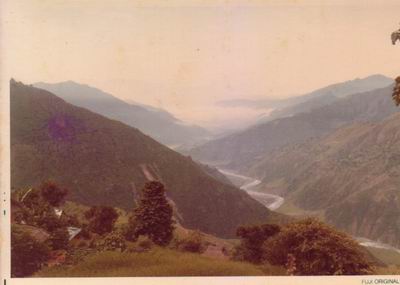 |
| DAY 2: THARE-RAMCHE |
| Passing through sweet slumbering valleys on our second day's march to Thare 6,600ft. | 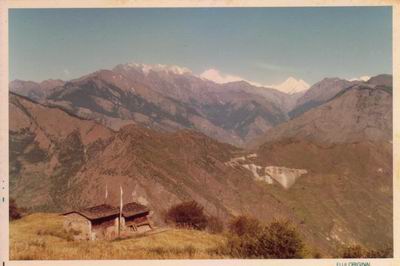 |
| Our journey was not without thrills which presented itself just after morning tea break of Day2 when we were faced with a dizzy terrain of loose rock and scree with barely a foothold in some places and featuring sheer drops of hundreds of feet in others. This was the place we dubbed, the Danger Cliff where the track had been wiped out by landslide. The sherpa bore my little one on his shoulders and incredibly seemed to sail across while I had to go down almost on all fours and crawled over to where the good track meets the rubble. | 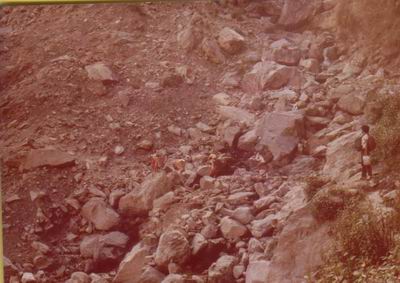 |
| After clearing the Danger Cliff we passed the village of Ramache at 5,500ft. | 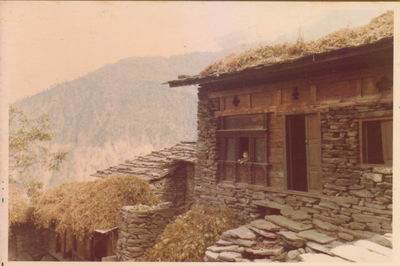 |
| Pressing on to Thare at 6,600ft our second overnight stop we encountered more lost remote villages. | 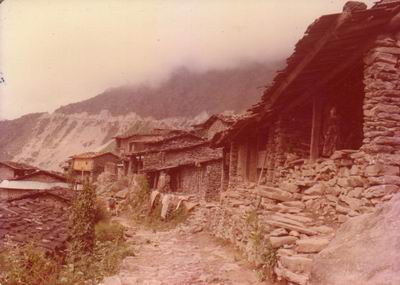 |
| DAY 3: DHUNCHE |
| ...the hills are alive with the sound of laughter, and of songs and of faith ......Buddhist shrines and stupas dot the hillsides enroute to Dhunche. The Nepalese love singing and despite their heavy loads they would still sing their hearts out making the countryside reverbrate with the sound of music. Our group also carried a small hand drum and marching to the sound of drumbeats certainly made our loads lighter. | 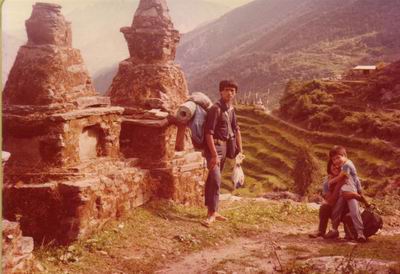 |
| The villagers are drying chillis, pounding corn, cutting wood. | 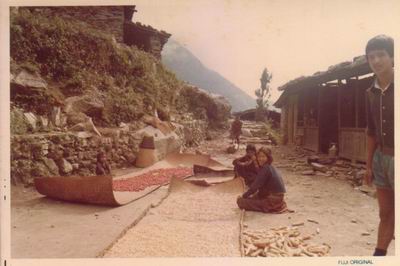 |
| The zinc and wooden rooftops in this village are weighted down with rocks. The level of poverty here is quite bad. | 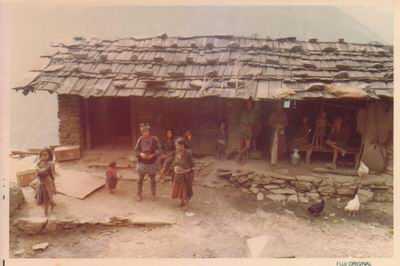 |
| Little Boy Blue... taking an inspection tour of our Dhunche campsite 7,000ft. |  |
| DAY 4: SYABRU |
| Setting off from Dhunche, we had to descend to river level before climbing up a vertical cliff some 800ft. high to reach the Syabru track on the opposite mountain. It would be a tough haul and the inclement weather did nothing to help. |  |
| Though I was the last one up, with great effort, I finally crested the top of the cliff. The guide must have heaved a private sigh of relief too as he lived in mortal dread of having to carry me up the last leg, should I fail to make it. Like a mirage in a desert, a tea-house was located on the cliff top and this shack-like place was crowded with trekkers and their porters seeking shelter from the downpour. After a brief respite and the rains abated, we trekked on to Syabru village at 7500ft. |  |
| Syabru Campsite at 7500ft. Its a rather busy spot with trekkers converging from different nationalities - Canadian, French, Polish, American, German and I also met a solitary Icelandic lady trekking with a guide. We camped in front of the Langtang Himal Hotel. |  |
| The Langtang Himal Hotel is a stone and wooden hut. It offers sleeping accommodation on wooden floor boards where trekkers could unroll their sleeping bags. Nonetheless it is a sweet little cottage with carved latticed windows sporting flower boxes. Inside this humble little abode are handsome wooden cabinets, chest and cupboards, all elaborately carved. The lookout from the windows on to the mountains more than made up for the discomfort, if any. |  |
| DAY 5: CHONGONG |
| Chongong Campsite at 9,000ft. We pitched our tents among the rocks and low drifting clouds, in front of the Lama hotel. Nearby there is a sort of pond which we treated as some kind of swimming pool and had our first full cleansing after 5 days on the trek. |  |
| DAY 6-7 LANGTANG |
| Walking beside the Langtang Khola, in the company of firs and conifers, we slowly made our way until we were past the tree-line and the mountains were barren, rocky and cloud-swept. |  |
| A water-driven prayer wheel spanning a stream at the entrance of Langtang village. "...spiritual purposes are served by many natural phenomena - not only wind, but also water and earth. A prayer wheel can, for example be driven by the current of a stream, where it will spin endlessly, imparting to the waters the aura of its prayers. Its spiritual influence will thus extend from stream to river, and thence to the sea, and may even return to the earth once more in the form of rain...." wrote Olivier Follmi in his wonderful book Where heaven and mountains meet. |  |
| A mani wall, composed of dry stone slates inlaid with Buddhist prayers near the village of Langtang. The inscribed prayer is simply "Om Mani Padme Hum" or "Hail the Jewel in the Lotus" repeated over and over again, a most powerful mantra. |  |
| A sheep-gathering in the high valley of Langtang. |  |
| Langtang village @12,000ft.We had a quiet day relaxing in Langtang, walking to the village monastery, lolling on the boulders and simply exulting with the mountains, rocks, stones and sky. In the evening our campfire dinner attracted the villagers,especially when someone struck the drums, many came running out for an impromptu dancing session. |  |
| The return journey was no less of a penance. Going downhill doesn't hurt your lungs or put so much strain on your muscles but what it does to your knees is another story. Going downhill is also far more tricky than ascent as the not too infrequent bumps to my bottom will testify. We took 5 days to backtrek all the way to Betrawati. The alternative route involved going over high mountain passes which was not feasible for us. At trek's end we were several pounds lighter, blistered and bruised but still we counted ourselves lucky for having undertaken one of the most memorable trips of our lives. |  |